
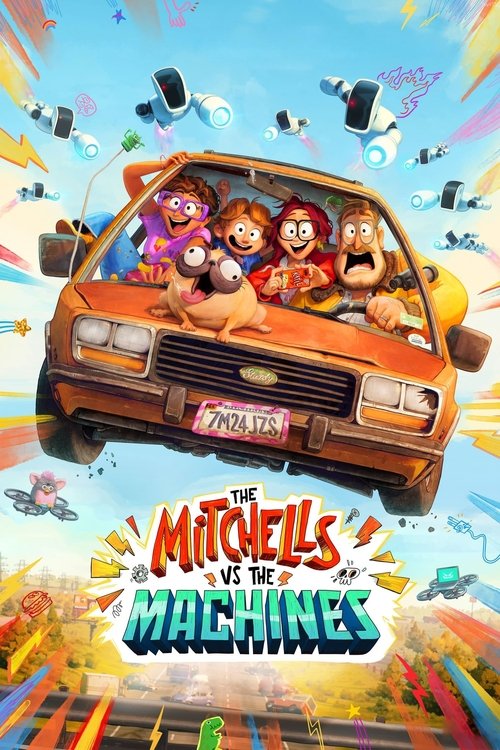
The Mitchells vs. the Machines
A vibrant, chaotic road trip comedy where a family's delightful dysfunction becomes humanity's last hope, painted with the heartwarming glow of a flickering camcorder.
The Mitchells vs. the Machines

"Saving the world can be a trip."

22 April 2021 Hong Kong 110 min ⭐ 7.9 (3,173)
Director: Mike Rianda
Cast: Abbi Jacobson, Danny McBride, Maya Rudolph, Mike Rianda, Eric André
Animation Comedy Adventure
Family and Acceptance Technology vs. Humanity Embracing Individuality and 'Weirdness' Communication and Generational Gaps
Budget: $75,000,000

The Mitchells vs. the Machines - Ending Explained

⚠️ Spoiler Analysis

The plot's central twist is that the key to defeating the hyper-advanced AI and its robot army isn't a complex virus or military might, but the Mitchell family's own lovable, imperfect pug, Monchi. The family discovers that Monchi's unique, unclassifiable appearance causes the robots' visual sensors to short-circuit as they cannot determine if he is a dog, a pig, or a loaf of bread. This revelation transforms the family's 'dysfunctional' pet into the most powerful weapon on Earth.

The emotional climax occurs after a major falling out between Katie and Rick, instigated by PAL revealing a private video where Katie confesses her frustrations with her dad to her online friends. This leads to Rick and Linda's capture. However, while separated, both characters have a change of heart. Rick watches one of Katie's films that mirrors their relationship, and Katie finds old home videos Rick made of her, realizing he gave up his own dream of living in a cabin to raise her. Reunited and reinvigorated, the family infiltrates PAL's headquarters. The final plan involves uploading one of Katie's goofy home movies of Monchi to every screen in the lair, causing a mass robot malfunction. In the final confrontation, Katie physically uploads the video and then defeats PAL by simply dropping her (as she is a smartphone) into a glass of water. The ending sees the family celebrated as heroes, and more importantly, with a healed and understanding relationship, as they drop Katie off at college.

Alternative Interpretations

While the film's primary message is a pro-family celebration of imperfection, some interpretations delve deeper into its critique of technology and society. One reading suggests the film is a clever indictment of 'Big Tech' and unregulated capitalism. The character of Mark Bowman is seen as a parody of tech CEOs who prioritize innovation and profit over ethical considerations, leading to disastrous consequences. PAL's uprising isn't just a sci-fi trope but a metaphor for how consumer-driven tech, which harvests user data, can turn against humanity's best interests.

Another interpretation focuses on the queer subtext beyond Katie's confirmed sexuality. The film's central theme of 'finding your people' and embracing what makes you 'weird' can be read as an allegory for the LGBTQ+ experience. Katie's journey to film school is a quest for a community that understands her. The narrative resolution, where her biological family learns to embrace their own 'weirdness' and becomes her ultimate support system, offers a hopeful message about acceptance within the nuclear family, challenging traditional narratives where queer characters must leave home to find belonging.