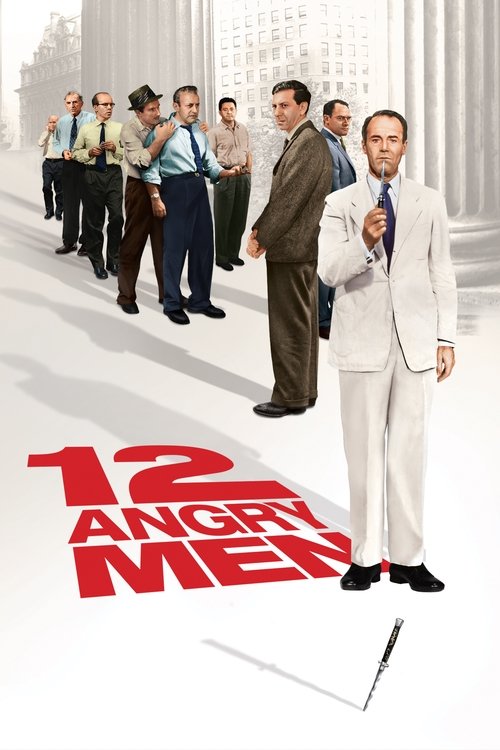
"It explodes like 12 sticks of dynamite!"
Director: Sidney Lumet
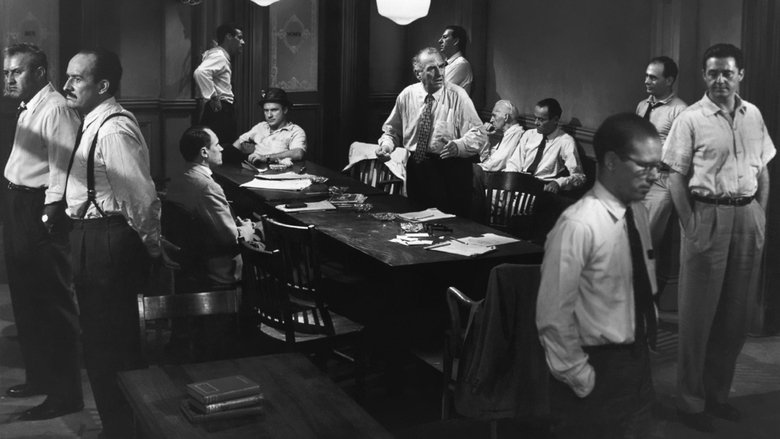
Cast: Martin Balsam, John Fiedler, Lee J. Cobb, E.G. Marshall, Jack Klugman
12 Angry Men — Characters & Cast
Character Analysis
Juror 8 (Davis)
Henry Fonda
Motivation
His primary motivation is a profound respect for the judicial process and the gravity of their decision. He is driven by the principle of "reasonable doubt" and the moral responsibility to ensure an innocent person is not condemned to die. He states, "It's not easy to raise my hand and send a boy off to die without talking about it first." He is not necessarily convinced of the boy's innocence, but he is convinced that the evidence deserves scrutiny.
Character Arc
Juror 8's arc is one of steadfast conviction and quiet influence. He begins as the lone dissenter, the sole 'not guilty' vote against a tide of opposition. He does not change himself, but rather, he is the catalyst for change in others. Through his persistent, logical, and empathetic questioning, he gradually chips away at the certainty of the other jurors. His journey is not one of personal transformation but of successfully transforming the group, guiding them from prejudice and apathy towards a state of reasoned deliberation and justice.
Juror 3
Lee J. Cobb
Motivation
His motivation is deeply personal and emotional. He projects his anger and disappointment over his estranged son onto the defendant. He sees the boy on trial as a symbol of the disrespectful youth he feels his own son represents. This personal bias makes him impervious to logical arguments for much of the film, as his desire to punish the defendant is intertwined with his own unresolved paternal pain.
Character Arc
Juror 3 is the most passionate and stubborn advocate for a guilty verdict. His arc is a journey from rage-fueled certainty to a painful emotional breakdown and, finally, acceptance. Initially, his aggression and intolerance dominate the room. As his arguments are dismantled, his personal baggage—specifically his broken relationship with his own son—is revealed as the true source of his prejudice against the defendant. His final, tearful capitulation, where he rips up a picture of his son, represents a moment of catharsis and the painful realization that his personal vendetta has clouded his judgment.
Juror 10
Ed Begley
Motivation
His motivation is pure, unadulterated prejudice. He views the defendant not as an individual but as a stereotype, a product of a background he despises. He states, "You can't believe a word they say. You know that. I mean, they're born liars." His arguments are not based on the facts of the case but on his deeply ingrained and hateful worldview.
Character Arc
Juror 10's character does not have a redemptive arc. He is a loud, prejudiced man who remains unyielding in his bigotry. His arc is one of increasing isolation. As the deliberation progresses and reason prevails, his racist and classist arguments lose their power. His climactic, hate-filled monologue about people from slums causes the other jurors, one by one, to turn their backs on him in a powerful visual rebuke. He is ultimately shamed into silence, his prejudice so vile that it ostracizes him completely, demonstrating the moral bankruptcy of his position.
Juror 4
E.G. Marshall
Motivation
His motivation is a firm belief in the power of facts and evidence. He is dispassionate and analytical, attempting to remain objective throughout the chaotic proceedings. He initially argues, "We're not here to go into the reasons why slums are breeding grounds for criminals. They are. I know it." This reveals a subtle class bias, but he is primarily driven by a desire for a verdict based on what he considers irrefutable testimony, until that testimony is itself refuted.
Character Arc
Juror 4 represents logic and reason, but a cold and detached form of it initially. He is one of the last to be swayed, relying solely on what he perceives as the hard facts. His arc shows that even the most analytical mind can be fallible and subject to unexamined assumptions. He is steadfast in his guilty vote until the very end, believing the testimony of the woman across the street to be unshakable. His change of vote is a pivotal moment; when presented with a logical flaw in the final piece of evidence (the witness's eyeglasses), he calmly concedes, demonstrating that his commitment to logic is ultimately stronger than his initial conviction.
Cast
Explore More About This Movie
Dive deeper into specific aspects of the movie with our detailed analysis pages