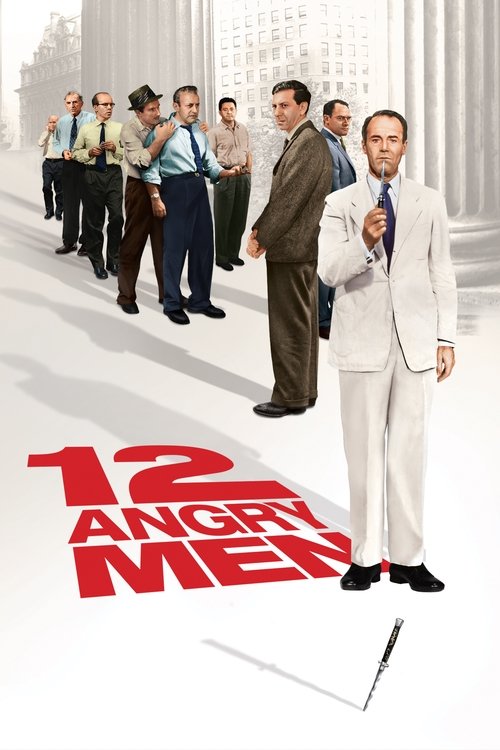
12 Angry Men
A sweltering huis clos drama where the weight of a life hangs in the balance, as twelve ordinary men become a storm of conflicting ideologies and hidden prejudices.
12 Angry Men

12 Angry Men

"It explodes like 12 sticks of dynamite!"

10 April 1957 United States of America 97 min ⭐ 8.5 (9,434)
Director: Sidney Lumet
Cast: Martin Balsam, John Fiedler, Lee J. Cobb, E.G. Marshall, Jack Klugman
Drama
Justice and Reasonable Doubt Prejudice and Bias The Power of the Individual Social Class and Environment
Budget: $397,751
Box Office: $4,360,000

Overview

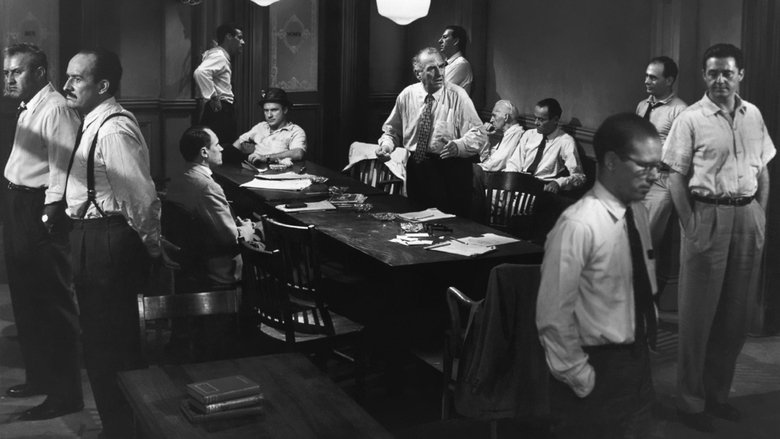
"12 Angry Men" (1957), directed by Sidney Lumet in his feature debut, is a gripping legal drama that unfolds almost entirely within the confines of a New York City jury room on a scorching summer day. The film centers on the deliberations of twelve jurors tasked with deciding the fate of an 18-year-old from a slum, accused of fatally stabbing his father. A guilty verdict carries a mandatory death sentence.

What appears to be an open-and-shut case, with eleven jurors initially voting for a guilty verdict, is thrown into turmoil by a single dissenting voice, Juror 8. He insists on a thorough discussion of the evidence, citing the gravity of sending a young man to his death without due consideration. As the jurors re-examine the testimony and evidence, their personal biases, deep-seated prejudices, and individual moral compasses are brought to the forefront, transforming the deliberation into a tense and volatile battle of wills.

The film masterfully builds suspense not through action, but through dialogue and the intense psychological interplay between the characters. Each juror's personality and background influences their perspective, leading to heated arguments and shifting alliances. The claustrophobic setting amplifies the rising tension as Juror 8 systematically challenges the seemingly irrefutable facts, forcing his fellow jurors to confront the concept of "reasonable doubt" and the profound responsibility that rests on their shoulders.
Core Meaning

The core meaning of "12 Angry Men" revolves around the themes of justice, prejudice, and the paramount importance of civic duty and moral responsibility. Director Sidney Lumet and writer Reginald Rose crafted a powerful critique of the American jury system, emphasizing that justice is not a foregone conclusion but a fragile ideal that requires courage, reason, and empathy to uphold. The film argues that a single individual, through persistent and reasoned argument, can challenge the tide of popular opinion and prevent a miscarriage of justice.

The central message is a profound exploration of the concept of "reasonable doubt." It posits that the legal system's safeguard against wrongful conviction is only as strong as the individuals who comprise the jury. The film powerfully illustrates how personal biases, stemming from classism, racism, and personal history, can cloud judgment and obstruct the truth. Ultimately, "12 Angry Men" is a testament to the triumph of reason and compassion over prejudice and haste, championing the idea that true justice requires a willingness to question assumptions and to afford every individual a thorough and unbiased examination of the facts.

Thematic DNA

Justice and Reasonable Doubt 35%
Prejudice and Bias 30%
The Power of the Individual 20%
Social Class and Environment 15%

Justice and Reasonable Doubt

The entire narrative of "12 Angry Men" is a meticulous examination of the principle of "reasonable doubt." Juror 8's initial dissent is not based on a conviction of the boy's innocence, but on the belief that the prosecution's case is not airtight and that the jury has a moral obligation to deliberate seriously. The film systematically deconstructs each piece of evidence—the uniqueness of the switchblade, the testimony of the two key witnesses—to demonstrate how certainty can crumble under scrutiny. The film posits that justice is not merely about punishing the guilty, but about protecting the innocent, and that this protection lies in the rigorous application of the standard of reasonable doubt.

Prejudice and Bias

The film is a powerful exposé of how personal prejudices can infect the course of justice. Several jurors harbor biases that influence their initial guilty votes. Juror 10 is an unabashed bigot who distrusts people from slums, Juror 3 is blinded by his own strained relationship with his son, and Juror 4 exhibits a class-based prejudice. As the deliberations proceed, these prejudices are brought to light and challenged. The film argues that for justice to be served, individuals must recognize and confront their own biases, separating personal feelings from the objective facts of the case. The climax of Juror 10's prejudiced rant, which causes the other jurors to literally turn their backs on him, serves as a powerful condemnation of bigotry.

The Power of the Individual

"12 Angry Men" is a compelling story about the impact one person can have. Juror 8, initially standing alone against eleven others, embodies the courage of conviction. His steadfastness and calm, logical approach create a space for doubt and discussion, ultimately changing the minds of his fellow jurors. The film celebrates the individual who is willing to stand against the majority in the pursuit of truth and justice. It serves as an inspiring testament to the idea that one person's integrity and commitment to moral principles can be a catalyst for profound change.

Social Class and Environment

The defendant's background as a "slum kid" is a recurring point of contention and prejudice among the jurors. Some jurors, like Juror 10 and Juror 4, are quick to assume his guilt based on his upbringing, arguing that slums are "breeding grounds for criminals." Conversely, Juror 5, who grew up in a similar environment, is able to offer insights that challenge these stereotypes, particularly regarding the use of a switchblade. The film explores the socio-economic tensions of 1950s America and questions the fairness of a justice system where a person's background can be used as evidence against them.

Character Analysis

Juror 8 (Davis)

Henry Fonda

Archetype: The Hero / The Voice of Reason
Key Trait: Principled

Motivation

His primary motivation is a profound respect for the judicial process and the gravity of their decision. He is driven by the principle of "reasonable doubt" and the moral responsibility to ensure an innocent person is not condemned to die. He states, "It's not easy to raise my hand and send a boy off to die without talking about it first." He is not necessarily convinced of the boy's innocence, but he is convinced that the evidence deserves scrutiny.

Character Arc

Juror 8's arc is one of steadfast conviction and quiet influence. He begins as the lone dissenter, the sole 'not guilty' vote against a tide of opposition. He does not change himself, but rather, he is the catalyst for change in others. Through his persistent, logical, and empathetic questioning, he gradually chips away at the certainty of the other jurors. His journey is not one of personal transformation but of successfully transforming the group, guiding them from prejudice and apathy towards a state of reasoned deliberation and justice.

Juror 3

Lee J. Cobb

Archetype: The Antagonist
Key Trait: Volatile

Motivation

His motivation is deeply personal and emotional. He projects his anger and disappointment over his estranged son onto the defendant. He sees the boy on trial as a symbol of the disrespectful youth he feels his own son represents. This personal bias makes him impervious to logical arguments for much of the film, as his desire to punish the defendant is intertwined with his own unresolved paternal pain.

Character Arc

Juror 3 is the most passionate and stubborn advocate for a guilty verdict. His arc is a journey from rage-fueled certainty to a painful emotional breakdown and, finally, acceptance. Initially, his aggression and intolerance dominate the room. As his arguments are dismantled, his personal baggage—specifically his broken relationship with his own son—is revealed as the true source of his prejudice against the defendant. His final, tearful capitulation, where he rips up a picture of his son, represents a moment of catharsis and the painful realization that his personal vendetta has clouded his judgment.

Juror 10

Ed Begley

Archetype: The Bigot
Key Trait: Prejudiced

Motivation

His motivation is pure, unadulterated prejudice. He views the defendant not as an individual but as a stereotype, a product of a background he despises. He states, "You can't believe a word they say. You know that. I mean, they're born liars." His arguments are not based on the facts of the case but on his deeply ingrained and hateful worldview.

Character Arc

Juror 10's character does not have a redemptive arc. He is a loud, prejudiced man who remains unyielding in his bigotry. His arc is one of increasing isolation. As the deliberation progresses and reason prevails, his racist and classist arguments lose their power. His climactic, hate-filled monologue about people from slums causes the other jurors, one by one, to turn their backs on him in a powerful visual rebuke. He is ultimately shamed into silence, his prejudice so vile that it ostracizes him completely, demonstrating the moral bankruptcy of his position.

Juror 4

E.G. Marshall

Archetype: The Rationalist
Key Trait: Analytical

Motivation

His motivation is a firm belief in the power of facts and evidence. He is dispassionate and analytical, attempting to remain objective throughout the chaotic proceedings. He initially argues, "We're not here to go into the reasons why slums are breeding grounds for criminals. They are. I know it." This reveals a subtle class bias, but he is primarily driven by a desire for a verdict based on what he considers irrefutable testimony, until that testimony is itself refuted.

Character Arc

Juror 4 represents logic and reason, but a cold and detached form of it initially. He is one of the last to be swayed, relying solely on what he perceives as the hard facts. His arc shows that even the most analytical mind can be fallible and subject to unexamined assumptions. He is steadfast in his guilty vote until the very end, believing the testimony of the woman across the street to be unshakable. His change of vote is a pivotal moment; when presented with a logical flaw in the final piece of evidence (the witness's eyeglasses), he calmly concedes, demonstrating that his commitment to logic is ultimately stronger than his initial conviction.

Symbols & Motifs

The Switch Knife

Meaning:

The switch knife initially represents the seemingly irrefutable evidence of the defendant's guilt. However, when Juror 8 produces an identical knife, it symbolizes the introduction of reasonable doubt. The two knives represent two possible versions of reality: one where the boy is guilty and one where he is innocent. The knife ceases to be a unique object and becomes a symbol of the fallibility of evidence and the importance of questioning assumptions.

Context:

The prosecution claims the murder weapon is rare and unique. The jurors examine it, and it seems to be a key piece of evidence. The turning point comes when Juror 8 pulls an identical knife from his pocket, which he bought in the defendant's neighborhood, shattering the prosecution's claim of its uniqueness and opening the door for other jurors to reconsider their votes.

The Weather (Heat and Rain)

Meaning:

The oppressive heat in the jury room at the beginning of the film mirrors the simmering tension and anger among the jurors. The claustrophobic, sweltering environment reflects the high stakes and the heated, often irrational, arguments. The eventual thunderstorm that breaks symbolizes a catharsis, a washing away of prejudices and a clearing of the air. The rain brings a sense of relief and clarity as the jurors begin to reach a more reasoned consensus.

Context:

The film is set on the "hottest day of the year." The jurors are constantly shown sweating, fanning themselves, and complaining about the heat, which exacerbates their irritability. The fan in the room is initially broken, adding to the discomfort. The storm begins as the deliberations reach their most intense point, coinciding with a key shift in the voting, and the room cools as the truth becomes clearer.

Eyeglasses

Meaning:

The eyeglasses symbolize clarity of vision, both literally and figuratively. They become the key to dismantling the testimony of a crucial witness, representing the idea that what one perceives as fact may be flawed or incomplete. They highlight the theme that one must look closely and critically to see the truth, and that appearances can be deceiving.

Context:

Late in the film, Juror 9 observes Juror 4 rubbing the indentations on the bridge of his nose left by his eyeglasses. This leads to the realization that the female witness, who claimed to have seen the murder from across the street, had the same marks on her nose, indicating she was a glasses-wearer. The jurors deduce she likely wasn't wearing her glasses in bed and couldn't have seen the events as clearly as she testified, thus creating reasonable doubt about her testimony.

Memorable Quotes

There were eleven votes for guilty. It's not easy to raise my hand and send a boy off to die without talking about it first.

— Juror 8

Context:

This is said near the beginning of the film, immediately after the initial 11-1 vote. Juror 8 is explaining to the other impatient and annoyed jurors why he cast the lone 'not guilty' vote, setting the stage for the entire conflict and deliberation to follow.

Meaning:

This quote encapsulates the central theme of the film: the immense moral responsibility of the jury. It's not a statement of the boy's innocence, but a plea for deliberation and a stand against haste when a life is at stake. It establishes Juror 8's character as the film's moral compass.

Nobody has to prove otherwise. The burden of proof is on the prosecution. The defendant doesn't even have to open his mouth. That's in the Constitution.

— Juror 8

Context:

Juror 8 says this during the early stages of the deliberation, in response to Juror 2's weak reasoning that the defendant is guilty because "nobody proved otherwise." It's a key moment where he grounds the discussion in legal principle rather than personal feeling.

Meaning:

This line is a crucial reminder of a cornerstone of the American legal system: the presumption of innocence. Juror 8 has to educate his fellow jurors on this fundamental principle, highlighting how easily it can be forgotten and how prejudice can shift the burden of proof onto the accused.

You don't really mean you'll kill me, do you?

— Juror 8

Context:

This quote comes at a moment of high tension, after Juror 8 has systematically poked holes in several pieces of evidence. An infuriated Juror 3 attacks him, shouting the same words the defendant was accused of saying. Juror 8's quiet question makes the entire room go silent as the parallel becomes undeniable.

Meaning:

This is a powerful and ironic line that exposes the hypocrisy of Juror 3. After Juror 3 lunges at Juror 8 and screams "I'll kill him!", this calm response forces everyone, including Juror 3, to realize that words spoken in anger are not always meant literally. This directly undermines the prosecution's claim that the defendant's overheard threat to his father was proof of premeditation.

Wherever you run into it, prejudice always obscures the truth.

— Juror 8

Context:

This is said after the jurors have witnessed Juror 10's ugly, racist tirade. The statement serves as a summation of the toxic influence they have just seen, which nearly led them to a wrongful conviction, and reinforces the moral lesson of the film.

Meaning:

This quote serves as a direct statement of one of the film's most important themes. It articulates the idea that bias and bigotry are fundamental obstacles to justice. It's a universal truth that applies not just within the jury room but to society at large.

Philosophical Questions

What is the nature of truth and justice?

The film delves into the epistemological question of how we can know the truth. It suggests that "facts" are not always as solid as they appear and can be colored by perception, bias, and context. Justice, therefore, is not a simple matter of applying rules to facts, but a complex, fallible human process. The film explores the idea that true justice requires not just an examination of evidence, but also a deep self-examination of one's own prejudices and motives. It asks whether a truly objective verdict is possible when the decision-makers are inherently subjective human beings.

What is the moral responsibility of an individual within a collective?

"12 Angry Men" is a profound exploration of individual versus group morality. It poses the question of whether one has a duty to dissent when they believe the majority is wrong, even at the cost of conflict and ostracization. Juror 8's struggle highlights the tension between the desire for social harmony and the moral imperative to stand up for one's convictions. The film ultimately argues that the health and integrity of a democratic process, like a jury trial, depends on the willingness of individuals to take personal responsibility and challenge a potentially flawed consensus.

How do personal experiences and prejudices shape our perception of reality?

The film is a case study in how our internal worlds construct our external realities. Each juror's interpretation of the evidence is filtered through their own life experiences, social status, and prejudices. Juror 3's relationship with his son makes him see guilt, while Juror 5's experience in a slum allows him to see a detail others miss. The film asks the viewer to consider how their own biases affect their judgments. It suggests that achieving a more objective view requires acknowledging and actively questioning the lens through which we see the world.

Alternative Interpretations

While the film is widely seen as a celebration of the American justice system's potential, some alternative interpretations offer a more critical view. One perspective argues that the film is not a realistic depiction of a jury deliberation but rather an idealized fantasy. Critics of this view point out that it's highly improbable that one man could so thoroughly and successfully sway eleven others through pure logic, suggesting the film is more of a moral fable than a procedural drama.

Another interpretation focuses on the character of Juror 8 as a manipulative figure. Instead of being a hero of justice, this reading suggests he uses clever rhetorical tricks and emotional appeals to impose his own will on the group, much like the jurors he criticizes. This view notes that he brings in outside information (the second knife) and conducts his own experiments, which are actions not typically permitted for jurors. This interpretation sees the film as a more ambiguous study of persuasion and group dynamics, where the 'correct' outcome is achieved through questionable means.

Finally, some analyses suggest the film is less about the guilt or innocence of the defendant and more a commentary on masculinity and group conflict in 1950s America. The all-male jury room becomes an arena where different models of masculinity—rational, aggressive, bigoted, timid—clash and compete for dominance. The verdict is almost secondary to this exploration of how men interact, persuade, and clash in a high-stakes, enclosed environment.

Cultural Impact

"12 Angry Men" had a profound and lasting cultural impact, solidifying its place as a classic of American cinema. Upon its release in 1957, it was a critique of the American justice system, reflecting the societal tensions of the post-war and McCarthy era, where conformity was often valued over individual dissent. The film champions the importance of civil liberties and the thoroughness required for justice, a message that resonated deeply during a period of political paranoia.

Its influence on cinema has been vast. The film's minimalist, single-location setting and reliance on dialogue and character development over action have influenced countless filmmakers and demonstrated the dramatic power of a confined space. It helped define a gritty, realistic style of filmmaking that became a hallmark of the "New York School" of cinema. Furthermore, it foreshadowed America's cultural obsession with legal dramas, paving the way for television shows like "Law & Order" and the works of authors like John Grisham.

Critically acclaimed from the start, it received Academy Award nominations for Best Picture, Best Director, and Best Screenplay. Though not a box office hit, its reputation has only grown over time, and it is now regarded as one of the greatest films ever made. It is frequently used as a teaching tool in law schools, business schools, and ethics courses to illustrate concepts like group dynamics, persuasion, and the principle of reasonable doubt. In 2007, it was selected for preservation in the United States National Film Registry by the Library of Congress for being "culturally, historically, or aesthetically significant."

Audience Reception

Audience reception for "12 Angry Men" has been overwhelmingly positive since its release, and it consistently ranks among the highest-rated films of all time on audience-based platforms like IMDb. Viewers universally praise the film's intelligent and tightly written script, the superb ensemble acting, and the masterful build-up of tension within a single location. The central performance of Henry Fonda as the principled Juror 8 is frequently cited as a highlight.

The aspects most lauded by audiences are the film's powerful moral message about justice, prejudice, and civic duty, and its compelling character-driven drama. Many viewers find it to be a deeply thought-provoking and emotionally resonant experience. The primary points of criticism, though rare, sometimes center on the perceived lack of realism in the deliberation process, with some finding the complete reversal of the jury's opinion to be somewhat theatrical or idealistic. A few viewers also point out that the characters can feel more like archetypes representing different societal viewpoints rather than fully fleshed-out individuals. Despite these minor criticisms, the overall verdict from audiences is that "12 Angry Men" is a timeless masterpiece and a powerful, essential film.

Interesting Facts

  • The film was inspired by screenwriter Reginald Rose's own experience serving on a jury for a manslaughter case.
  • "12 Angry Men" was Sidney Lumet's feature film directorial debut, for which he received an Academy Award nomination.
  • Henry Fonda was so passionate about the project that he co-produced the film with Reginald Rose, and it was the only film Fonda ever produced.
  • The film had a very low budget of around $350,000 and was shot in just 21 days after two weeks of intense rehearsals.
  • To create a growing sense of claustrophobia, director Sidney Lumet and cinematographer Boris Kaufman gradually used lenses with longer focal lengths as the film progressed.
  • Lumet also manipulated the camera angles, starting with shots from above eye level, moving to eye level for the middle of the film, and finally shooting from below eye level to make the room feel more enclosed and the characters more imposing.
  • The actors were rehearsed for two weeks in the jury room set to give them a real sense of confinement and to allow them to build a natural rapport and tension.
  • Despite its critical acclaim and lasting legacy, the film was a box office failure upon its initial release.
  • The film takes place almost entirely in one room, with only about three minutes of footage shot outside the jury room.

⚠️ Spoiler Analysis

Click to reveal detailed analysis with spoilers

Frequently Asked Questions

Explore More About This Movie

Dive deeper into specific aspects of the movie with our detailed analysis pages

Comments (0)

Leave a comment

No comments yet. Be the first to share your thoughts!