
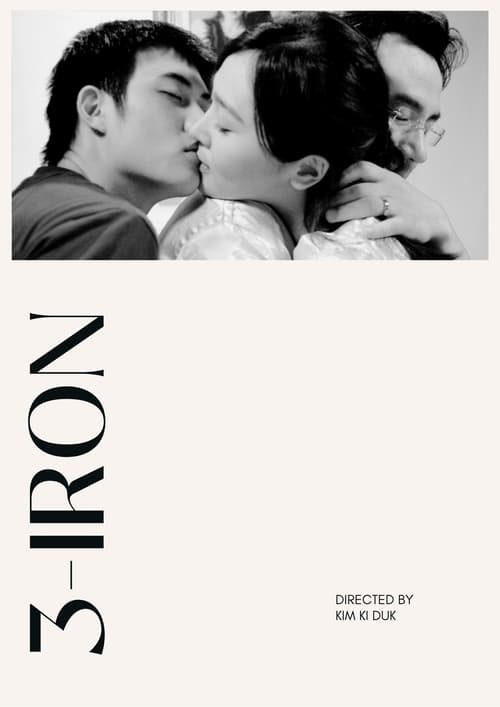
빈집
"In the quietness of empty houses, love finds a voice."
3-Iron - Symbolism & Philosophy
Symbols & Motifs
3-Iron Golf Club
The 3-iron symbolizes both violence and liberation. It is an instrument of aggression when Tae-suk uses it to attack Sun-hwa's abusive husband, but it's also a tool of defiance that facilitates her escape. The club itself is noted as one that is rarely used, mirroring the main characters who are alienated and overlooked by society. Tae-suk's practice of hitting tethered golf balls represents a contained, practiced form of rebellion. Later, in prison, his miming of a golf swing becomes a meditative act, transforming the symbol from a physical weapon to a tool for spiritual training and achieving invisibility.
The club is first seen with Sun-hwa's husband. Tae-suk uses it to hit golf balls at the husband, rescuing Sun-hwa. He continues to practice with it until a tragic accident occurs. In prison, he practices with an imaginary club, which is key to his transformation.
Empty Houses (Bin-jip)
The empty houses, the film's original Korean title ('Bin-jip'), represent the voids in the lives of both their owners and the main characters. For Tae-suk and Sun-hwa, these temporary homes are sanctuaries where they can build a silent, intimate world. They also function as windows into different lives, reflecting themes of social status, loneliness, and the superficiality of material possessions. The act of breaking in is less a violation and more an act of temporary symbiosis; Tae-suk repairs broken items, leaving the homes in better condition and connecting with the absent owners in a ghostly way.
The entire narrative is structured around the couple moving from one empty house to another. Each house has a distinct personality, from a traditional hanok to a modern, sterile apartment, reflecting the lives of the people they temporarily replace.
Photographs and Selfies
Tae-suk takes selfies with the possessions and portraits in the homes he visits. This act symbolizes his desire for connection, identity, and a place in the world. He inserts himself into the lives and families of others, trying to capture a sense of belonging that he lacks. The photographs are the only tangible records of his phantom existence, yet they are ultimately confiscated, erasing his physical footprint and pushing him further toward a purely spectral existence.
In several of the houses, Tae-suk carefully poses with family pictures and objects before taking a photo with his digital camera. The police later use these photos to track down the homeowners he visited.
The Bathroom Scale
The scale symbolizes weight, both physical and emotional, and the ultimate transcendence of it. Tae-suk fixes a broken scale in one of the first homes, an act of his gentle, restorative nature. The final scene, where he and Sun-hwa stand on the scale together and it registers "0", is one of the film's most powerful and enigmatic images. It suggests they have become weightless, existing on a different plane of reality, freed from the burdens of the physical world. Their love is not a tangible weight but a spiritual, ethereal force.
Early in the film, Tae-suk repairs a scale. The film concludes with Sun-hwa and the invisible Tae-suk standing on her scale at home. The display reads "0", as her husband looks on, confused.
Philosophical Questions
What is the nature of reality and human connection?
The film fundamentally questions whether objective reality is the only valid one. Through its dreamlike logic and the final title card, "It's hard to tell whether the world we live in is a reality or a dream," the film suggests that our internal worlds—fantasies, dreams, and spiritual connections—can be equally, if not more, meaningful. The silent, profound bond between Tae-suk and Sun-hwa proposes that true human connection doesn't require words or even constant physical presence; it can be a shared state of being that transcends conventional communication and exists on a spiritual or telepathic level.
Can one be truly free while physically confined?
"3-Iron" explores different forms of freedom and confinement. Sun-hwa is a prisoner in her own luxurious home, while Tae-suk is physically free but socially invisible and detached. The climax of this theme occurs when Tae-suk is in jail. In the most extreme state of physical confinement, he achieves the ultimate freedom by mastering his perception and presence, learning to become invisible. The film argues that true freedom is an internal state of being, a form of spiritual transcendence that cannot be restricted by physical barriers.
Is it possible to exist without leaving a trace?
Tae-suk's lifestyle is an attempt to live without creating a permanent impact. He is a ghost who borrows spaces and leaves them slightly better than he found them. However, the film shows this is impossible. His actions inevitably have consequences: he falls in love, he commits an act of violence (however justified), and his golf ball causes a tragic accident. His attempt to remain a phantom fails, leading to his arrest and erasure from the physical world (his photos are confiscated). This suggests that human existence is inherently about connection and consequence, and to live is to affect the world and be affected by it, whether one wants to or not.
Core Meaning
The core meaning of "3-Iron" revolves around the themes of invisibility, human connection beyond words, and the ambiguity between reality and fantasy. Director Kim Ki-duk explores the lives of marginalized individuals who exist like ghosts in the spaces of others, unseen and unheard. The film suggests that true connection transcends verbal communication and physical presence, becoming a spiritual or even ghostly bond. It poses existential questions about what constitutes reality, suggesting that our internal worlds and fantasies can be as real and meaningful as the physical world we inhabit. The final title card, "It's hard to tell whether the world we live in is a reality or a dream," encapsulates this central idea, inviting the audience to question the nature of the characters' existence and their ethereal reunion.