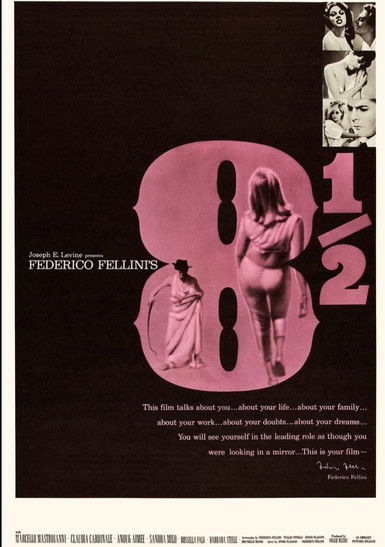
"A picture that goes beyond what men think about - because no man ever thought about it in quite this way!"
Director: Federico Fellini
Cast: Marcello Mastroianni, Anouk Aimée, Sandra Milo, Claudia Cardinale, Rossella Falk
8½ — Characters & Cast
Character Analysis
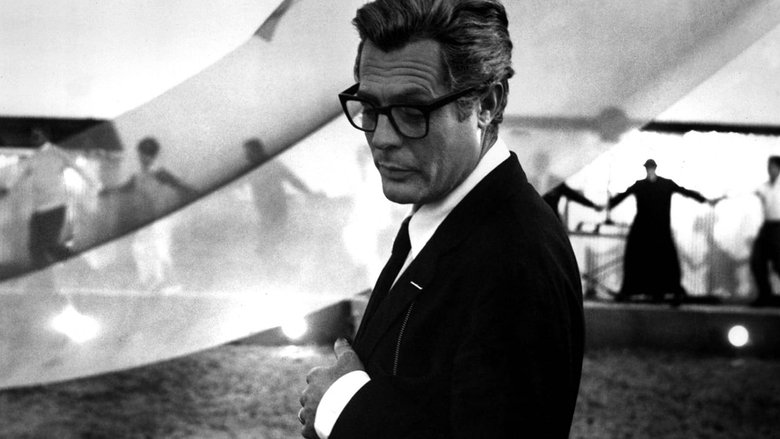
Guido Anselmi
Marcello Mastroianni
Motivation
Guido's primary motivation is to find something honest and true to say through his art. He is tormented by the feeling that he is a fraud and a liar, and he desperately wants to create a film that is pure and meaningful. On a personal level, he seeks salvation and peace, hoping that an idealized woman or a successful film can rescue him from his confusion, guilt, and marital problems.
Character Arc
Guido begins the film in a state of paralysis, creatively and emotionally blocked, and dishonest with himself and everyone around him. He escapes into fantasies and memories rather than confronting his problems. His journey is entirely internal. After a series of humiliating failures, including a disastrous press conference and a fantasy of his own suicide, he hits rock bottom. This breakdown leads to a breakthrough: he abandons his pretentious film and accepts the chaotic truth of his life. His arc is a move from creative sterility and self-deception to a joyful acceptance of imperfection, culminating in his decision to make a film about his own confusion.
Luisa Anselmi
Anouk Aimée
Motivation
Luisa is motivated by a desire for honesty and genuine connection with her husband. She is fed up with his lies and his self-absorbed artistic temperament. She represents a call to reality and emotional truth that Guido spends most of the film trying to avoid. Her motivation is to be seen and respected as a person, not just another character in his psychodrama.
Character Arc
Luisa is Guido's intelligent and elegant wife, who is painfully aware of his infidelities and the way he uses their life as material for his films. Initially, she is hurt and resentful, maintaining a dignified but cold distance. Her arc is subtle; she doesn't change so much as she is given the space to voice her pain. In the end, Guido asks for her acceptance, and while her expression remains pained, she joins the final procession, suggesting a fragile hope for reconciliation based on his newfound, albeit difficult, honesty.
Carla
Sandra Milo
Motivation
Carla is motivated by a desire for Guido's affection and attention. She enjoys the lifestyle he provides and seems to genuinely care for him, even if their relationship is superficial. She wants to be a more central part of his life, a desire that Guido is unwilling and unable to fulfill.
Character Arc
Carla is Guido's flamboyant and sensual mistress. She is a source of earthly pleasure for Guido but also another complication he cannot manage. She does not have a significant arc; rather, she remains a consistent presence representing a kind of gaudy, uncomplicated sensuality that both attracts and repels Guido. He tries to hide her away, but she continually intrudes on his life, highlighting his inability to keep the different parts of his life separate.
Claudia
Claudia Cardinale
Motivation
In Guido's fantasy, her motivation is simply to save him. As a real person, her motivation is that of a professional actress trying to understand her role. More symbolically, her motivation is to speak the truth, acting as a clear-eyed mirror reflecting Guido's own failings back at him.
Character Arc
Claudia exists for most of the film as a fantasy figure for Guido—an angelic, pure woman in white who he believes will be the key to his film and his salvation. Her arc is the shattering of this ideal. When Guido finally meets the real actress, she is a real person, not the symbol he imagined. In a crucial scene, she becomes his confessor, telling him bluntly that his problem is that he "doesn't know how to love." She rejects the idealized role he has created for her, forcing him to confront his own lies.
Cast
Explore More About This Movie
Dive deeper into specific aspects of the movie with our detailed analysis pages