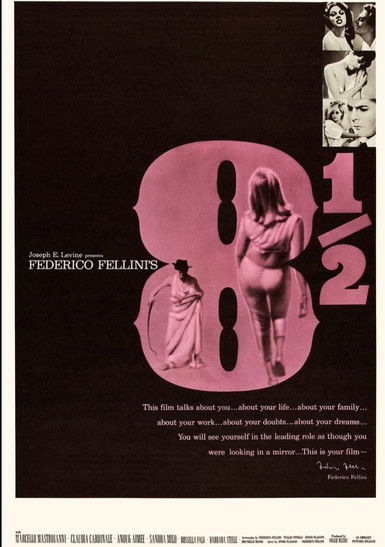
8½
A surreal, black-and-white dreamscape of a filmmaker's chaotic mind, where creative paralysis blossoms into a carnivalesque acceptance of life's beautiful disarray.
8½

"A picture that goes beyond what men think about - because no man ever thought about it in quite this way!"

14 February 1963 Italy 139 min ⭐ 8.1 (2,422)
Director: Federico Fellini
Cast: Marcello Mastroianni, Anouk Aimée, Sandra Milo, Claudia Cardinale, Rossella Falk
Drama
The Crisis of Creativity The Blurring of Reality and Fantasy Memory and Childhood Male Infidelity and Relationships with Women

8½ - Ending Explained

⚠️ Spoiler Analysis

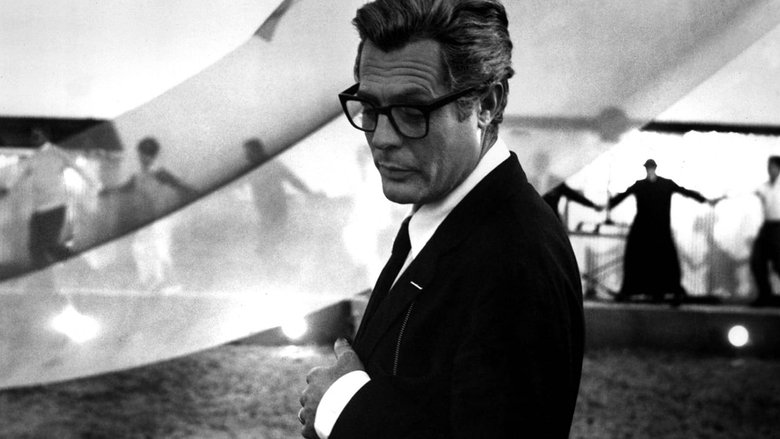
The entire narrative of "8½" is a build-up to Guido's ultimate creative and personal collapse, which paradoxically becomes his salvation. Throughout the film, he attempts to construct a grandiose science-fiction film centered around a giant spaceship, a project that is a clear metaphor for his hollow artistic ambitions. The key plot twist is that this film will never be made. After a humiliating press conference where he is bombarded with questions he cannot answer, Guido hides under a table and fantasizes about shooting himself in the head—the ultimate admission of failure.

Following this symbolic suicide, he cancels the film and orders the spaceship set to be dismantled. Just as his rationalist critic, Daumier, congratulates him for abandoning the project, Guido has his epiphany. He realizes his film isn't about the spaceship or some grand idea; it is about his own confusion, his memories, his lies, and all the people he has known. The hidden meaning, which becomes clear only at the end, is that the true film is the one we have been watching all along: "8½" itself.

The final, cathartic scene is not a return to the narrative of the sci-fi film but a complete embrace of his life's chaos. He takes on the role of a circus ringmaster, summoning every character from his reality, memories, and dreams—his wife, mistress, parents, the prostitute Saraghina, the Cardinal, his producer—to join hands and parade together. By accepting all these contradictory parts of himself and his life, he finds his true subject. He finds peace not by solving his problems, but by accepting them as the very substance of his life and art. His final act is to ask his wife, Luisa, to accept this new, honest version of their life, a festival to be lived together.

Alternative Interpretations

While the dominant interpretation of "8½" sees the ending as a triumphant moment of self-acceptance for Guido, some alternative readings offer a more ambiguous or even cynical perspective. One interpretation suggests that the final circus parade is not a breakthrough into reality but just another one of Guido's elaborate fantasies—perhaps his most grandiose one yet. In this view, he has not truly resolved his issues but has simply chosen to escape into a beautifully orchestrated illusion, reinforcing his tendency to prioritize artifice over genuine human connection. His plea to Luisa is just another line in his script.

Another perspective focuses on the film as a critique of male solipsism. From this viewpoint, Guido's final "acceptance" is profoundly selfish. He asks everyone in his life, particularly his long-suffering wife, to accept him exactly as he is, flaws and all, without any promise of change. The celebratory ending can thus be seen as a validation of the narcissistic artist who successfully incorporates everyone into his personal vision, rather than a genuine moment of mutual understanding and reconciliation. The film, then, becomes a darkly ironic portrait of the male ego's ability to reframe its failings as a form of profound artistic truth.