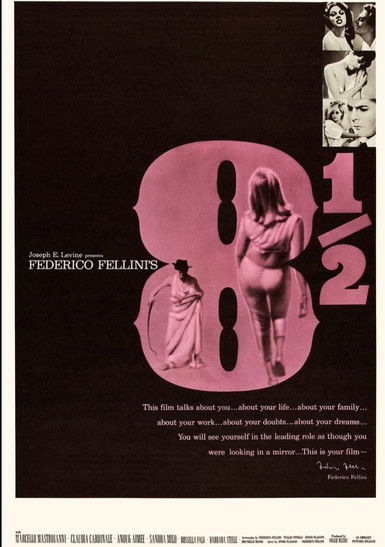
"A picture that goes beyond what men think about - because no man ever thought about it in quite this way!"
8½ - Symbolism & Philosophy
Symbols & Motifs
The Spa / Water
Water in the film symbolizes purity, healing, and salvation, but its meaning is complicated. The spa offers "holy water" as a cure for all ailments, reflecting Guido's search for a simple solution to his complex problems. However, this same water makes his mistress sick, suggesting that easy cures are illusory. The sea, where the prostitute Saraghina lives, also represents a more primal, perhaps purer, form of life, contrasting with the repressive doctrines of the church.
The film is set at a spa where Guido is "taking the cure." He is prescribed to drink the mineral water, and the setting is filled with imagery of baths and springs. He also describes his ideal woman, Claudia, as a healing figure who gives him water from a spring.
The Spaceship / Tower of Babel
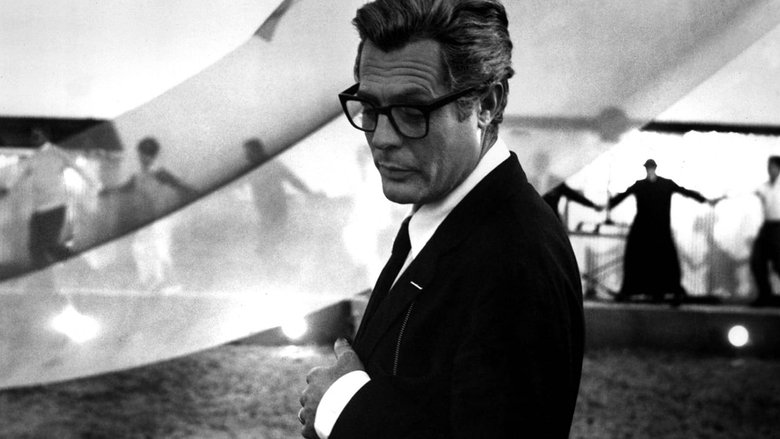
The massive, unfinished spaceship set for Guido's film is a powerful symbol of his artistic hubris and creative impotence. It is often compared to the Tower of Babel, a monument to human arrogance that was ultimately left unfinished. The structure represents the grandiose, meaningless project Guido feels pressured to create. Its eventual dismantling signifies the collapse of his false artistic ambitions and the beginning of a more honest approach to his work.
The gigantic steel structure looms over many scenes at the beach location for Guido's film. It is the central set piece for the movie-within-the-movie. At the climax, a disastrous press conference is held at its base, and Guido finally orders it to be torn down.
The Circus / Parade
The circus motif represents life itself—a chaotic, beautiful, and collaborative performance. For Fellini, the circus was a recurring image of magic, community, and the suspension of disbelief. In "8½", it symbolizes Guido's ultimate realization that he must embrace all the characters and experiences of his life, orchestrating them into a harmonious whole, much like a ringmaster.
The film's final, iconic scene takes the form of a circus parade. A magician, acting as a ringmaster, calls all the figures from Guido's life—real and imagined—to join hands and march in a circle around the spaceship set, led by a troupe of clowns and a band. Guido joins them, accepting his role as the director of his own life's circus.
White and Black Clothing
The film's black-and-white cinematography is used symbolically. White often represents Guido's idealized, pure vision of women, particularly the ethereal Claudia who appears in his fantasies dressed in all white. Black can symbolize the corruption of this ideal or the complexities of reality. When Guido meets the real Claudia, she is dressed in black, shattering his fantasy. Guido himself often wears a black suit with a white shirt, visually representing his internal conflict between purity and corruption, artifice and authenticity.
Throughout the film, characters' costumes are starkly black or white. Claudia's appearances in Guido's dreams and fantasies feature her in flowing white gowns. The prostitute Saraghina also wears a white scarf. In contrast, the real-world Claudia and many of the film industry figures wear black.
Philosophical Questions
What is the relationship between art and life?
"8½" posits that art and life are not separate but are deeply intertwined, with one constantly feeding and reflecting the other. Guido's creative block is a direct symptom of his personal life being in disarray—his lies, his troubled marriage, his unresolved childhood traumas. He cannot create an honest film because he is not living an honest life. The film argues that true artistic expression requires a profound and courageous engagement with one's own experiences, flaws, and contradictions. The only way Guido can make his film is to make it about his failure to make a film, thereby turning his life's chaos directly into his art's subject matter.
Can one achieve authenticity in a world of artifice?
Guido is obsessed with the idea of making an "honest film" with "no lies whatsoever," yet he is a compulsive liar in his personal life and works in the medium of cinema, which is inherently an artifice. The film explores this paradox by suggesting that authenticity is not about achieving some objective, unblemished truth. Instead, it is found in the honest admission of one's own confusion and fragmentation. Guido finds his authentic voice not by discovering a simple, pure message, but by embracing the messy, contradictory, and multifaceted nature of his own consciousness and presenting it truthfully.
How do memory and fantasy shape our reality?
The film's structure, which fluidly moves between the present, memory, and fantasy, suggests that our reality is not a fixed, objective state. It is constantly being shaped and interpreted through the lens of our past experiences and our inner desires. Guido's memories of his Catholic upbringing inform his adult guilt, while his fantasies of an ideal woman prevent him from engaging with the real women in his life. Fellini demonstrates that the subconscious is not a hidden realm but an active force that colors every moment of our waking lives, making the line between the internal and external world porous and indistinct.
Core Meaning
At its core, "8½" is a profound exploration of the creative process and the struggle for artistic and personal authenticity. Director Federico Fellini uses the protagonist, Guido, as a stand-in for himself, turning his own creative block following the success of La Dolce Vita into the central subject of the film. The film argues that art and life are inextricably linked; Guido's inability to make his film stems from his inability to make sense of his own life, his relationships, and his past.
The message of the film is one of acceptance. Guido's breakthrough does not come from finding a perfect, coherent idea for his movie, but from embracing the chaos, the contradictions, the memories, and the flaws of his life. The celebrated final sequence, where all the characters from his life join hands in a circus-like procession, symbolizes this ultimate acceptance. Fellini suggests that true creation is not about imposing order on life, but about finding the courage to honestly portray its beautiful, messy, and fragmented nature. It is a celebration of the artist's inner world and the idea that our anxieties and imperfections are not obstacles to creativity, but its very source.