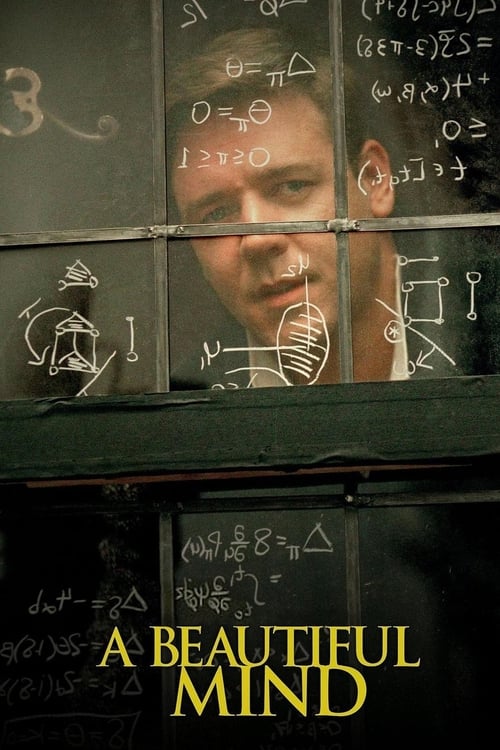
"He saw the world in a way no one could have imagined."
A Beautiful Mind - Symbolism & Philosophy
Symbols & Motifs
Pens at Princeton
The pens symbolize the highest form of respect and acknowledgment of a lifetime of achievement from one's peers. It represents acceptance, honor, and the recognition of a profound contribution to the field.
Towards the end of the film, an elderly John Nash is sitting in the Princeton faculty dining hall when various professors approach his table and lay down their pens in a gesture of reverence. This "ceremony of the pens," while factually fictitious and created for the film, serves as a powerful visual metaphor for his redemption and acceptance back into the academic community he was once ostracized from.
Patterns and Codes
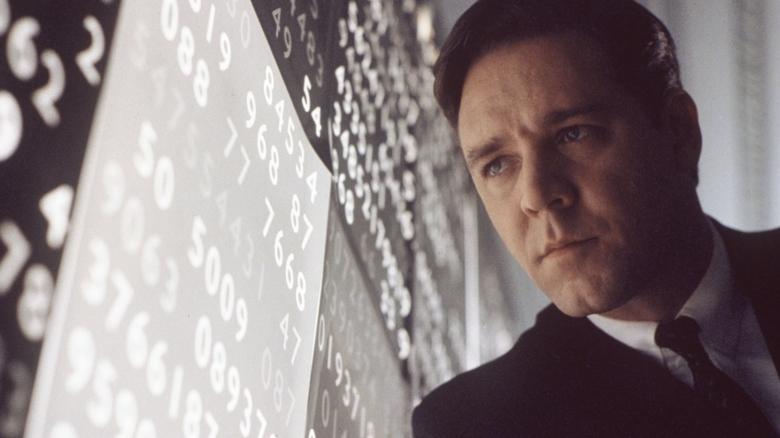
These represent Nash's unique perception of the world. Initially, they are a manifestation of his mathematical genius, allowing him to see connections and theories that are invisible to others. Later, they become a symbol of his paranoia and schizophrenia, as he believes he is deciphering secret Soviet messages, showing how his gift has been twisted by his illness.
From the beginning, Nash is shown looking for patterns in everything, from a flock of pigeons to a teammate's tie. This ability leads to his breakthrough in game theory. However, this same skill is later co-opted by his delusions, where he spends hours manically searching for hidden codes in magazines and newspapers for his imagined handler, William Parcher.
The Tie
The tie that Charles gives John represents friendship, normalcy, and a connection to the world outside his own mind. However, as Charles is a hallucination, the tie also symbolizes the deceptive nature of his reality.
Early in the film, John's roommate Charles gifts him a tie. This act of friendship stands out because of Nash's social awkwardness. Later, when John realizes Charles is not real, the memory of this simple object becomes a poignant reminder of a friendship that never was, highlighting the depth of his delusion and isolation.
Philosophical Questions
What is the true nature of reality?
The film fundamentally challenges the audience's perception of reality. For nearly half its runtime, it presents a compelling spy thriller that is then revealed to be a complete delusion. This narrative structure forces viewers to confront the idea that reality is subjective and can be profoundly shaped by the internal workings of the mind. It raises the question: If a person's experiences, emotions, and relationships feel real to them, what makes them less valid than an objective, consensus reality? The film explores the terrifying possibility that our own minds can betray us, constructing a world that is internally consistent yet entirely false.
Can love triumph over logic and illness?
John Nash lives in a world governed by numbers, patterns, and logic. His illness is a perversion of that logic. The film posits that the solution to his struggle is not a more powerful form of logic or reason, but something entirely different: love. Alicia's decision to stay with him is not logical, especially when he becomes a danger to their family. Yet, it is her emotional commitment and faith in him that ultimately provides the anchor he needs to manage his condition. The film asks whether love, an unquantifiable and often illogical force, is the most powerful tool for healing and redemption, succeeding where medicine and intellect alone fail. Nash's Nobel speech, where he calls love the source of all reason, is the ultimate affirmation of this idea.
Core Meaning
The core meaning of "A Beautiful Mind" is a testament to the resilience of the human spirit and the profound power of love and acceptance in overcoming immense personal challenges. Director Ron Howard explores the idea that true genius is not just intellectual brilliance but also the courage to confront one's own demons. The film posits that the mind, the very source of John Nash's genius, is also the source of his torment. Ultimately, it sends a powerful message that a fulfilling life is possible not by conquering one's illness, but by learning to live with it, and that logic and reason find their most meaningful application in the mysterious equations of love and human connection.