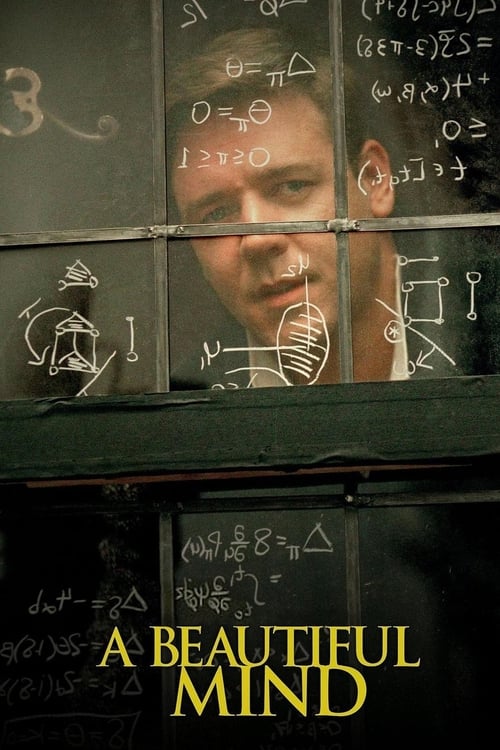
A Beautiful Mind
"He saw the world in a way no one could have imagined."
Overview
"A Beautiful Mind" chronicles the life of John Nash, a brilliant but asocial mathematician who arrives at Princeton University in 1947 as a graduate student. Obsessed with finding a truly original idea, he is often perceived as arrogant and awkward by his peers. His world is populated by his free-spirited roommate, Charles Herman, and his classmates. Nash's groundbreaking work on game theory eventually earns him a prestigious position at MIT.
While at MIT, he is recruited by a mysterious Department of Defense agent, William Parcher, for a top-secret assignment to decipher Soviet codes hidden in periodicals. This clandestine work plunges him deeper into a world of paranoia and conspiracy. During this time, he also finds love with a brilliant student, Alicia Larde, whose affection offers a grounding force in his increasingly chaotic life. Their relationship is tested as Nash's perception of reality begins to unravel, forcing them both on a harrowing journey of self-discovery and immense personal struggle.

Core Meaning
The core meaning of "A Beautiful Mind" is a testament to the resilience of the human spirit and the profound power of love and acceptance in overcoming immense personal challenges. Director Ron Howard explores the idea that true genius is not just intellectual brilliance but also the courage to confront one's own demons. The film posits that the mind, the very source of John Nash's genius, is also the source of his torment. Ultimately, it sends a powerful message that a fulfilling life is possible not by conquering one's illness, but by learning to live with it, and that logic and reason find their most meaningful application in the mysterious equations of love and human connection.
Thematic DNA
The Nature of Reality
The film masterfully puts the audience inside John Nash's mind, making his hallucinations feel entirely real for the first half of the movie. It forces viewers to question what is real and what is a construct of the mind. The major plot twist reveals that key characters—his roommate Charles, agent Parcher, and the little girl Marcee—are figments of his schizophrenia, making the audience experience the same disorientation and betrayal of the senses that Nash endures. This theme explores the fragility of perception and the struggle to distinguish between delusion and reality.
Love and Devotion as an Anchor
Alicia Nash's unwavering love and support for John is the emotional core of the film. Despite his terrifying episodes and the immense strain on their lives, she remains his anchor to reality. Her declaration, "I need to believe that something extraordinary is possible," signifies her commitment to stand by him. The film suggests that while logic and intellect are powerful, it is love that provides the ultimate reason and strength to persevere through life's most profound struggles, a sentiment Nash himself expresses in his Nobel acceptance speech.
The Stigma and Struggle of Mental Illness
"A Beautiful Mind" offers a poignant and humanizing look at schizophrenia, a condition often misunderstood and stigmatized. It depicts the brutal treatments of the era, like insulin shock therapy, and the devastating impact of the illness on Nash's career and personal life. The film charts his journey from denial and fear to a courageous acceptance, where he learns to consciously ignore his hallucinations rather than letting them control him. It highlights the internal battle of living with mental illness and the immense strength required to coexist with it.
Genius and Madness
The film explores the classic trope of the fine line between genius and madness. Nash's brilliant mind, capable of seeing patterns and concepts others cannot, is also the source of his debilitating delusions. His creativity and his illness are intrinsically linked. The very skills that make him a legendary mathematician are the same ones that construct his elaborate paranoid fantasies, raising questions about the nature of a gifted mind and its inherent vulnerabilities.
Character Analysis
John Forbes Nash, Jr.
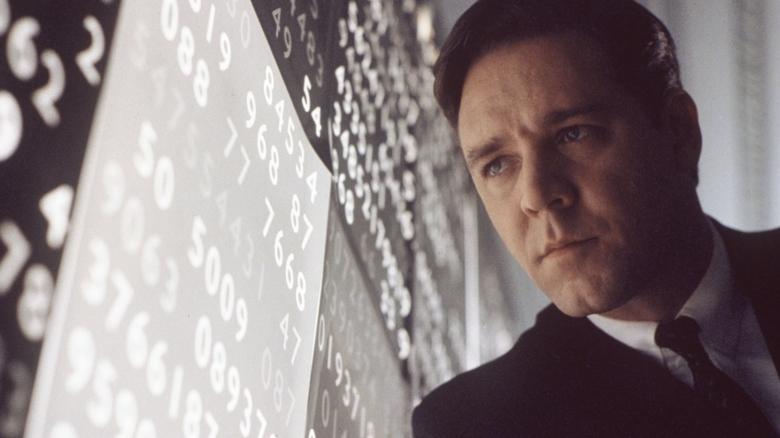
Russell Crowe
Motivation
Initially, his motivation is purely intellectual and ego-driven: to create a "truly original idea" and matter in the world. After his diagnosis, his motivation shifts to survival and the desperate need to reclaim his mind and his life. Ultimately, his love for his wife Alicia becomes his primary reason to fight and endure.
Character Arc
John Nash begins as an arrogant, socially inept, and intensely ambitious Princeton graduate student, convinced of his own superiority yet insecure about his legacy. His descent into paranoid schizophrenia transforms him into a fearful and tormented man, isolated by a reality he can't trust. Through the unwavering support of his wife Alicia and his own incredible force of will, he gradually learns to manage his condition. He evolves from someone who fights his delusions to someone who accepts and coexists with them, ultimately becoming a humbled, beloved, and Nobel Prize-winning figure who values love and relationships over intellectual acclaim.
Alicia Nash
Jennifer Connelly
Motivation
Her primary motivation is her deep and abiding love for John. She is driven by a need to believe that "something extraordinary is possible" – that they can overcome his schizophrenia together and that the brilliant man she fell in love with is still there.
Character Arc
Alicia starts as a bright, confident physics student who is intrigued by John's eccentric genius. After falling in love and marrying him, her life is upended by his diagnosis. She transforms from a romantic partner into a resilient and fiercely protective caregiver. Her journey is one of immense sacrifice and strength, as she navigates the pain and fear of John's illness. Despite moments of despair, she makes the conscious choice to stand by him, becoming the anchor that saves him from being lost to his illness entirely. Her love matures from infatuation into a profound, enduring commitment.
William Parcher
Ed Harris
Motivation
As a figment of Nash's imagination, Parcher's motivation is a projection of Nash's own desires and fears. He represents Nash's yearning for importance beyond academia and, later, his deep-seated paranoia and the aggressive, self-destructive aspects of his illness.
Character Arc
Parcher appears as a charismatic and menacing government agent who recruits Nash into the world of espionage. He represents purpose, danger, and national importance, feeding into Nash's ego and desire to matter. His arc is entirely illusory; he is a hallucination. He transitions from a commanding figure of authority to a threatening tormentor who embodies Nash's paranoia and fear of failure, goading him even as Nash tries to reclaim his sanity.
Charles Herman
Paul Bettany
Motivation
As a hallucination, Charles's motivation is to provide the friendship, encouragement, and emotional support that John desperately craves but is unable to find. He fills the void of Nash's social isolation.
Character Arc
Charles is introduced as John's cheerful, literary, and supportive Princeton roommate, the one person who seems to understand and accept him. He acts as John's social guide and confidant. The shocking reveal is that Charles, along with his young niece Marcee, is a hallucination. His arc is a complete fabrication of Nash's mind, representing a deep-seated need for friendship and human connection that Nash struggled to achieve in reality. He remains a presence in Nash's mind, a symbol of a companionship that was never real.
Symbols & Motifs
Pens at Princeton
The pens symbolize the highest form of respect and acknowledgment of a lifetime of achievement from one's peers. It represents acceptance, honor, and the recognition of a profound contribution to the field.
Towards the end of the film, an elderly John Nash is sitting in the Princeton faculty dining hall when various professors approach his table and lay down their pens in a gesture of reverence. This "ceremony of the pens," while factually fictitious and created for the film, serves as a powerful visual metaphor for his redemption and acceptance back into the academic community he was once ostracized from.
Patterns and Codes
These represent Nash's unique perception of the world. Initially, they are a manifestation of his mathematical genius, allowing him to see connections and theories that are invisible to others. Later, they become a symbol of his paranoia and schizophrenia, as he believes he is deciphering secret Soviet messages, showing how his gift has been twisted by his illness.
From the beginning, Nash is shown looking for patterns in everything, from a flock of pigeons to a teammate's tie. This ability leads to his breakthrough in game theory. However, this same skill is later co-opted by his delusions, where he spends hours manically searching for hidden codes in magazines and newspapers for his imagined handler, William Parcher.
The Tie
The tie that Charles gives John represents friendship, normalcy, and a connection to the world outside his own mind. However, as Charles is a hallucination, the tie also symbolizes the deceptive nature of his reality.
Early in the film, John's roommate Charles gifts him a tie. This act of friendship stands out because of Nash's social awkwardness. Later, when John realizes Charles is not real, the memory of this simple object becomes a poignant reminder of a friendship that never was, highlighting the depth of his delusion and isolation.
Memorable Quotes
I've made the most important discovery of my life. It's only in the mysterious equations of love that any logical reasons can be found. I'm only here tonight because of you. You are the reason I am. You are all my reasons.
— John Nash
Context:
Spoken during his Nobel Prize acceptance speech. After a lifetime of struggling with his mind and finding solace in numbers, he looks at his wife, Alicia, and attributes all his success and survival to her unwavering love and support.
Meaning:
This is the emotional climax of the film, where Nash publicly acknowledges that his greatest discovery isn't mathematical, but emotional. It signifies his ultimate realization that logic and reason alone are insufficient for a meaningful life; love is the foundational element that gives everything else purpose.
Imagine if you suddenly learned that the people, the places, the moments most important to you were not gone, not dead, but worse, had never been. What kind of hell would that be?
— Dr. Rosen
Context:
Dr. Rosen says this to Alicia when explaining the severity of John's diagnosis. He is trying to make her understand that John's world, including some of his most significant relationships and life events, were complete fabrications of his illness.
Meaning:
This line powerfully encapsulates the horror of Nash's condition. It frames his schizophrenia not as simple madness, but as a profound and cruel theft of his own reality and memories, making the audience empathize with the terrifying nature of his psychological struggle.
Classes will dull your mind, destroy the potential for authentic creativity.
— John Nash
Context:
Said to his fellow graduate students at Princeton. While they are attending classes and following the curriculum, Nash chooses to isolate himself, believing that true discovery can only happen outside the confines of formal education.
Meaning:
This quote establishes Nash's core character at the beginning of the film: his arrogance, his disdain for conventional structures, and his unwavering belief in his own unique genius. It sets up his isolation and his intense internal pressure to produce a truly original idea.
Alicia: How big is the universe? John: Infinite. Alicia: How do you know? John: I know because all the data indicates it's infinite. Alicia: But it hasn't been proven yet. John: No. Alicia: You haven't seen it. John: No. Alicia: How do you know for sure? John: I don't, I just believe it. Alicia: It's the same with love, I guess.
— Alicia and John Nash
Context:
This exchange takes place during one of their early dates. They are looking at the stars, and Alicia gently challenges John's reliance on pure data and logic, drawing a parallel between his belief in an infinite universe and her belief in love.
Meaning:
This dialogue beautifully bridges the gap between scientific proof and faith. It shows Alicia teaching John that not everything can be quantified or empirically proven. Love, like the infinity of the universe, requires a leap of faith, a concept that the logic-driven Nash begins to understand through her.
Philosophical Questions
What is the true nature of reality?
The film fundamentally challenges the audience's perception of reality. For nearly half its runtime, it presents a compelling spy thriller that is then revealed to be a complete delusion. This narrative structure forces viewers to confront the idea that reality is subjective and can be profoundly shaped by the internal workings of the mind. It raises the question: If a person's experiences, emotions, and relationships feel real to them, what makes them less valid than an objective, consensus reality? The film explores the terrifying possibility that our own minds can betray us, constructing a world that is internally consistent yet entirely false.
Can love triumph over logic and illness?
John Nash lives in a world governed by numbers, patterns, and logic. His illness is a perversion of that logic. The film posits that the solution to his struggle is not a more powerful form of logic or reason, but something entirely different: love. Alicia's decision to stay with him is not logical, especially when he becomes a danger to their family. Yet, it is her emotional commitment and faith in him that ultimately provides the anchor he needs to manage his condition. The film asks whether love, an unquantifiable and often illogical force, is the most powerful tool for healing and redemption, succeeding where medicine and intellect alone fail. Nash's Nobel speech, where he calls love the source of all reason, is the ultimate affirmation of this idea.
Alternative Interpretations
While the film presents a clear narrative—that John's experiences with Charles, Parcher, and Marcee are hallucinations—some viewers have explored alternative readings. One interpretation suggests that the first half of the film could be viewed not as a depiction of reality followed by a twist, but as a subjective reality from the start. From this perspective, the entire spy narrative is a metaphor for the pressures of the Cold War academic environment, where genius was weaponized and paranoia was rampant. Parcher isn't just a hallucination but a manifestation of the intense, secretive, and competitive atmosphere Nash found himself in at RAND and MIT.
Another interpretation focuses on Alicia's role, suggesting that the film is as much her story as it is John's. It can be read as a drama about the profound and often unexamined sacrifices of caregivers. Her journey—from being the partner of a celebrated genius to the caretaker of a man lost in his own mind—highlights the immense emotional labor and resilience required when a loved one suffers from a chronic illness. The 'beautiful mind' of the title could, in this light, refer not only to Nash's intellect but also to Alicia's beautiful heart and unwavering capacity for love and belief.
Cultural Impact
"A Beautiful Mind" was a major critical and commercial success, grossing over $313 million worldwide and winning four Academy Awards, including Best Picture and Best Director for Ron Howard. Its most significant cultural impact was in raising mainstream awareness and fostering a more empathetic public conversation about schizophrenia and mental illness. By portraying a brilliant Nobel Prize winner as someone living with the condition, the film helped to destigmatize it, challenging the stereotype of individuals with schizophrenia as merely dangerous or incoherent.
However, the film also sparked considerable debate regarding historical accuracy. Critics and those familiar with John Nash's life pointed out significant deviations from the biography by Sylvia Nasar, such as the invention of visual hallucinations, the omission of his son born out of wedlock, his alleged homosexual experiences, and the glossing over of his divorce and eventual remarriage to Alicia. Despite these creative liberties, the filmmakers argued they were true to the "spirit" of Nash's story. The movie became a touchstone for discussions on the responsibility of biopics, weighing dramatic storytelling against factual representation. For millions, the film provided a powerful, albeit fictionalized, narrative of hope, love, and the triumph of the human spirit over a debilitating illness.
Audience Reception
"A Beautiful Mind" was very well-received by audiences, who awarded it an "A-" CinemaScore. Viewers were particularly moved by the powerful love story and the inspiring narrative of overcoming adversity. Russell Crowe's immersive performance as John Nash and Jennifer Connelly's Oscar-winning role as Alicia were widely praised, with their on-screen chemistry being a highlight for many. The film's major plot twist was highly effective, with many viewers reporting that it completely fooled them and made for a stunning and memorable cinematic experience.
The primary points of criticism from audiences and critics alike centered on the film's historical inaccuracies and its sentimental, "Hollywood-ized" approach to a complex true story. Some felt that by omitting the darker and more complicated aspects of Nash's life—such as his other child, his divorce from Alicia, and the true nature of his non-visual hallucinations—the film presented an overly sanitized and simplified version of events. Despite this, the overwhelming audience verdict was positive, with most viewers finding it to be a deeply emotional, uplifting, and masterfully crafted film.
Interesting Facts
- The film was shot about 90% in chronological order to help Russell Crowe better develop the character's physical and mental shifts over time.
- The real John Nash did not experience visual hallucinations; his schizophrenia was primarily auditory. The characters of Charles, Marcee, and Parcher were a narrative invention by screenwriter Akiva Goldsman to visually represent Nash's internal struggles.
- The 'pen ceremony' at Princeton, where faculty members leave their pens on Nash's table as a sign of respect, is entirely fictional but has become one of the film's most iconic scenes.
- Makeup artist Greg Cannom's team developed special silicone cosmetics to realistically age the actors, cutting the makeup application time from eight hours to four.
- Russell Crowe met the real John Nash, who visited the set, and observed his hand movements and mannerisms to incorporate into his performance.
- The equations seen on the chalkboards in the film are the actual equations written by the real John Nash.
- Salma Hayek was considered for the role of Alicia Nash because the real Alicia was from El Salvador. Jennifer Connelly won the role and met with the real Alicia to prepare.
- The real John Nash and his wife Alicia were tragically killed in a car accident in 2015, returning home after he had received the Abel Prize, another prestigious award in mathematics.
⚠️ Spoiler Analysis
Click to reveal detailed analysis with spoilers
Frequently Asked Questions
Explore More About This Movie
Dive deeper into specific aspects of the movie with our detailed analysis pages
Comments (0)
No comments yet. Be the first to share your thoughts!