
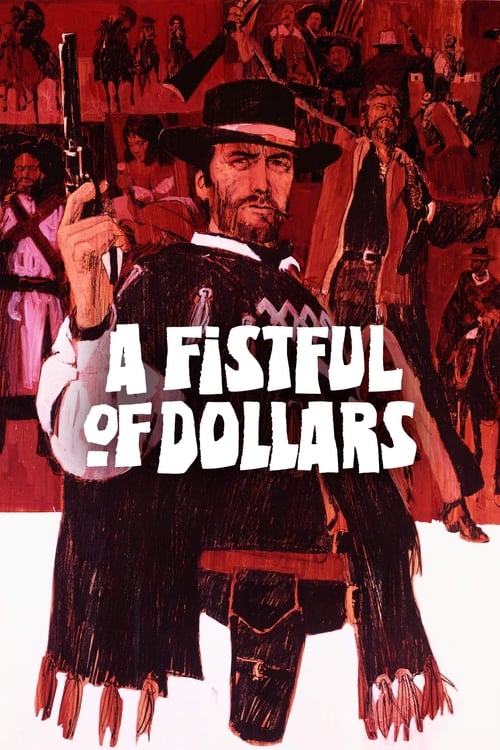
Per un pugno di dollari
"In his own way he is, perhaps, the most dangerous man who ever lived!"
A Fistful of Dollars - Symbolism & Philosophy
Symbols & Motifs
The Man with No Name's Poncho
The poncho serves as a visual signifier of the protagonist's status as an outsider and a drifter. It obscures his identity and adds to his mystique. The dirt and wear it accumulates throughout the trilogy also symbolize his harsh experiences and the gritty reality of his world.
Clint Eastwood wears the poncho throughout the film. It's a key part of his iconic costume, which he largely assembled himself. Interestingly, the same poncho was used in all three films of the Dollars Trilogy and was never washed to maintain its authentic, weathered look.
San Miguel
The town of San Miguel symbolizes a moral vacuum, a microcosm of a world dominated by greed and violence. It is a desolate, almost-dead town with no law or order, where two families are locked in a destructive power struggle. The Stranger's arrival acts as a catalyst that ultimately cleanses the town, but through further violence.
The film opens with the Stranger riding into the dusty, deserted streets of San Miguel. The town is the primary setting for the entire narrative, a battleground for the Rojos and the Baxters where the Stranger executes his plan.
The Mule
The mule that the Stranger rides into town can be seen as a symbol of his own humble, stubborn, and resilient nature. His humorous defense of the mule in the opening scene, where he insists on an apology from the men who mock it, is an early indication of his unconventional and defiant character.
Upon his arrival in San Miguel, a group of Baxter's men shoot at his mule's feet to frighten it. The Stranger's deadpan reaction and subsequent deadly confrontation establish his formidable skills and his unique code of conduct.
Philosophical Questions
Does morality have a place in a lawless world?
The film explores this question through its protagonist. San Miguel is a town devoid of law and traditional morality, governed only by the violent whims of the Rojos and Baxters. The Stranger initially operates within this amoral framework, using violence and deception for personal gain. However, his decision to save Marisol suggests that even in a brutal and cynical world, innate human compassion can surface and motivate actions that are not self-serving. It raises the question of whether a personal code of ethics can exist and function outside of societal laws and norms.
What is the nature of justice?
"A Fistful of Dollars" presents a very different form of justice than the one typically found in classic Westerns. Justice is not delivered by a righteous lawman in a white hat, but by a morally ambiguous outsider through manipulation and extreme violence. The Stranger's actions ultimately free the town from tyranny, but his methods are as ruthless as those of the villains he destroys. The film forces the audience to consider whether the ends justify the means and if justice can be achieved through immoral actions.
Core Meaning
Sergio Leone's "A Fistful of Dollars" serves as a cynical deconstruction of the classic American Western. The film discards the genre's traditional notions of heroism, clear-cut morality, and the romanticized frontier. Instead, it presents a world driven by greed, where violence is a tool for personal gain and the line between good and evil is irrevocably blurred. The protagonist is not a noble lawman, but a self-serving anti-hero whose actions, while ultimately leading to a form of justice, are motivated by profit. Leone's message is a bleaker, more realistic portrayal of human nature in a lawless environment, suggesting that in a world devoid of authority, survival and self-interest are the primary driving forces.