
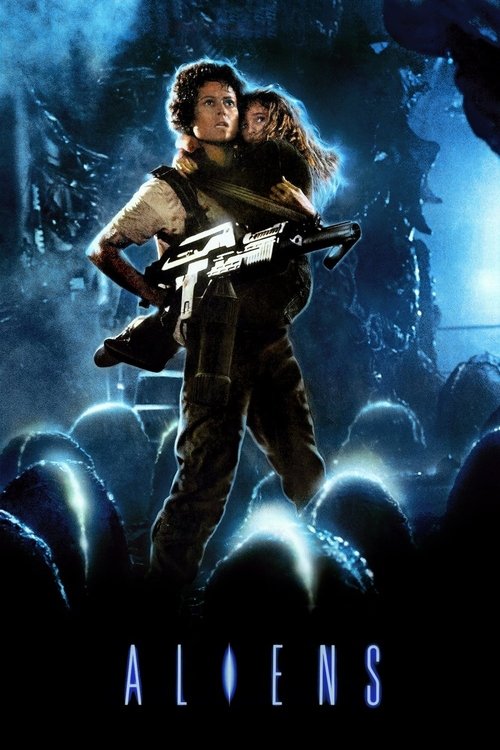
"This time it's war."
Aliens - Symbolism & Philosophy
Symbols & Motifs
The Alien Queen
The Alien Queen symbolizes the dark mirror of Ripley's own maternal instincts. She is the ultimate matriarch, a monstrous representation of motherhood stripped of all compassion and driven solely by the biological imperative to reproduce and protect her young at any cost. Her intelligence and ferocity make her a formidable antagonist, representing a force of nature that is both terrifying and strangely majestic.
The Queen is discovered deep within the alien hive, attached to a massive egg-laying ovipositor. Ripley's destruction of the eggs enrages the Queen, severing her from her biological function and turning her into a figure of pure vengeance. The final battle between Ripley in the power loader and the Queen is a symbolic clash of two mothers fighting for their respective 'children'.
The Power Loader
The Power Loader is an industrial exoskeleton that symbolizes the amplification of human strength and ingenuity, but more importantly, it represents Ripley's maternal rage given physical form. By strapping into the machine, she effectively creates an artificial body that can match the Queen's physical power, leveling the playing field. It's a fusion of technology and raw human will, allowing a human to physically battle a monster. Cameron wanted the final fight to be a personal, hand-to-hand struggle rather than a distant one with guns.
Ripley first demonstrates her proficiency with the power loader early in the film while working on a space station. In the climax, as the Alien Queen corners Newt, Ripley emerges in the power loader and delivers the iconic line, "Get away from her, you bitch!" The ensuing battle is a brutal, physical confrontation between the two matriarchs.
Newt
Newt symbolizes innocence, hope, and the chance for Ripley to reclaim her own lost motherhood. As the sole survivor of the Hadley's Hope colony, she represents the resilience of the human spirit in the face of unimaginable horror. For Ripley, protecting Newt becomes a way to heal from her own trauma and the loss of her biological daughter, giving her a renewed sense of purpose beyond mere survival.
Newt is found hiding in the ventilation shafts of the derelict colony. She is initially catatonic from trauma but slowly forms a deep, trusting bond with Ripley. This relationship becomes the emotional core of the film, culminating in Ripley risking her own life to descend into the heart of the alien nest to rescue Newt from the Queen.
Philosophical Questions
What defines humanity in the face of the 'perfect organism'?
The film contrasts the human characters, with all their flaws—fear, greed, heroism, and love—against the Xenomorph, which is described as a 'perfect organism' driven purely by instinct and survival. This raises questions about what it truly means to be human. Is our humanity defined by our emotions and moral choices, even when they lead to illogical or self-sacrificial acts? The film suggests that qualities like empathy, as seen in Ripley's protection of Newt, and integrity, as demonstrated by the android Bishop, are what truly separate 'us' from 'them', making a case that our perceived imperfections are our greatest strengths.
Can technology and military might overcome a primal, natural force?
Aliens explores the hubris of technological overconfidence. The Colonial Marines are equipped with state-of-the-art weaponry and believe themselves to be invincible. However, their technology proves largely ineffective against the Xenomorphs' overwhelming numbers, animal cunning, and biological advantages in their own environment. This serves as a philosophical exploration of humanity's relationship with nature and the limits of our attempts to control it. The film suggests that primal forces, whether they are the aliens' survival instinct or Ripley's maternal rage, can often be more powerful than any weapon.
Is corporate ambition a greater threat than any alien monster?
The film presents the Weyland-Yutani Corporation as a villain that is arguably more insidious than the Xenomorphs. While the aliens kill out of instinct, the company, through its agent Burke, is willing to sacrifice human lives knowingly and deliberately for profit. This raises a philosophical question about the nature of evil. Is the 'pure' survival instinct of a predator evil, or is true evil found in the calculated, amoral decisions of humans who value profit over people? The film strongly suggests the latter, presenting a cynical but powerful critique of corporate capitalism.
Core Meaning
At its heart, Aliens is an exploration of motherhood and survival in the face of overwhelming trauma and corporate malfeasance. Director James Cameron shifts the franchise from pure horror to high-octane action, but the core message delves into what it means to be human when confronted by the monstrous 'other'. The film posits that true strength is found not in superior firepower but in courage, empathy, and the fierce, primal instinct to protect the innocent. Ripley's journey is one of confronting and overcoming her PTSD by transforming from a sole survivor into a powerful maternal figure, showcasing a resilience that transcends the hyper-masculinity of the soldiers around her. Ultimately, the film is a powerful allegory for facing one's demons, with the literal monsters representing the psychological horrors that must be conquered.