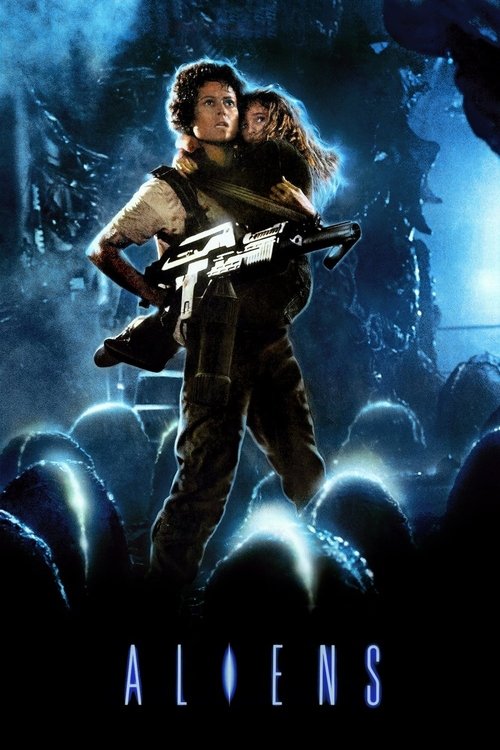
Aliens
"This time it's war."
Overview
Fifty-seven years after surviving the horrific events on the Nostromo, Ellen Ripley is rescued from her long hypersleep, only to find her story about the deadly Xenomorph met with disbelief by the Weyland-Yutani Corporation. She is stripped of her flight officer status and learns that the desolate moon where her crew first encountered the creature, LV-426, has since been colonized.
When contact with the colony is mysteriously lost, Ripley is reluctantly persuaded to accompany a unit of tough, high-tech Colonial Marines back to LV-426 as an advisor. Haunted by nightmares, she agrees on the condition that their mission is to exterminate the creatures, not to study them.
Upon arrival, they find the colony seemingly abandoned, except for a traumatized young girl named Newt. Soon, the marines discover the horrifying truth: the colonists have been used as hosts for a massive hive of Xenomorphs. A simple investigation turns into a desperate battle for survival against overwhelming odds, forcing Ripley to confront her deepest fears to protect the last innocent survivor.
Core Meaning
At its heart, Aliens is an exploration of motherhood and survival in the face of overwhelming trauma and corporate malfeasance. Director James Cameron shifts the franchise from pure horror to high-octane action, but the core message delves into what it means to be human when confronted by the monstrous 'other'. The film posits that true strength is found not in superior firepower but in courage, empathy, and the fierce, primal instinct to protect the innocent. Ripley's journey is one of confronting and overcoming her PTSD by transforming from a sole survivor into a powerful maternal figure, showcasing a resilience that transcends the hyper-masculinity of the soldiers around her. Ultimately, the film is a powerful allegory for facing one's demons, with the literal monsters representing the psychological horrors that must be conquered.
Thematic DNA
The Ferocity of Motherhood
The theme of motherhood is central to Aliens, creating a powerful emotional core. Ripley, who learns in a deleted scene that her own daughter died of old age during her 57-year stasis, develops a fierce maternal bond with the orphaned Newt. This bond becomes her primary motivation, transforming her from a traumatized survivor into a ferocious protector. This is mirrored by the Alien Queen, who is driven by an equally powerful instinct to protect her own brood. The film's climax is a duel between two mothers fighting for their children, elevating the conflict from a simple monster movie to a primal battle of maternal wills.
Critique of Corporate Greed
The Weyland-Yutani Corporation, referred to as 'The Company', represents the film's human villainy. Embodied by the duplicitous Carter Burke, the company's insatiable greed puts profits above human lives. Burke's secret orders are to bring back a Xenomorph specimen for the bioweapons division, regardless of the cost to the crew. Ripley's famous line, "You don't see them screwing each other over for a goddamn percentage," perfectly encapsulates the film's cynical view of corporate ethics, suggesting that human avarice can be just as monstrous as the aliens themselves. The film serves as a cautionary tale about the dehumanizing nature of unchecked capitalism.
The Vietnam War Allegory
James Cameron has acknowledged the influence of the Vietnam War on the film's narrative. The Colonial Marines, with their advanced technology, superior firepower, and cocky bravado, are analogous to the US military. They are a technologically superior force entering a hostile, unfamiliar territory, only to be systematically dismantled by a seemingly primitive, yet highly effective, native force—the Xenomorphs. The marines' overconfidence quickly evaporates into fear and chaos, reflecting the disillusionment and hubris associated with the Vietnam conflict. The inability of their technology to overcome the aliens' primal ferocity serves as a powerful commentary on the limits of military power.
Humanity vs. The 'Other'
The film explores what it means to be human by contrasting the characters with the monstrous Xenomorphs and the synthetic android, Bishop. Ripley's initial distrust of Bishop, stemming from her traumatic experience with Ash in the first film, evolves into respect and trust, questioning the rigid lines between man and machine. The Xenomorphs represent a perfect, primal organism, "unclouded by conscience, remorse, or delusions of morality." This forces the human characters to define their own humanity through their compassion, self-sacrifice, and emotional bonds, particularly Ripley's love for Newt.
Character Analysis
Ellen Ripley
Sigourney Weaver
Motivation
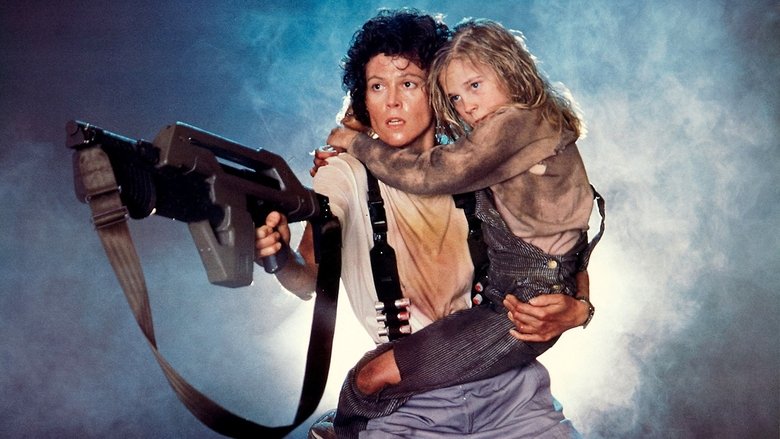
Her primary motivation shifts from simply surviving and eradicating the alien threat to the fierce, unconditional protection of Newt. The rediscovery of her maternal instincts gives her the strength to face the ultimate horror—the Alien Queen's nest—to save the child.
Character Arc
Ripley begins the film as a traumatized survivor, haunted by her past and distrustful of authority. Initially hesitant to return to LV-426, she finds a new purpose in protecting Newt. This transforms her from a 'final girl' into a proactive warrior. Her arc is one of empowerment and healing, as she confronts her fears directly, takes command when leadership fails, and ultimately embraces a fierce maternal identity, becoming one of cinema's most iconic action heroes.
Corporal Dwayne Hicks
Michael Biehn
Motivation
Hicks is motivated by his duty as a soldier and a fundamental sense of decency. His goal is the survival of his squad and the civilians they are tasked to protect. He is pragmatic and focused on finding a solution to their dire situation, readily collaborating with Ripley to achieve their shared goal.
Character Arc
Hicks is introduced as a quiet, professional marine who, unlike his commanding officer, remains calm under pressure. He quickly recognizes Ripley's expertise and respects her judgment. His arc is one of stepping up to leadership after the chain of command collapses. He forms a strong, respectful partnership with Ripley, representing a stable and reliable form of masculinity in contrast to the panicked Hudson or the inept Gorman.
Private William Hudson
Bill Paxton
Motivation
Initially motivated by machismo and the thrill of the mission, his motivation becomes pure survival fueled by terror. Ultimately, his loyalty to his fellow survivors pushes him to overcome his fear and act heroically in his final moments.
Character Arc
Hudson starts as the embodiment of the marines' overconfidence—cocky, loud, and full of bravado. He boasts about their advanced weaponry and dismisses the threat. After the first alien attack decimates their squad, his bravado shatters, and he descends into panic and despair, famously crying, "Game over, man! Game over!" His arc concludes with a moment of redemption as he finds his courage and sacrifices himself, fighting to the last to buy the others time.
Carter Burke
Paul Reiser
Motivation
Burke's sole motivation is corporate profit and personal advancement. He is willing to sacrifice every human life, including his own supposed allies, to secure a Xenomorph specimen for the company's bioweapons division, embodying the film's theme of corporate greed.
Character Arc
Burke presents himself as a friendly, supportive ally to Ripley, a seemingly reasonable representative of the Weyland-Yutani corporation. His character arc is a revelation of his true nature: a manipulative, greedy, and morally bankrupt individual. He is revealed to have orchestrated the colonists' encounter with the derelict ship and later attempts to impregnate Ripley and Newt with alien embryos for profit. His arc ends with him being left to his fate at the hands of the creatures he sought to exploit.
Bishop
Lance Henriksen
Motivation
Bishop is motivated by his programming, which dictates that he must protect human life. However, his actions suggest a deeper sense of duty and perhaps even a form of synthetic integrity. His primary goal is to carry out the mission and ensure the survival of the remaining crew members, often undertaking the most dangerous tasks to do so.
Character Arc
Bishop initially serves as a source of tension due to Ripley's deep-seated distrust of androids after her experience with Ash. He patiently endures her hostility, insisting that his programming makes him incapable of harming humans. Over the course of the film, he proves his loyalty and courage through his actions, culminating in him risking his own destruction to rescue Ripley and Newt. His arc serves to challenge Ripley's prejudices and explores the potential for artificial intelligence to be genuinely humane.
Symbols & Motifs
The Alien Queen
The Alien Queen symbolizes the dark mirror of Ripley's own maternal instincts. She is the ultimate matriarch, a monstrous representation of motherhood stripped of all compassion and driven solely by the biological imperative to reproduce and protect her young at any cost. Her intelligence and ferocity make her a formidable antagonist, representing a force of nature that is both terrifying and strangely majestic.
The Queen is discovered deep within the alien hive, attached to a massive egg-laying ovipositor. Ripley's destruction of the eggs enrages the Queen, severing her from her biological function and turning her into a figure of pure vengeance. The final battle between Ripley in the power loader and the Queen is a symbolic clash of two mothers fighting for their respective 'children'.
The Power Loader
The Power Loader is an industrial exoskeleton that symbolizes the amplification of human strength and ingenuity, but more importantly, it represents Ripley's maternal rage given physical form. By strapping into the machine, she effectively creates an artificial body that can match the Queen's physical power, leveling the playing field. It's a fusion of technology and raw human will, allowing a human to physically battle a monster. Cameron wanted the final fight to be a personal, hand-to-hand struggle rather than a distant one with guns.
Ripley first demonstrates her proficiency with the power loader early in the film while working on a space station. In the climax, as the Alien Queen corners Newt, Ripley emerges in the power loader and delivers the iconic line, "Get away from her, you bitch!" The ensuing battle is a brutal, physical confrontation between the two matriarchs.
Newt
Newt symbolizes innocence, hope, and the chance for Ripley to reclaim her own lost motherhood. As the sole survivor of the Hadley's Hope colony, she represents the resilience of the human spirit in the face of unimaginable horror. For Ripley, protecting Newt becomes a way to heal from her own trauma and the loss of her biological daughter, giving her a renewed sense of purpose beyond mere survival.
Newt is found hiding in the ventilation shafts of the derelict colony. She is initially catatonic from trauma but slowly forms a deep, trusting bond with Ripley. This relationship becomes the emotional core of the film, culminating in Ripley risking her own life to descend into the heart of the alien nest to rescue Newt from the Queen.
Memorable Quotes
Get away from her, you bitch!
— Ellen Ripley
Context:
After rescuing Newt from the alien nest and seemingly escaping, the survivors discover the Alien Queen has stowed away on their dropship. Just as the Queen is about to attack Newt, Ripley emerges in the massive power loader to confront the creature head-on, delivering this iconic line before their climactic battle.
Meaning:
This is Ripley's defining moment, encapsulating her transformation into the ultimate protective mother. It's a raw, visceral cry of maternal rage, directed at the Alien Queen who threatens Newt. The line solidifies her status as a formidable action hero, driven by love and fury rather than machismo.
Game over, man! Game over!
— Private Hudson
Context:
After the marines' first disastrous encounter with the aliens in the hive, they suffer heavy casualties and their evac dropship is destroyed. Stranded and realizing the sheer scale of the force they are up against, Hudson completely panics and delivers this memorable, terrified outburst.
Meaning:
This quote has become iconic, perfectly capturing the moment of absolute despair and panic. It represents the complete breakdown of the marines' initial bravado and confidence when faced with the horrifying reality of the Xenomorph threat. The line has been widely adopted in popular culture to signify a hopeless situation.
I say we take off and nuke the entire site from orbit. It's the only way to be sure.
— Ellen Ripley
Context:
Following the first alien ambush and the loss of their dropship, the survivors regroup. While the marines are in disarray, Ripley calmly and firmly proposes a plan: to remotely pilot the second dropship from the Sulaco, rescue them, and then destroy the entire colony with its nuclear reactor from the safety of space.
Meaning:
This line showcases Ripley's pragmatism and her deep understanding of the Xenomorph threat. Having witnessed their deadliness firsthand, she knows that containment is not an option and that complete annihilation is the only rational response. It demonstrates her taking command and providing the clear, decisive strategy the surviving marines need.
They mostly come at night... mostly.
— Newt
Context:
As Ripley and the marines explore the seemingly deserted colony, Newt warns them that they need to get back to safety because it will be dark soon. She explains the aliens' primary hunting behavior based on her own harrowing experience of hiding from them.
Meaning:
Delivered with chilling, childlike innocence, this line is deeply unsettling. It reveals Newt's intimate, firsthand knowledge of the aliens' behavior, gained through the trauma of surviving their onslaught alone. The addition of "mostly" adds a layer of terrifying uncertainty, implying they are not strictly bound by this pattern.
Philosophical Questions
What defines humanity in the face of the 'perfect organism'?
The film contrasts the human characters, with all their flaws—fear, greed, heroism, and love—against the Xenomorph, which is described as a 'perfect organism' driven purely by instinct and survival. This raises questions about what it truly means to be human. Is our humanity defined by our emotions and moral choices, even when they lead to illogical or self-sacrificial acts? The film suggests that qualities like empathy, as seen in Ripley's protection of Newt, and integrity, as demonstrated by the android Bishop, are what truly separate 'us' from 'them', making a case that our perceived imperfections are our greatest strengths.
Can technology and military might overcome a primal, natural force?
Aliens explores the hubris of technological overconfidence. The Colonial Marines are equipped with state-of-the-art weaponry and believe themselves to be invincible. However, their technology proves largely ineffective against the Xenomorphs' overwhelming numbers, animal cunning, and biological advantages in their own environment. This serves as a philosophical exploration of humanity's relationship with nature and the limits of our attempts to control it. The film suggests that primal forces, whether they are the aliens' survival instinct or Ripley's maternal rage, can often be more powerful than any weapon.
Is corporate ambition a greater threat than any alien monster?
The film presents the Weyland-Yutani Corporation as a villain that is arguably more insidious than the Xenomorphs. While the aliens kill out of instinct, the company, through its agent Burke, is willing to sacrifice human lives knowingly and deliberately for profit. This raises a philosophical question about the nature of evil. Is the 'pure' survival instinct of a predator evil, or is true evil found in the calculated, amoral decisions of humans who value profit over people? The film strongly suggests the latter, presenting a cynical but powerful critique of corporate capitalism.
Alternative Interpretations
One of the most debated aspects of Aliens revolves around the theatrical cut versus the 1991 'Special Edition'. The Special Edition includes 17 minutes of restored footage, which significantly alters the film's pacing and character motivations. Key additions include scenes showing the Hadley's Hope colony before the infestation, including the moment Newt's family discovers the derelict alien ship, and a scene where Ripley learns her daughter died while she was in stasis. Some critics argue the Special Edition is the definitive version, adding emotional weight to Ripley's bond with Newt and providing a richer backstory. Others prefer the theatrical cut, contending that showing the colony beforehand diminishes the mystery and suspense of the marines' arrival.
The ending has also been subject to interpretation, especially in light of the subsequent film, Alien 3. Cameron's ending provides a sense of hopeful closure, with Ripley, Newt, Hicks, and Bishop forming a surrogate family and entering hypersleep for a peaceful journey home. However, a subtle sound effect of an alien egg opening can be heard at the very end of the closing credits. Some viewers interpret this as a deliberate foreshadowing by Cameron that the threat was not over, hinting at the presence of an egg on the Sulaco. This interpretation aligns with the controversial opening of Alien 3, although Cameron himself has expressed his disapproval of how the third film immediately killed off the surviving characters from his movie.
Cultural Impact
Aliens had a profound and lasting impact on popular culture, particularly within the science fiction and action genres. It is widely regarded as one of the greatest sequels ever made, successfully shifting the tone from the claustrophobic horror of its predecessor to a high-energy action thriller without losing its intensity. The film's depiction of the Colonial Marines—their camaraderie, futuristic weaponry, and tough-talking dialogue—created the template for the 'space marine' archetype that has been heavily influential in countless video games, such as Halo, Gears of War, and Starcraft.
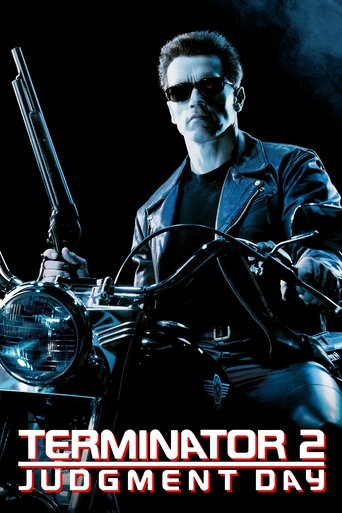
Perhaps its most significant legacy is the character of Ellen Ripley. Sigourney Weaver's performance, which earned her a rare Academy Award nomination for a sci-fi/action role, redefined the female action hero. Ripley was not a hyper-sexualized figure but a complex, intelligent, and resilient woman driven by trauma and a powerful maternal instinct. She became the benchmark for strong female protagonists in action films, paving the way for characters like Sarah Connor in Cameron's own Terminator 2: Judgment Day.
The film's practical effects, especially the awe-inspiring Alien Queen puppet created by Stan Winston's studio, set a new standard for creature design and animatronics, winning an Academy Award for Visual Effects. Aliens remains a touchstone of 80s cinema, celebrated for its masterful blend of action, suspense, and emotional depth, and its iconic lines have become ingrained in the cultural lexicon.
Audience Reception
Aliens was met with widespread critical acclaim and was a major box office success upon its release in 1986. Audiences and critics alike praised its masterful shift in genre from the slow-burn horror of the original to a relentless, high-octane action film. The film was lauded for its intense and sustained suspense, groundbreaking practical effects, and strong character development. Sigourney Weaver's performance as Ellen Ripley received particular praise, earning her an Academy Award nomination for Best Actress, a rare feat for a science-fiction action film. Bill Paxton's performance as the panicky Private Hudson was also frequently singled out as a fan favorite for providing both comic relief and genuine tension.
While overwhelmingly positive, some minor criticisms were directed at the film's intense and sometimes overwhelming level of action, with a few critics feeling it occasionally verged on sensory overload. The film is often cited in debates about whether it is superior to its predecessor, Alien, with fans divided over which film's tone and style is more effective. Overall, however, Aliens is regarded as a classic of its genre and one of the best sequels ever made, resonating with audiences for its perfect blend of visceral thrills and emotional depth.
Interesting Facts
- James Cameron pitched the film's title to 20th Century Fox executives by writing 'ALIEN' on a whiteboard, then adding an 'S' to the end. When the executives were unimpressed, he turned the 'S' into a dollar sign ('ALIEN$').
- The role of Corporal Hicks was originally given to actor James Remar. He was fired shortly after filming began due to drug-related issues and was quickly replaced by Michael Biehn. Some shots of Remar from behind remain in the final film.
- Sigourney Weaver was initially hesitant to return for a sequel. She was eventually persuaded with a salary of $1 million, a significant sum for an actress at the time, and a script she approved of.
- Actress Jenette Goldstein, who played the tough-as-nails Private Vasquez, originally thought the film was about immigrants and showed up to her audition dressed for a drama.
- The iconic 'knife trick' scene, where Bishop rapidly stabs a knife between Hudson's fingers, was performed by Lance Henriksen. Bill Paxton was reportedly not told the scene would be filmed that day, and his reaction of terror is genuine. Henriksen did accidentally nick Paxton's pinky finger during one of the takes.
- Due to budget constraints, only six alien suits were created. Director James Cameron used clever editing, smoke, and lighting to create the illusion of a massive hive of hundreds of Xenomorphs.
- The full-size Alien Queen was a 14-foot-tall practical effect puppet that required 16 puppeteers to operate. To test the concept, Stan Winston and James Cameron built a crude version out of foam core and black garbage bags.
- The names of the two spaceships, the Nostromo (from 'Alien') and the Sulaco, are both references to the works of author Joseph Conrad. Sulaco is a town in his novel 'Nostromo'.
Easter Eggs
James Cameron has a voice cameo in the opening scene.
When the salvage crew discovers Ripley's shuttle, one of the crew members says the line, "Bio readouts are in the green, looks like she's alive!" This line is voiced by the film's director, James Cameron.
A photograph of Sigourney Weaver's actual mother is used in a deleted scene.
In the Special Edition version of the film, there is a scene where Burke shows Ripley a photograph of her daughter, Amanda, as an old woman. The photograph used is actually of Elizabeth Inglis, Sigourney Weaver's real-life mother, who was also an actress.
The harpoon gun from the first film is visible in Ripley's shuttle.
In the opening sequence, as the salvage crew cuts their way into the Narcissus shuttle, the harpoon gun that Ripley used to expel the alien at the end of the first film can be seen still wedged in the damaged doorway.
⚠️ Spoiler Analysis
Click to reveal detailed analysis with spoilers
Frequently Asked Questions
Explore More About This Movie
Dive deeper into specific aspects of the movie with our detailed analysis pages
Comments (0)
No comments yet. Be the first to share your thoughts!