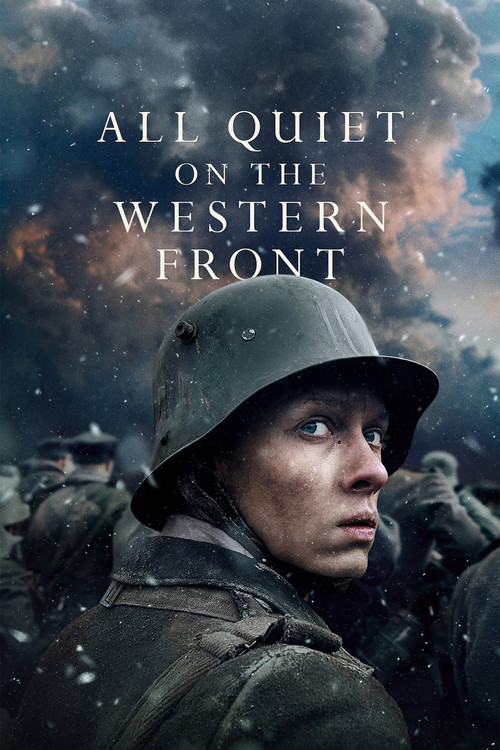
Im Westen nichts Neues
All Quiet on the Western Front - Symbolism & Philosophy
Symbols & Motifs
The Recycled Uniforms
They symbolize the cyclical, industrial nature of the war and the interchangeability of the soldiers. Paul unknowingly wears a uniform that belonged to a dead man, literally stepping into a dead man's shoes.
In the opening prologue, we see the journey of a uniform from a dead body on the battlefield to a laundry facility, a sewing room, and finally to Paul during his enlistment.
The Mud Mask
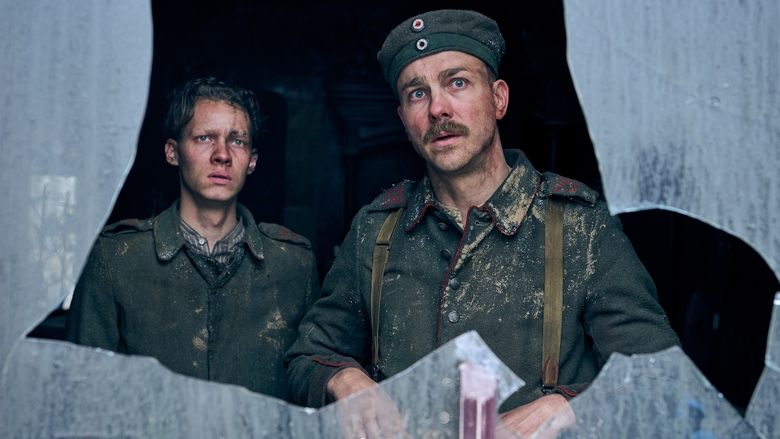
The mud that cakes the soldiers' faces acts as a mask of death and dehumanization, erasing their individuality and turning them into creatures of the earth. It also represents the stain of war that cannot be washed away.
Appears repeatedly, most notably when Paul's face is half-covered in dried mud after a bombardment, resembling a skull or a tragedy mask.
Franz's Scarf
A symbol of fleeting intimacy, the civilian world, and the connections that are severed by war. It is a fragile reminder of life outside the trenches.
Passed from Franz (who obtained it from a French woman) to Tjaden, and finally held by the new recruit who finds Paul's body, serving as a tragic baton passed between the dead and the living.
The Armistice Train
Represents the detached, luxurious world of the leadership. Its clean lines, warm lights, and fine food stand in grotesque contrast to the cold, blue-grey filth of the trenches.
Used during the negotiation scenes in the Forest of Compiègne, where Erzberger pleads for peace while generals debate honor.
Philosophical Questions
What is the value of an individual life in the machinery of state?
The film explores this by showing the industrial recycling of uniforms and the callous way generals spend thousands of lives for a few hundred yards of mud. It asks whether a soldier is a person or just a component of a weapon.
Who bears the moral responsibility for war?
By contrasting the suffering Paul with the dining generals, the film posits that those who declare war rarely suffer its consequences, raising questions about duty, obedience, and the morality of following orders that lead to certain death.
Core Meaning
Director Edward Berger's adaptation serves as a furious indictment of the futility of war and the disconnect between the decision-makers and those who pay the ultimate price. By juxtaposing the pristine, well-fed officials negotiating peace with the starving, filth-covered soldiers, the film emphasizes that war is a machine that consumes youth for the sake of pride and "honor." It strips away any notion of glory, presenting war not as an adventure, but as a bureaucratic process of recycling uniforms and bodies—a cycle where individual life is rendered meaningless by the machinery of state.