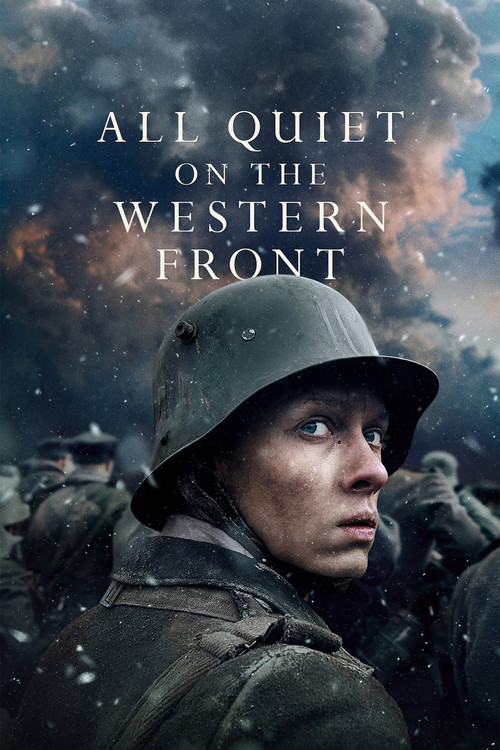
All Quiet on the Western Front
Im Westen nichts Neues
Overview
All Quiet on the Western Front (2022) is a harrowing anti-war epic that follows 17-year-old Paul Bäumer and his schoolmates as they enthusiastically enlist in the German army during World War I, fueled by patriotic propaganda. Their romanticized visions of heroism are swiftly shattered by the gruesome reality of trench warfare in Northern France. As the war drags on, Paul and his comrades—including his close friend Katczinsky—struggle to survive physically and psychologically amidst constant shelling, starvation, and the death of everyone they hold dear.
Parallel to the soldiers' suffering, the film depicts the armistice negotiations led by German official Matthias Erzberger, who desperately seeks to end the bloodshed while facing resistance from French generals and his own military leadership. The narrative builds to a tragic crescendo in the final hours of the war, contrasting the bureaucratic coldness of the railway carriage negotiations with the desperate, muddy chaos of the front lines, culminating in a senseless final offensive ordered minutes before peace is declared.
Core Meaning
Director Edward Berger's adaptation serves as a furious indictment of the futility of war and the disconnect between the decision-makers and those who pay the ultimate price. By juxtaposing the pristine, well-fed officials negotiating peace with the starving, filth-covered soldiers, the film emphasizes that war is a machine that consumes youth for the sake of pride and "honor." It strips away any notion of glory, presenting war not as an adventure, but as a bureaucratic process of recycling uniforms and bodies—a cycle where individual life is rendered meaningless by the machinery of state.
Thematic DNA
The Loss of Innocence
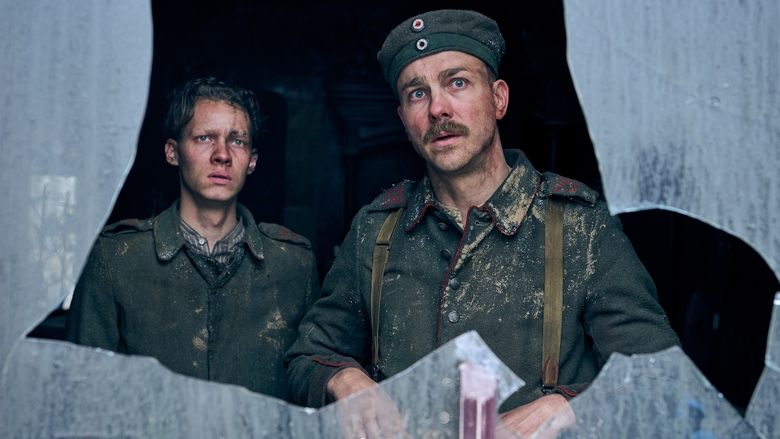
Paul and his friends begin as fresh-faced, eager students calling themselves the "Iron Youth." This innocence is violently stripped away within days at the front. The film visually tracks this degradation through the accumulation of mud on their faces and the hardening of their expressions, transforming them from children into traumatized veterans and finally into corpses.
Bureaucracy vs. Reality
The film introduces a subplot involving Matthias Erzberger and the armistice negotiations to highlight the stark contrast between the war's architects and its victims. While generals eat pastries and debate terms in warm train cars, soldiers drown in mud and blood. This dichotomy amplifies the sense of injustice and the dispensability of the common soldier.
The Machinery of Death
The opening sequence shows uniforms being stripped from dead soldiers, washed, mended, and reissued to new recruits like Paul. This powerful visual metaphor establishes war as an industrial process where human beings are raw materials, interchangeable and easily replaced once consumed.
Camaraderie as Survival
In the face of nihilistic destruction, the only source of warmth or meaning is the bond between the soldiers, particularly between Paul and the father-figure Kat. Their relationship is not just friendship but a necessary survival mechanism; without it, they are merely "shuddering specks of existence."
Character Analysis
Paul Bäumer
Felix Kammerer
Motivation
Initially motivated by patriotism and peer pressure; later motivated solely by the primal instinct to survive and protect his friends.
Character Arc
Paul transforms from an idealistic, wide-eyed student eager to serve the Kaiser into a hollowed-out shell of a man. His journey is one of systematic dehumanization, leading to his senseless death mere seconds before the war ends.
Stanislaus "Kat" Katczinsky
Albrecht Schuch
Motivation
To survive the war and return to his wife, though he fears he has become too broken to reintegrate into society.
Character Arc
An illiterate cobbler in civilian life, Kat becomes the resourceful leader of the group. He survives the worst of the front only to die from a trivial wound inflicted by a child shortly before the armistice, underscoring the absurdity of their fate.
Matthias Erzberger
Daniel Brühl
Motivation
To stop the slaughter and save as many young lives as possible from a lost war.
Character Arc
A real-life historical figure, Erzberger carries the burden of Germany's defeat. He fights a war of words to save lives, knowing he will be hated by his own people for signing the surrender.
General Friedrichs
Devid Striesow
Motivation
Preservation of military honor and a refusal to end his career on a surrender.
Character Arc
A fictional composite character representing the Prussian military aristocracy. Refusing to accept defeat, he orders a suicidal final attack to save his own twisted sense of honor, sacrificing men for nothing.
Symbols & Motifs
The Recycled Uniforms
They symbolize the cyclical, industrial nature of the war and the interchangeability of the soldiers. Paul unknowingly wears a uniform that belonged to a dead man, literally stepping into a dead man's shoes.
In the opening prologue, we see the journey of a uniform from a dead body on the battlefield to a laundry facility, a sewing room, and finally to Paul during his enlistment.
The Mud Mask
The mud that cakes the soldiers' faces acts as a mask of death and dehumanization, erasing their individuality and turning them into creatures of the earth. It also represents the stain of war that cannot be washed away.
Appears repeatedly, most notably when Paul's face is half-covered in dried mud after a bombardment, resembling a skull or a tragedy mask.
Franz's Scarf
A symbol of fleeting intimacy, the civilian world, and the connections that are severed by war. It is a fragile reminder of life outside the trenches.
Passed from Franz (who obtained it from a French woman) to Tjaden, and finally held by the new recruit who finds Paul's body, serving as a tragic baton passed between the dead and the living.
The Armistice Train
Represents the detached, luxurious world of the leadership. Its clean lines, warm lights, and fine food stand in grotesque contrast to the cold, blue-grey filth of the trenches.
Used during the negotiation scenes in the Forest of Compiègne, where Erzberger pleads for peace while generals debate honor.
Memorable Quotes
The iron youth of Germany!
— School Official
Context:
Delivered during a rousing speech in the school auditorium to encourage Paul and his classmates to enlist.
Meaning:
Represents the hollow, nationalistic propaganda used to manipulate young men into sacrificing their lives. The phrase becomes bitterly ironic as the 'iron' youth are easily broken by steel and explosives.
Man is a beast. All he does is eat, sleep, and kill.
— Katczinsky
Context:
Spoken during a quiet moment of reflection between battles, as the men eat and discuss their bleak reality.
Meaning:
Summarizes the reduction of human existence to its most primal, animalistic state within the trenches. It reflects the loss of civilization and higher purpose.
My son is dead. He feels no honor.
— Matthias Erzberger
Context:
Spoken to the French delegation or German generals (implied context from his historical stance and film dialogue) during discussions about the cost of continuing the war.
Meaning:
A sharp rebuke to the military leadership's obsession with 'honor.' It humanizes the cost of war and highlights that dead soldiers do not care about national pride.
Heinrich! Get out there!
— General Friedrichs
Context:
Shouted from a balcony or safe distance as he orders men to their deaths.
Meaning:
Shows the General's complete detachment from reality and his view of soldiers as disposable tools to be ordered around even in the face of certain death.
Philosophical Questions
What is the value of an individual life in the machinery of state?
The film explores this by showing the industrial recycling of uniforms and the callous way generals spend thousands of lives for a few hundred yards of mud. It asks whether a soldier is a person or just a component of a weapon.
Who bears the moral responsibility for war?
By contrasting the suffering Paul with the dining generals, the film posits that those who declare war rarely suffer its consequences, raising questions about duty, obedience, and the morality of following orders that lead to certain death.
Alternative Interpretations
The Ending: Action vs. Nihilism. The film's ending is often debated. The book's ending (Paul dying on a quiet day) suggests that his death is meaningless because it goes unnoticed. The film's ending (dying in a final charge) suggests his death is meaningless because it was preventable and caused by ego.
The Role of Friedrichs. Some interpret General Friedrichs not as a realistic character but as a caricature of the 'Stab-in-the-back' myth's origin—representing the military leadership that would later blame civilians for the loss, setting the stage for WWII.
Cultural Impact
Released during the ongoing war in Ukraine, the film resonated deeply with modern audiences as a timeless warning against conflict. It was a massive critical success internationally, dominating the BAFTAs with 7 wins and securing 4 Academy Awards, including Best International Feature. However, in Germany, reception was more divided; while praised for its technical mastery, some critics and historians felt it sensationalized the sombre source material and criticized the 'Hollywood-esque' addition of the General Friedrichs subplot and the action-heavy ending. Nevertheless, it stands as a significant modernization of Remarque's work, bringing its anti-war message to a new streaming generation.
Audience Reception
Praised: Audiences and critics universally acclaimed the cinematography, score (the iconic three-note synthesizer motif), and the visceral, unflinching depiction of combat. The acting, particularly by Felix Kammerer and Albrecht Schuch, was highly lauded.
Criticized: Purists of the novel and some German critics felt the film deviated too far from the source material. The omission of Paul's home leave (a key emotional arc in the book) and the addition of the 'action-movie' ending were common points of contention. Some felt the music was too modern and intrusive.
Interesting Facts
- The film was shot largely in the Czech Republic, including at Barrandov Studios in Prague.
- Cinematographer James Friend and director Edward Berger used a system of 'camera traps' inside a purpose-built den to film the wild fox and her cubs in the opening sequence, aiming for a nature documentary look.
- Makeup designer Heike Merker treated the actors' faces 'like a canvas,' using specific textures of mud and clay to visually represent the stages of their psychological decay.
- It tied with 'Fanny and Alexander', 'Crouching Tiger, Hidden Dragon', and 'Parasite' for the most Oscar wins by a non-English language film (4 wins).
- The film uses a specific color palette: the trenches are graded in cold, sickly blues and greys, while the General's quarters and the armistice train are bathed in warm, golden hues.
- Unlike the book, the film includes the perspective of the armistice negotiations, a change made to provide historical context and contrast the soldiers' experience with the leadership's.
- The sound design team created the terrifying sound of the French Saint-Chamond tanks by recording metal chains being dragged over metal plates.
- Felix Kammerer (Paul) was a theater actor making his feature film debut; his physical transformation involved wearing a weighted vest to simulate the heavy equipment's toll on his posture.
Easter Eggs
The name on the uniform
When Paul receives his uniform, he notices a name tag that isn't his ('Heinrich'). The officer tears it off, claiming it was 'too small for the fellow.' This references the opening prologue where Heinrich is killed, confirming Paul is wearing a dead man's clothes.
The bald farmer's son
In the final farm raid where Kat is killed, the boy who shoots him appears to be the same boy (or related to) the one from the earlier goose-stealing scene, suggesting a cycle of violence where even children are lethal defenders.
11:00 AM Death
Paul dying literally seconds before the clock strikes 11 is a dramatic departure from the book (where he dies on a quiet day in October) to emphasize the cruel irony of dying for a war that is already technically over.
⚠️ Spoiler Analysis
Click to reveal detailed analysis with spoilers
Frequently Asked Questions
Explore More About This Movie
Dive deeper into specific aspects of the movie with our detailed analysis pages
Comments (0)
No comments yet. Be the first to share your thoughts!