All the President's Men
A paranoid political thriller that pulses with relentless tension, where the rhythmic clatter of typewriters and suffocating shadows become the cinematic battleground for uncovering the truth.
All the President's Men

"The most devastating detective story of this century."

09 April 1976 United States of America 138 min ⭐ 7.7 (2,018)
Director: Alan J. Pakula
Cast: Robert Redford, Dustin Hoffman, Jack Warden, Martin Balsam, Hal Holbrook
Drama Thriller Mystery
Freedom of the Press and Journalistic Integrity Paranoia and Secrecy Institutional Corruption The Power of Diligence and Process
Budget: $8,500,000
Box Office: $70,600,000

All the President's Men - Ending Explained

⚠️ Spoiler Analysis

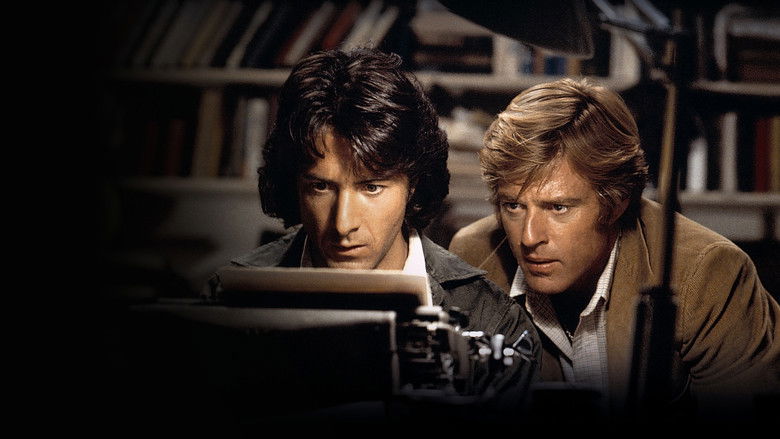
The primary twist in All the President's Men is not a surprise ending—as the audience knows Nixon will resign—but rather the escalating scale of the paranoia and danger. The pivotal turn occurs when Deep Throat finally drops his cryptic demeanor in a late-night garage meeting, explicitly warning Woodward that their lives are in danger and that the conspiracy involves the entire U.S. intelligence community. This shifts the film from a journalistic procedural into a genuine thriller, culminating in the famous, paranoid scene where Woodward goes to Bernstein's apartment, turns up a classical record to deafening levels to mask their conversation from hidden microphones, and types out Deep Throat's terrifying revelations.

The structural twist of the film lies in its ending. Rather than depicting the cathartic resignation of Richard Nixon, the film ends abruptly in January 1973 with Nixon taking the oath of office for his second term. The camera pans away from the inauguration on television to focus on Woodward and Bernstein, heads down, fiercely typing. The screen then cuts to an extreme close-up of a teletype machine punching out a rapid succession of real-world headlines, documenting the subsequent indictments, the discovery of the White House tapes, and finally, Nixon's resignation. This brilliant stylistic choice emphasizes that the journalists' work was the catalyst, leaving the audience to supply the historical triumph themselves.

Alternative Interpretations

While generally viewed as a heroic tale of a free press saving democracy, an alternative interpretation focuses on the systemic failures and complicity of institutions. Some critics and historians argue that the film inadvertently highlights how the press was used as a tool for institutional infighting. In this reading, Deep Throat (later revealed to be FBI Associate Director Mark Felt) is not a noble defender of truth, but a disgruntled bureaucrat settling scores after being passed over for promotion, manipulating eager young reporters to execute a political hit against the Nixon administration.

Another analytical perspective, often discussed by media scholars, is a feminist critique of the film's narrative structure. Throughout the movie, women—such as the bookkeeper Judy Hoback—hold the crucial pieces of the puzzle and take immense personal risks to share them. However, their contributions are continually mined by the male protagonists who ultimately claim the glory and the bylines. In this interpretation, the film is a fascinating, if unintentional, document of 1970s workplace gender dynamics, where women possess the truth but lack the institutional power to expose it without male intermediaries.