The core meaning of "Arcane" is an exploration of duality and the tragic inevitability of conflict born from deep-seated societal inequity and unresolved personal trauma. The creators illustrate that there are no true heroes or villains, only deeply flawed individuals shaped by their environment and their pain. The series argues that the relentless pursuit of progress without empathy or consideration for its societal cost—be it Jayce's Hextech utopia or Silco's vision of a liberated Zaun—leads to destruction. It posits that love and family bonds, while powerful, can be twisted into instruments of pain and control when fractured by grief and misunderstanding. Ultimately, "Arcane" is a cautionary tale about how systems of oppression create monsters and how the cycle of violence, once started, consumes everything and everyone, making reconciliation almost impossible.
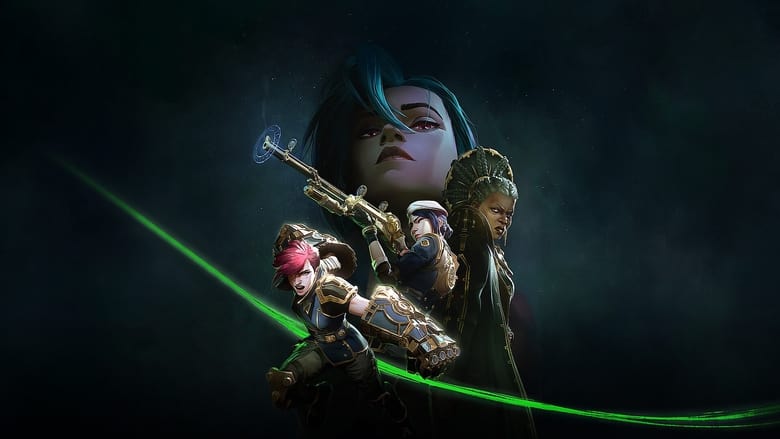
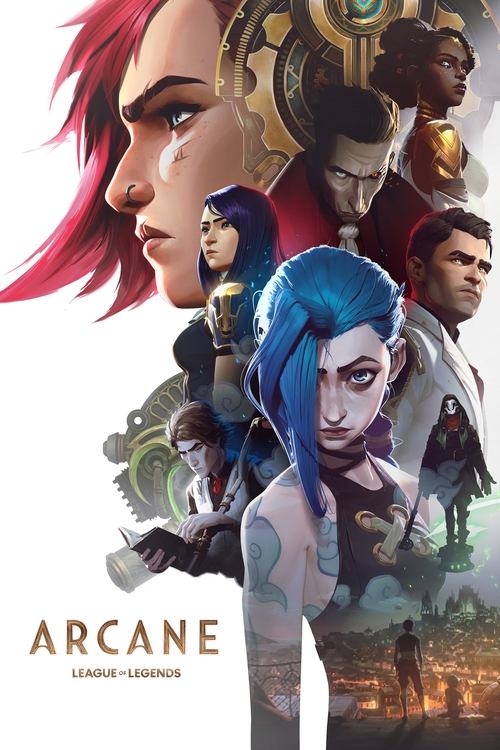
"The hunt is on."
Cast: Hailee Steinfeld, Ella Purnell, Kevin Alejandro, Jason Spisak, Toks Olagundoye
Arcane — Symbolism & Philosophy
Symbols & Motifs
Hextech Crystals
Hextech symbolizes the double-edged nature of progress and power. These magical crystals are a source of immense potential for good—powering the city and healing the sick—but they are also easily weaponized, becoming tools of immense destruction. They represent the central conflict between magic and science, and the dangerous pursuit of power that corrupts the ideals of inventors like Jayce and Viktor.
The story begins with Powder stealing the unstable crystals, leading to the inciting tragedy. Jayce and Viktor's ability to stabilize them ushers in Piltover's golden age. In the finale of Season 1, Jinx weaponizes a crystal to attack the Council, demonstrating its destructive potential. In Season 2, Viktor's obsession with the Hexcore, an advanced form of Hextech, drives his descent into a post-human ideologue.
Jinx's Graffiti (Monkeys and Smileys)
Jinx's chaotic graffiti, particularly the monkey bombs and neon smiley faces, symbolizes her fractured psyche and her anarchic worldview. The monkey is a symbol of playful mayhem, while the manic smileys often mark sites of destruction. They are external manifestations of her inner turmoil, a way for her to impose her chaotic identity onto the world that broke her.
Jinx's artwork is seen throughout both Piltover and Zaun, often as a prelude to or the aftermath of her attacks. Her hideouts are covered in these drawings, representing her internal landscape. The graffiti style evolves with her character, becoming more aggressive and prominent as her identity as Jinx solidifies and her connection to Powder fades.
The Bridge of Progress
The grand bridge connecting Piltover and Zaun symbolizes the deep, seemingly uncrossable divide between the two societies. It is a physical manifestation of their forced separation and the inequality that defines their relationship. It is simultaneously a path for commerce and a choke point for control, representing both connection and oppression.
The series opens with Vi and Powder's parents being killed during a protest on the bridge. It is the site of multiple key confrontations throughout the series, including the spectacular fight between Jinx and Ekko in Season 1, which visually represents the fractured timeline and relationship between the two former childhood friends.
Shimmer
The volatile purple chemical, Shimmer, symbolizes false hope and destructive power. It offers a quick, monstrous strength to the desperate people of Zaun but at a terrible cost, leading to addiction, madness, and death. It is a dark mirror to Hextech—while Hextech is a refined, 'clean' power for the elite, Shimmer is a raw, dirty power for the oppressed, ultimately serving only to deepen their suffering.
Silco uses Shimmer to control Zaun's population and create an army of brutes. Vander takes it in a final act of sacrifice to save Vi. The drug's influence is seen throughout Zaun's alleys and fight pits. In Season 2, it is revealed to be crucial in the creation of Warwick (Vander's mutated form), representing the permanent, monstrous scarring of past sins.
Philosophical Questions
Does the pursuit of a utopian ideal inevitably lead to dystopian outcomes?
The series explores this question through multiple characters. Jayce and Viktor begin with the noble goal of using Hextech to eliminate hardship and advance society. However, their creation becomes a weapon, a source of political corruption, and the catalyst for war. Viktor's personal quest to eradicate human frailty drives him to become a tyrannical figure who wishes to strip humanity of its free will for a 'greater good.' Silco's vision for a free Zaun is also a utopia for his people, but he employs terror, murder, and drugs to achieve it. "Arcane" consistently suggests that the pursuit of perfection, whether societal or personal, is fraught with peril and often requires sacrificing the very humanity one seeks to save.
Can an individual ever truly overcome their formative trauma?
This is the central question of the series, explored through Vi and Jinx. Jinx is the embodiment of someone consumed by trauma; it redefines her identity, dictates her actions, and poisons her relationships. The series suggests that for some, the damage is too deep to be repaired, and the 'monster' created by trauma becomes the dominant self. Vi's journey is a struggle against this idea; she believes she can save her sister by appealing to their shared past, but is ultimately forced to accept that the person she knew is gone. The tragic conclusion suggests that while one can learn to live with trauma, and even find moments of redemption, one cannot simply erase it or revert to a past self.
Is violence a necessary tool for liberation against an oppressive system?
"Arcane" presents a nuanced and unresolved debate on this question. Vander represents the path of peace and de-escalation, having seen the devastating cost of a failed violent uprising. His approach maintains a fragile stability but does not solve the underlying oppression. Silco represents the opposite view: that freedom for Zaun can only be achieved through absolute ruthlessness and violence, meeting the 'base violence' of the system with overwhelming force of his own. The series does not offer a clear answer. While Silco's methods are horrific, the narrative validates his grievance that Piltover only responds to power. The devastating war in the finale is the result of these conflicting ideologies, suggesting that in a world of such extreme inequality, a violent outcome may be tragically inevitable.
Core Meaning
Explore More About This Movie
Dive deeper into specific aspects of the movie with our detailed analysis pages