Arcane
"The hunt is on."
Overview
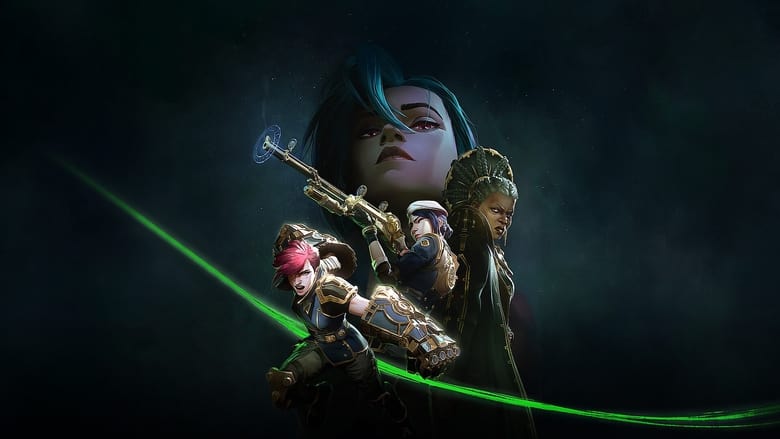
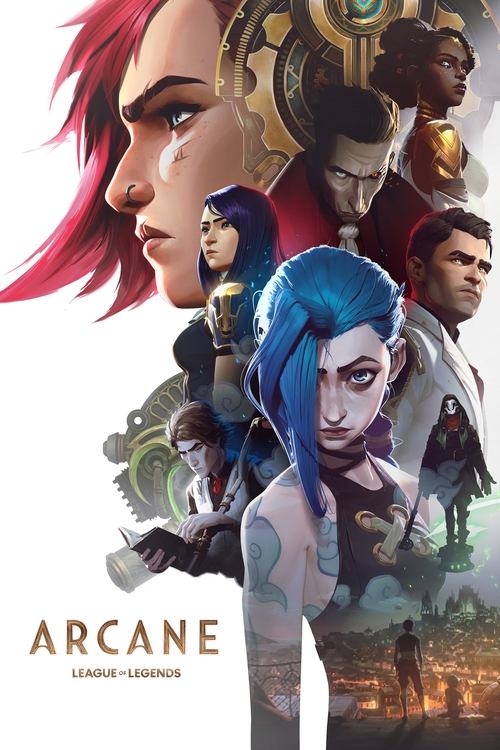
Set in the dual cities of Piltover, the gleaming city of progress, and Zaun, its oppressed and chemically-blighted underbelly, "Arcane" tells the story of a world on the brink of change. The invention of Hextech, a way to harness magical energy for technological use, promises a new era of prosperity for Piltover but widens the already catastrophic divide with Zaun. At the heart of this escalating conflict are two sisters, Vi and Powder, orphaned by a failed uprising and raised by the benevolent tavern-owner Vander. A childhood tragedy tears them apart, setting them on radically different paths. Vi grows up to be a pragmatic enforcer with a strong sense of justice, while the traumatized and abandoned Powder is molded into the chaotic and brilliant anarchist, Jinx, by the charismatic revolutionary Silco.
Across its two seasons, the series masterfully intertwines the personal tragedy of the sisters with the escalating political and social war between the two cities. The narrative expands to include the idealistic inventors Jayce and Viktor, whose pursuit of progress through Hextech unleashes unforeseen consequences, and Caitlyn Kiramman, a Piltover enforcer who bridges the gap between the two worlds. As tensions escalate, fueled by ambition, betrayal, and deeply rooted trauma, the characters are forced to confront the monsters they've become and the devastating cost of their convictions. The story culminates in an all-out war, forcing every character to make choices that will irrevocably define the future of both cities and their own fractured relationships, leading to a poignant and explosive conclusion to their saga.
Core Meaning
The core meaning of "Arcane" is an exploration of duality and the tragic inevitability of conflict born from deep-seated societal inequity and unresolved personal trauma. The creators illustrate that there are no true heroes or villains, only deeply flawed individuals shaped by their environment and their pain. The series argues that the relentless pursuit of progress without empathy or consideration for its societal cost—be it Jayce's Hextech utopia or Silco's vision of a liberated Zaun—leads to destruction. It posits that love and family bonds, while powerful, can be twisted into instruments of pain and control when fractured by grief and misunderstanding. Ultimately, "Arcane" is a cautionary tale about how systems of oppression create monsters and how the cycle of violence, once started, consumes everything and everyone, making reconciliation almost impossible.
Thematic DNA
Duality and Binary Oppositions
The entire series is built on a foundation of dualities: Piltover vs. Zaun, magic vs. science, order vs. chaos, progress vs. tradition. This is most powerfully embodied in the central relationship between Vi and Jinx (Powder), two halves of a whole, torn apart and set on opposing paths. The pristine, sunlit architecture of Piltover contrasts sharply with the grimy, neon-drenched depths of Zaun. The narrative consistently avoids simple moral binaries, showing the corruption within Piltover's council and the humanity within Zaun's revolutionaries like Silco. Characters like Viktor embody this theme internally, struggling between his human frailty and the promise of a cold, mechanical evolution. The series argues that these opposing forces are intrinsically linked and often create one another.
Trauma and Identity
"Arcane" is a profound study of trauma and its lasting impact on the human psyche. Powder's transformation into Jinx is the series' central tragedy, stemming from a single moment of catastrophic failure and abandonment. Her erratic behavior, hallucinations, and desperate need for validation are all direct consequences of her childhood trauma. Vi is also driven by her own trauma and guilt, fueling a relentless quest to save a sister who may no longer exist. Other characters, like Viktor with his physical illness and Jayce with the pressure of his inventions, are also shaped by their personal struggles, which dictate their choices and ultimately their fates.
Social Inequality and Revolution
The stark class divide between the utopian Piltover and the exploited Zaun is the engine of the plot. The series explores the political and social ramifications of this inequality, showing how the oppression and neglect of Zaun's populace breeds resentment and fuels a violent revolutionary spirit. Leaders like Vander and later Silco rise from this desperation, offering different paths to salvation—one through peace and compromise, the other through ruthless violence. The show questions the very definition of progress, suggesting that Piltover's advancements are built on the suffering of the undercity, making conflict not just possible, but inevitable.
The Price of Progress
Through the story of Jayce and Viktor, "Arcane" critically examines the nature of scientific and technological advancement. Their invention of Hextech is initially portrayed as a miracle that could solve the world's problems, but it quickly becomes a source of conflict, a weapon, and a corrupting influence. The theme is encapsulated in Viktor's poignant realization: "In the pursuit of great, we failed to do good." The series consistently demonstrates that progress without morality is dangerous, and that ambition, even when well-intentioned, can lead to catastrophic outcomes when unchecked by wisdom and humanity.
Character Analysis
Vi (Violet)
Hailee Steinfeld
Motivation
Vi's primary motivation is guilt and a fierce, protective love for her sister. She blames herself for leaving Powder behind and believes she can fix her. This singular focus evolves as she becomes entangled in the larger Piltover-Zaun conflict. Her relationship with Caitlyn introduces a new motivation: a desire for a future where peace is possible, forcing her to reconcile her personal quest with the needs of the many.
Character Arc
Vi begins as a protective but reckless older sister and a leader of her small gang in Zaun's undercity. After the traumatic events of the first act, which lead to her imprisonment, she emerges hardened, pragmatic, and driven by a singular goal: find and save her sister, Powder. Her arc across the series is one of painfully letting go of the past. She is forced to confront the reality that the innocent sister she lost is gone, replaced by the chaotic Jinx. Initially fueled by rage and a desire for direct action, she learns to work with others, like Caitlyn, and grapples with the complexities of a conflict that can't be solved with her fists. Her journey culminates in the tragic acceptance of her sister's new identity and the realization that she cannot save Jinx, only try to stop her, forcing her to choose a side in the inevitable war.
Jinx (Powder)
Ella Purnell
Motivation
Jinx is driven by a deep-seated fear of abandonment and a desperate need for acceptance. Her actions are a twisted attempt to win the love and approval she craves—first from Vi, and later from Silco. She creates chaos to feel in control of a world that has only ever hurt her. Her motivation is a paradoxical mix of wanting to destroy everything that rejected her while still yearning for the sister she lost.
Character Arc
Powder starts as an insecure but brilliant young inventor, desperate for the approval of her older sister, Vi. A catastrophic mistake born from her desire to help leads to the death of her friends and adoptive father, and Vi's subsequent abandonment shatters her psyche. She is taken in by the villain Silco, who nurtures her brilliance and rage, transforming her into the feared anarchist, Jinx. Her arc is a tragic descent into madness, haunted by the ghosts of her past (Mylo and Claggor) and a desperate, toxic need to prove her worth to both Silco and the memory of Vi. The series finale shows her fully embracing the identity of Jinx, rejecting the name Powder and choosing chaos over reconciliation. By the end, she finds a final, tragic form of love and acceptance in her own destructive nature, culminating in a sacrificial act to save Vi, bringing her story to a close.
Jayce Talis
Kevin Alejandro
Motivation
Jayce is motivated by a desire to create a better future and live up to the title Piltover gives him: "The Man of Progress." He is driven by the belief that science can solve humanity's problems. This motivation is challenged throughout the series, forcing him to question whether the progress he champions is worth the price in blood.
Character Arc
Jayce begins as a brilliant, arrogant, but ultimately well-meaning scientist who believes his invention, Hextech, can change the world for the better. His journey is one of disillusionment. As he gains political power in Piltover, he is forced to make compromises that tarnish his idealistic vision. He struggles to balance his scientific ambition with the harsh realities of politics, war, and corruption. Initially believing progress is always the answer, he witnesses firsthand the death and destruction his technology causes. His arc is about the loss of innocence, realizing that good intentions are not enough to prevent catastrophe in a broken world. He is left at the end as a jaded leader, forced to deal with the consequences of the war he inadvertently helped start.
Viktor
Harry Lloyd
Motivation
Viktor's core motivation is the fear of his own mortality and a deep-seated desire to help the downtrodden he grew up with in Zaun. He wants to eradicate the pain and frailty of the human body. As the Hexcore influences him, this motivation warps into a messianic complex to forcibly 'perfect' all of humanity, believing that suffering is a flaw that must be engineered away, no matter the cost.
Character Arc
Viktor, a brilliant but physically frail scientist from the undercity, is Jayce's partner in creating Hextech. His arc is a tragic pursuit of transcendence. Facing a terminal illness, he becomes obsessed with using the Hexcore—a sentient form of Hextech—to eliminate human weakness and suffering. His desperation leads him down a dark path, blurring the line between healing and horrifying evolution. He loses his humanity piece by piece, sacrificing his relationships and his morality in pursuit of what he calls the "Glorious Evolution." By the end of the series, he becomes a primary antagonist, a messianic figure who believes the only way to save humanity is to strip it of its free will and merge it with machines, representing the ultimate perversion of his initial noble goals.
Symbols & Motifs
Hextech Crystals
Hextech symbolizes the double-edged nature of progress and power. These magical crystals are a source of immense potential for good—powering the city and healing the sick—but they are also easily weaponized, becoming tools of immense destruction. They represent the central conflict between magic and science, and the dangerous pursuit of power that corrupts the ideals of inventors like Jayce and Viktor.
The story begins with Powder stealing the unstable crystals, leading to the inciting tragedy. Jayce and Viktor's ability to stabilize them ushers in Piltover's golden age. In the finale of Season 1, Jinx weaponizes a crystal to attack the Council, demonstrating its destructive potential. In Season 2, Viktor's obsession with the Hexcore, an advanced form of Hextech, drives his descent into a post-human ideologue.
Jinx's Graffiti (Monkeys and Smileys)
Jinx's chaotic graffiti, particularly the monkey bombs and neon smiley faces, symbolizes her fractured psyche and her anarchic worldview. The monkey is a symbol of playful mayhem, while the manic smileys often mark sites of destruction. They are external manifestations of her inner turmoil, a way for her to impose her chaotic identity onto the world that broke her.
Jinx's artwork is seen throughout both Piltover and Zaun, often as a prelude to or the aftermath of her attacks. Her hideouts are covered in these drawings, representing her internal landscape. The graffiti style evolves with her character, becoming more aggressive and prominent as her identity as Jinx solidifies and her connection to Powder fades.
The Bridge of Progress
The grand bridge connecting Piltover and Zaun symbolizes the deep, seemingly uncrossable divide between the two societies. It is a physical manifestation of their forced separation and the inequality that defines their relationship. It is simultaneously a path for commerce and a choke point for control, representing both connection and oppression.
The series opens with Vi and Powder's parents being killed during a protest on the bridge. It is the site of multiple key confrontations throughout the series, including the spectacular fight between Jinx and Ekko in Season 1, which visually represents the fractured timeline and relationship between the two former childhood friends.
Shimmer
The volatile purple chemical, Shimmer, symbolizes false hope and destructive power. It offers a quick, monstrous strength to the desperate people of Zaun but at a terrible cost, leading to addiction, madness, and death. It is a dark mirror to Hextech—while Hextech is a refined, 'clean' power for the elite, Shimmer is a raw, dirty power for the oppressed, ultimately serving only to deepen their suffering.
Silco uses Shimmer to control Zaun's population and create an army of brutes. Vander takes it in a final act of sacrifice to save Vi. The drug's influence is seen throughout Zaun's alleys and fight pits. In Season 2, it is revealed to be crucial in the creation of Warwick (Vander's mutated form), representing the permanent, monstrous scarring of past sins.
Memorable Quotes
In the pursuit of great, we failed to do good.
— Viktor
Context:
Spoken in Season 1, Episode 9 ("The Monster You Created"). After the Hexcore inadvertently kills his assistant, Sky, Viktor is horrified by what their creation has become. He says this to Jayce as they lament how far they have strayed from their original dream of helping people.
Meaning:
This quote encapsulates one of the series' central themes: the danger of unchecked ambition. It reflects Viktor's and Jayce's tragic realization that their noble goal of advancing humanity through Hextech has led to conflict, death, and corruption. It serves as a powerful commentary on how progress without moral consideration is ultimately a failure.
Is there anything so undoing as a daughter?
— Silco
Context:
In Season 1, Episode 9 ("The Monster You Created"), Silco is speaking to the statue of his former brother, Vander. He is contemplating the deal offered by Jayce: Zaun's independence in exchange for Jinx. He realizes he cannot give her up, finally understanding the choice Vander made to protect his family over their revolution.
Meaning:
This line reveals the unexpected depth of Silco's character. For a ruthless and calculating villain, his genuine, albeit twisted, love for his adopted daughter, Jinx, becomes his greatest strength and his ultimate weakness. It shows that even the most hardened ideologue can be swayed by love, humanizing him and complicating his role as the antagonist.
You're perfect.
— Silco
Context:
Occurs in the final scene of Season 1, Episode 9 ("The Monster You Created"). During a chaotic "tea party," a crazed Jinx fires her minigun and accidentally hits Silco. As he dies in her arms, he comforts her with these words, cementing his role as the one person who never abandoned her.
Meaning:
These are Silco's dying words to Jinx after she accidentally shoots him. In this final moment, he gives her the unconditional acceptance she has desperately craved her entire life. This validation solidifies her transformation, freeing her from the ghost of Powder and allowing her to fully embrace the identity of Jinx. It's a tragic, powerful moment that confirms his love for her was real.
What makes you different makes you strong.
— Vi
Context:
Spoken in Season 1, Episode 1 ("Welcome to the Playground"). Vi says this to Powder to comfort her after she is belittled by their friend Mylo for being a jinx and unable to fight. It's a moment of pure sisterly love that stands in stark contrast to their future relationship.
Meaning:
This line, spoken to a young and insecure Powder, is a poignant piece of foreshadowing that becomes deeply ironic by the end of the series. It represents Vi's love and belief in her sister's unique talents. However, it is precisely Powder's "difference"—her instability and volatile genius—that ultimately leads to tragedy and transforms her into Jinx.
Episode Highlights
The Base Violence Necessary for Change
This episode is the devastating climax of the first act and the emotional core of the entire series. It depicts the disastrous attempt to rescue Vander from Silco. Desperate to help, Powder uses the unstable magic crystals to create a bomb, but her plan backfires horribly, resulting in the deaths of her friends Claggor and Mylo, and contributing to Vander's demise. The episode ends with a grief-stricken Vi hitting Powder and walking away, only to be abducted. This moment of abandonment is the catalyst for Powder's transformation into Jinx.
This single episode establishes the foundational trauma that drives the main characters for the rest of the series. It is the birth of Jinx, the moment that severs the bond between the sisters, and the event that solidifies Silco's control over the undercity. Everything that follows is a direct consequence of the tragedy in this episode.
When These Walls Come Tumbling Down
Vi, released from prison by Caitlyn, finally confronts Jinx after years of separation. The reunion on the old arcade grounds is emotionally charged and ultimately catastrophic. Jinx, torn between her lingering love for her sister and her loyalty to Silco, is further destabilized by the arrival of the Firelights, led by her childhood friend Ekko. The episode masterfully builds tension, culminating in Jinx's panicked firing of a flare, signaling her distress and choosing neither side.
This episode shatters any hope for a simple, happy reunion. It demonstrates the psychological chasm that has grown between the sisters, showing Vi that the Powder she knew may be truly gone. It also brings Ekko back into the narrative as a significant third party in the conflict, representing a different path for the youth of Zaun.
The Boy Savior
This episode features one of the series' most visually spectacular and emotionally resonant sequences: the fight between Jinx and Ekko on the Piltover bridge. Animated to the song "Dynasties & Dystopia," the fight is stylized as a childhood game of make-believe turned deadly serious. Ekko uses his wits and knowledge of Jinx's patterns to outmaneuver her, culminating in a tragic moment where he sees the face of his old friend Powder before striking her down. The episode also explores Viktor's increasingly desperate experiments with the Hexcore.
The Ekko vs. Jinx fight is a masterpiece of visual storytelling, encapsulating their entire shared history and tragic divergence in a single sequence. It highlights Ekko's role as a protector of Zaun's future while showing Jinx is not completely invincible. It is a poignant look at what could have been for the children of the undercity.
The Monster You Created
The Season 1 finale is an explosive culmination of every plotline. Jinx kidnaps Vi, Caitlyn, and Silco, forcing them into a twisted "tea party" to resolve her internal conflict. Forced to choose between her sister and her loyalty to Silco, she inadvertently kills Silco, who uses his dying breath to affirm his love for her. Finally embracing her new identity, Jinx—now fully unburdened by Powder—fires a Hextech-powered rocket directly at the Piltover Council chamber just as they vote to grant Zaun independence.
This episode provides a shocking cliffhanger that irrevocably changes the world. Jinx's decision makes all-out war between Piltover and Zaun inevitable, rendering Jayce's diplomatic efforts meaningless. It solidifies Jinx's character arc for the season, as she fully embraces her chaotic identity and declares war on the world.
The Dirt Under Your Nails
The series finale delivers the promised war between Piltover and Zaun, which has now expanded to include Viktor's machine army and Ambessa's Noxian forces. The climax centers on the final confrontation between Vi and Jinx amidst the battle. In a final act of love and sacrifice, Jinx dies protecting Vi from their mutated father, Vander (now Warwick). The war concludes with significant losses on all sides, leading to a new, fragile political landscape where Zaun gains representation on the council, and Vi and Caitlyn leave together to hunt down remaining threats.
This episode provides a conclusive, albeit tragic, ending to the sisters' story. It resolves the central conflict of the series through Jinx's final choice, bringing her tortured arc to a close with an act of redemption. The finale establishes a new status quo for the world of Runeterra, closing the chapter on Vi and Jinx while opening the door for future stories in the universe, as confirmed by the show's creators.
Philosophical Questions
Does the pursuit of a utopian ideal inevitably lead to dystopian outcomes?
The series explores this question through multiple characters. Jayce and Viktor begin with the noble goal of using Hextech to eliminate hardship and advance society. However, their creation becomes a weapon, a source of political corruption, and the catalyst for war. Viktor's personal quest to eradicate human frailty drives him to become a tyrannical figure who wishes to strip humanity of its free will for a 'greater good.' Silco's vision for a free Zaun is also a utopia for his people, but he employs terror, murder, and drugs to achieve it. "Arcane" consistently suggests that the pursuit of perfection, whether societal or personal, is fraught with peril and often requires sacrificing the very humanity one seeks to save.
Can an individual ever truly overcome their formative trauma?
This is the central question of the series, explored through Vi and Jinx. Jinx is the embodiment of someone consumed by trauma; it redefines her identity, dictates her actions, and poisons her relationships. The series suggests that for some, the damage is too deep to be repaired, and the 'monster' created by trauma becomes the dominant self. Vi's journey is a struggle against this idea; she believes she can save her sister by appealing to their shared past, but is ultimately forced to accept that the person she knew is gone. The tragic conclusion suggests that while one can learn to live with trauma, and even find moments of redemption, one cannot simply erase it or revert to a past self.
Is violence a necessary tool for liberation against an oppressive system?
"Arcane" presents a nuanced and unresolved debate on this question. Vander represents the path of peace and de-escalation, having seen the devastating cost of a failed violent uprising. His approach maintains a fragile stability but does not solve the underlying oppression. Silco represents the opposite view: that freedom for Zaun can only be achieved through absolute ruthlessness and violence, meeting the 'base violence' of the system with overwhelming force of his own. The series does not offer a clear answer. While Silco's methods are horrific, the narrative validates his grievance that Piltover only responds to power. The devastating war in the finale is the result of these conflicting ideologies, suggesting that in a world of such extreme inequality, a violent outcome may be tragically inevitable.
Alternative Interpretations
One of the most discussed alternative interpretations revolves around the character of Silco. While presented as the primary antagonist of Season 1, many viewers and critics interpret him not as a simple villain, but as a tragic revolutionary and a loving father. His methods are brutal, but his goal—the creation of a free and respected nation of Zaun—is born from legitimate grievance. His genuine, unconditional love for Jinx, especially in his final moments, leads to an interpretation where he is a more sympathetic and morally complex figure than the 'good' leaders of Piltover, who oversee an oppressive system. This reading challenges the viewer to question who the true villains of the story are: the individuals committing violence or the systems that create the conditions for it.
Another area of interpretation concerns the ending and the nature of Jinx's final act in Season 2. While on the surface it is an act of sacrifice to save Vi, some interpret it as the final, logical conclusion of her nihilistic and chaotic identity. In this view, her death is not just about saving her sister, but about achieving a form of ultimate self-expression through destruction—taking Vander/Warwick, a symbol of their shared, painful past, down with her. It's seen as the only way she could truly be free from the warring identities of Powder and Jinx, a final, explosive release from her trauma.
Cultural Impact
"Arcane" is widely regarded as a landmark achievement in animation and television, fundamentally changing the perception of video game adaptations. Upon its release in 2021, it was met with universal critical acclaim, achieving a 100% score on Rotten Tomatoes for its first season and repeating the feat for its second. The series became a global phenomenon, ranking as the #1 series on Netflix in over 52 countries within a week of its premiere. Its success proved that stories originating from video games could possess profound emotional depth, complex character writing, and mature thematic weight, appealing to audiences far beyond the game's existing fanbase.
The show's most significant impact is arguably on the animation industry itself. The unique visual style developed by French studio Fortiche, a stunning blend of 3D character animation with 2D hand-painted textures and backgrounds, set a new standard for what is possible in television animation. It was hailed as "revolutionary" and "groundbreaking," influencing other productions and raising the bar for artistic expression in the medium. This visual excellence was recognized with numerous accolades, including multiple Primetime Emmy Awards for Outstanding Animated Program across both seasons, a historic first for a streaming-exclusive series.
Culturally, "Arcane" brought the rich lore of "League of Legends" to a mainstream audience, sparking renewed interest in the game's universe. Its thoughtful exploration of themes like trauma, inequality, and moral ambiguity resonated deeply with viewers. The series has left a lasting legacy, not only as one of the greatest video game adaptations ever made but as a masterpiece of modern television that pushed the boundaries of both storytelling and animation. The creators have confirmed that while Vi and Jinx's story is complete, "Arcane" is just the beginning of a larger storytelling journey in the world of Runeterra.
Audience Reception
"Arcane" received overwhelmingly positive and near-universal acclaim from audiences worldwide. Upon its premiere, it quickly became a word-of-mouth phenomenon, praised by both longtime "League of Legends" fans and viewers with no prior knowledge of the game. Both seasons of the show hold near-perfect audience scores on platforms like Rotten Tomatoes, with Season 1 at 96% and Season 2 at 97%, indicating consistent and widespread approval. Viewers consistently lauded the series for its stunning, unique animation style, which was frequently described as a masterpiece. The complex and mature storytelling, rich character development, and emotional depth were also major points of praise, with many considering it to be one of the greatest animated series ever made.
The primary aspects praised by audiences were the tragic and compelling relationship between sisters Vi and Jinx, the nuanced portrayal of its villains, particularly Silco, and the intricate world-building of Piltover and Zaun. The show's ability to handle mature themes like trauma, mental illness, and social inequality with grace and intelligence was frequently highlighted. The announcement that Season 2 would be the final season was met with sadness from the fanbase, but also with respect for the creators' decision to tell a complete, contained story rather than extending it unnecessarily. This decision was often cited as a sign of the show's creative integrity.
Interesting Facts
- The series was in development for approximately six years before its release. The first episode's animation was completed about four years before the full series production began, as the studio, Fortiche, refined its unique style.
- The animation style is a unique blend of 3D character models and hand-painted 2D backgrounds and effects, designed to look like a 'living painting.' Animators at Fortiche did not use motion capture, instead opting for a balance between realistic and stylized keyframe animation.
- It takes an immense amount of time to produce the show's visuals. At one point, it was reported that a small team of animators at Fortiche could take a full week to complete just 3.5 seconds of footage.
- "Arcane" was the first streaming series to win the Primetime Emmy Award for Outstanding Animated Program, a historic achievement it won for both of its seasons.
- The show's creators, Christian Linke and Alex Yee, always envisioned a specific two-season arc to tell the story of Vi and Jinx, which is why the series concluded after its second season, despite its immense popularity.
- The series is reportedly one of the most expensive animated shows ever made, with a budget estimated to be around $250 million for its 18 episodes.
- Ella Purnell (Jinx) won an Annie Award for her voice acting, and the series swept the 2022 Annie Awards, winning in all nine categories for which it was nominated.
Easter Eggs
During a brief shot in the undercity, a small, furry creature in a hat, known as a Yordle, is seen. This character is heavily implied to be Teemo, a popular champion from the "League of Legends" game.
This is a fun cameo for fans of the game, confirming the presence of other iconic characters and races within the world of "Arcane" beyond the main cast. It's a nod to the wider Runeterra universe the show is set in.
In Jinx's hideout, among her trinkets and gadgets, a doll can be seen that bears a striking resemblance to the champion Fiddlesticks. Additionally, a book on the Piltover council member's desk has the symbol of the Howling Abyss, a location from the game.
These small details are direct references to other pieces of "League of Legends" lore, enriching the world for long-time fans and hinting at stories and characters that exist beyond the scope of the show's central narrative.
In Season 1, when Mel Medarda is examining Jayce's research, her back displays an intricate golden design. This pattern is reminiscent of the visual aesthetic of the celestial champion, Aurelion Sol, and the Targonian culture from the game's lore.
This detail hints at Mel's mysterious origins and connections to powerful forces beyond Piltover. It suggests she may be linked to the cosmic and magical aspects of the "League of Legends" universe, adding a layer of intrigue to her character that is explored more fully in the second season with the introduction of the Black Rose coven.
⚠️ Spoiler Analysis
Click to reveal detailed analysis with spoilers
Frequently Asked Questions
Explore More About This Movie
Dive deeper into specific aspects of the movie with our detailed analysis pages
Comments (0)
No comments yet. Be the first to share your thoughts!