"At long last Redmond Barry became a gentleman -- and that was his tragedy."
Barry Lyndon - Symbolism & Philosophy
Symbols & Motifs
Duels
Duels symbolize the destructive and absurd nature of honor, pride, and social convention in the 18th century. They are pivotal, life-altering events driven by trivial slights, highlighting the fragility of life and the foolishness of the social codes that govern the characters.
The film is framed by duels. It begins with Barry's father being killed in one over a dispute about horses. Barry's journey starts when he engages in a staged duel with Captain Quin over his cousin Nora. The final, climactic duel is with his stepson, Lord Bullingdon, a somber and pathetic affair in a tithe barn that costs Barry his leg and his position in society, sealing his fate.
Paintings and Tableaux
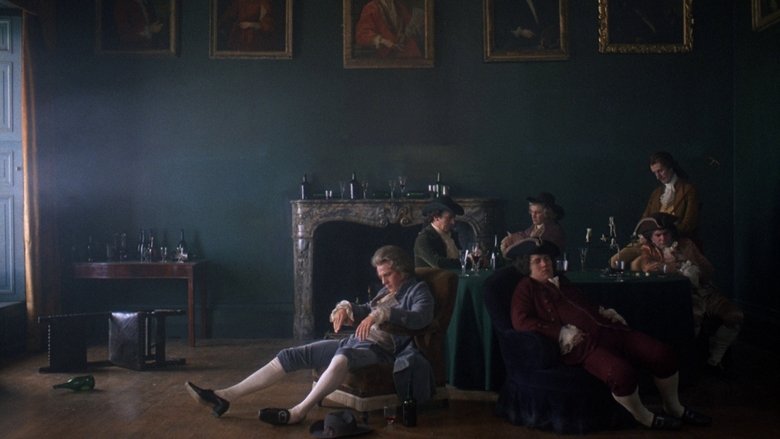
The film's composition, often resembling 18th-century paintings (notably by artists like William Hogarth), symbolizes the static and fated nature of the characters' lives. The characters appear as figures trapped within a meticulously crafted frame, their actions part of a pre-existing, unchangeable tapestry of history. The painterly aesthetic creates emotional distance, encouraging the viewer to observe the characters' lives as historical artifacts rather than engage with them emotionally.
Numerous scenes are deliberately framed as living paintings, with long, static shots and slow, deliberate zooms. From the landscapes of Ireland to the opulent interiors of English manors, the cinematography transforms the settings into works of art. This is particularly evident in the card-playing scenes and formal gatherings, where characters are arranged in carefully composed tableaux.
Candlelight
The extensive use of candlelight symbolizes the fleeting nature of beauty, fortune, and life itself. It represents the pre-electric era's natural, fragile beauty, while also hinting at the darkness and decay that is ever-present just beyond the flickering flame. It underscores the impermanence of Barry's success and the transient world he inhabits.
Kubrick famously used special, ultra-fast f/0.7 lenses developed for NASA to film entire scenes lit only by candlelight. These scenes, particularly the intimate dinners and gambling sequences with Lady Lyndon, are bathed in a warm, soft, and ephemeral glow that would have been impossible to achieve with conventional lighting, creating a uniquely authentic and symbolic visual texture.
Card Games
Card games are a recurring motif that symbolizes the roles of chance, deception, and social maneuvering in Barry's life. His skill as a gambler, both literally at the card table and metaphorically in his social climbing, is central to his rise. The games represent the high-stakes risks he takes to improve his station, where fortune can turn on the flip of a card.
Barry's life is punctuated by card games. He flirts with his cousin Nora over cards at the beginning. He hones his skills as a professional gambler with the Chevalier, cheating aristocrats across Europe. It is through gambling that he first encounters and attracts the attention of Lady Lyndon. After his fall, he returns to his old profession, but without his former success.
Philosophical Questions
To what extent do we control our own destiny, and how much is dictated by fate and chance?
Barry Lyndon relentlessly explores this question through its narrative structure. The omniscient narrator consistently tells the audience what will happen, suggesting a deterministic universe where the characters' struggles are futile. Barry makes active choices to advance his station, but his rise and fall are also punctuated by incredible strokes of luck and misfortune—a staged duel, a chance encounter, a misfired pistol. The film ultimately posits that while individuals strive and make choices, their lives are shaped by forces far beyond their control, with the finality of death rendering all their efforts equal.
What is the true nature of happiness and success?
The film serves as a cautionary tale against defining success purely in terms of wealth and social status. Barry achieves everything he desires: he becomes a nobleman, possesses immense wealth, and lives in luxury. Yet, his marriage is miserable, he is socially ostracized, and he finds no lasting contentment. The only period of genuine, uncomplicated happiness the film shows is the time Barry spends with his young son, Bryan. This suggests that true fulfillment comes from sincere human connection, not from the empty pursuit of ambition and material possessions. Barry's ultimate ruin is a powerful statement on the hollowness of a life spent chasing superficial rewards.
Can a person ever truly escape their origins?
Despite acquiring the name, title, and wealth of an aristocrat, Redmond Barry is never fully accepted. He is consistently viewed as an "Irish upstart" by the established nobility, especially his stepson. His manners, temper, and instincts betray his origins. The film suggests that social class is an almost inescapable construct, defined not just by wealth but by birth, breeding, and an innate understanding of its codes. Barry's failure to maintain his position implies that one cannot simply perform aristocracy; it must be inherent. His journey is a tragic testament to the rigid social structures of the era and the difficulty of transcending one's roots.
Core Meaning
At its core, Barry Lyndon is a profound meditation on the vanity of human ambition and the transient nature of fortune within a deterministic universe. Stanley Kubrick uses the life of Redmond Barry as a canvas to explore the idea that an individual's struggle for status, wealth, and happiness is ultimately insignificant in the grand, indifferent sweep of history. The film suggests that while Barry makes choices that propel his rise and orchestrate his fall, his destiny is largely preordained, a concept underscored by the narrator's fatalistic commentary.
Kubrick's message is crystallized in the film's final epilogue: "It was in the reign of George III that the aforesaid personages lived and quarrelled; good or bad, handsome or ugly, rich or poor, they are all equal now." This serves as the ultimate statement on the futility of worldly concerns. Social hierarchies, personal triumphs, and bitter rivalries are all rendered meaningless by the great equalizer, death. The film is not merely a critique of a specific historical aristocracy but a broader philosophical statement on the human condition, questioning the meaning of a life spent in pursuit of ephemeral gains.