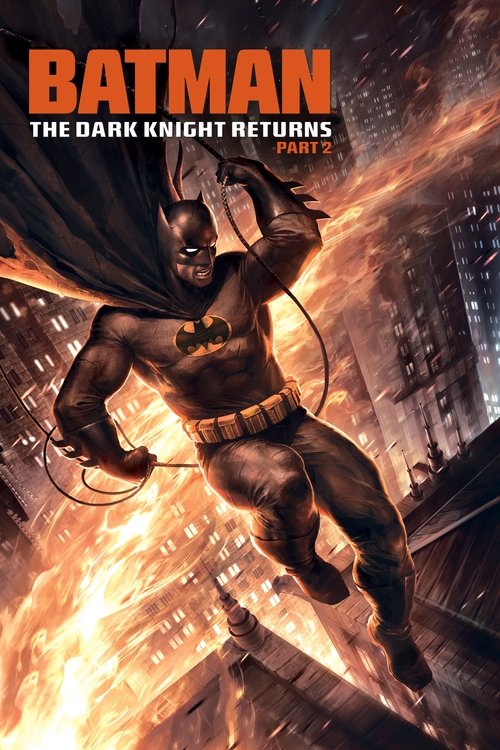
Batman: The Dark Knight Returns, Part 2
A dark, Reagan-era political thriller unleashes an aging, brutal Batman against a chaotic world, culminating in a clash of ideologies that feels both apocalyptic and deeply personal.
Batman: The Dark Knight Returns, Part 2

"Justice returns... vengeance returns... redemption comes to Gotham."

03 January 2013 United States of America 78 min ⭐ 7.9 (1,546)
Director: Jay Oliva
Cast: Peter Weller, Ariel Winter, David Selby, Michael Emerson, Mark Valley
Animation Action Mystery Science Fiction
Ideological Conflict: Man vs. God Order vs. Chaos Media and Public Perception Aging and Legacy
Budget: $3,500,000

Batman: The Dark Knight Returns, Part 2 - Ending Explained

⚠️ Spoiler Analysis

Batman: The Dark Knight Returns, Part 2 culminates in two definitive, violent showdowns. The first is with the Joker, who after being awakened by Batman's return, goes on a murderous rampage at a TV studio and a county fair. During their final fight in a Tunnel of Love, Batman, pushed to his absolute limit by the Joker's atrocities, paralyzes him but cannot bring himself to deliver the final blow. In a last, twisted act of victory, the Joker mocks Batman's morality and snaps his own neck, successfully framing Batman for his murder.

This act forces the government's hand, and Superman is sent to arrest Batman. Their climactic battle takes place in Crime Alley. Batman, using a powerful exo-suit and a series of brilliant traps, systematically dismantles Superman's strength, culminating in a blast from a Kryptonite arrow fired by a one-armed Oliver Queen. Just as he defeats a weakened Superman, Bruce Wayne's heart gives out, and he seemingly dies. However, this is all part of his master plan. At his funeral, Clark Kent hears a faint heartbeat from the coffin and chooses to ignore it. Bruce Wayne has faked his death to go underground, where, with Carrie Kelley and his new army of followers, he will continue his war on crime from the shadows, free from government interference, transforming the legend of Batman into an enduring revolutionary movement.

Alternative Interpretations

One of the most debated interpretations of the film revolves around Batman's political ideology. Some critics view his actions—imposing his own law, creating a private army, and rejecting government authority—as a form of fascism. This reading suggests Batman is an anti-authoritarian figure only when he is not the one in charge. His methods are brutal, his justice swift, and he ultimately seizes control of the city.

Conversely, another interpretation sees Batman as a revolutionary libertarian. He stands against a corrupt, overreaching government (represented by Reagan and Superman) that has abandoned its citizens. In this view, his actions are not about seizing power for himself but about creating a new, more just society from the ground up after the old one has failed. His faked death and move underground are seen as a rejection of authoritarian control in favor of a grassroots movement. The ending can be interpreted as either the birth of a new form of fascism or the start of a true revolution to restore power to the people of Gotham.