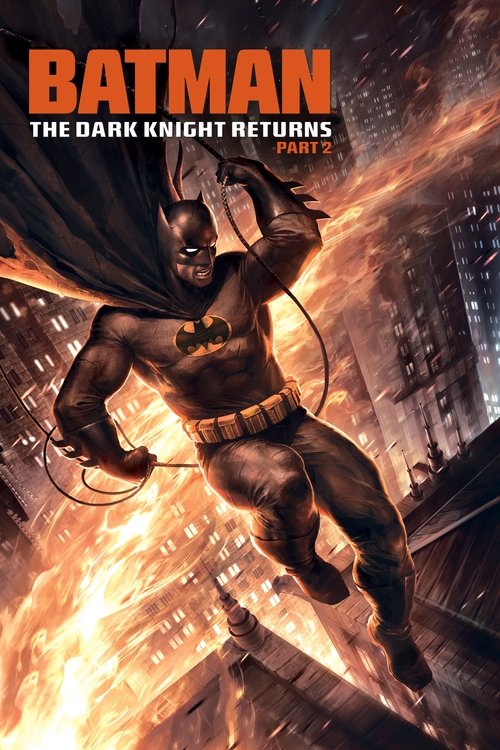
Batman: The Dark Knight Returns, Part 2
"Justice returns... vengeance returns... redemption comes to Gotham."
Overview
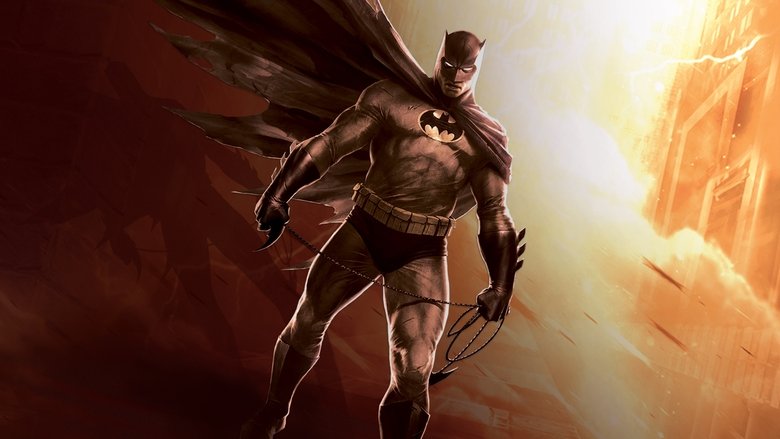
Picking up months after the first part, Batman: The Dark Knight Returns, Part 2 finds an older Bruce Wayne re-established as Gotham's grim protector, with a new Robin, Carrie Kelley, by his side. His resurgence, however, awakens his greatest nemesis, the Joker, from a catatonic state, leading to a horrifyingly public and final confrontation.
Simultaneously, Batman's brutal methods have drawn the ire of the U.S. Government. President Ronald Reagan, viewing Batman as a dangerous symbol of anarchy, dispatches the ultimate government operative—Superman—to bring the Dark Knight to heel. This sets the stage for a climactic, ideological battle between the two former allies, fought amidst a brewing Cold War crisis and a Gotham teetering on the edge of becoming a lawless state.
Core Meaning
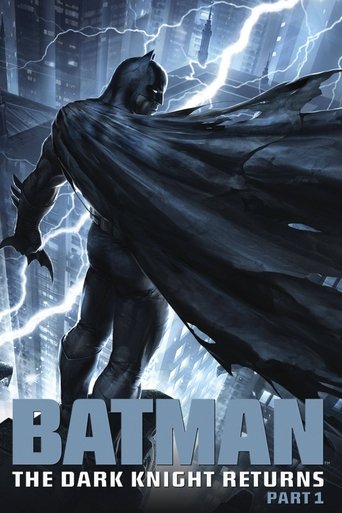
The core meaning of Batman: The Dark Knight Returns, Part 2 revolves around the clash between individualistic, uncompromising justice and state-sanctioned order. The film questions the nature of heroism in a decaying society, asking whether a hero should operate outside the law to be effective or submit to a flawed system for the sake of stability. Batman represents a rugged, almost anarchic form of justice, believing the established authority is impotent, while Superman embodies order and subservience to the government, even when its motives are questionable. Ultimately, the film suggests that true change requires rebellion against corrupt systems, with Batman's 'death' and rebirth as an underground leader symbolizing that a legend must endure beyond one man to inspire a true revolution against apathy and corruption.
Thematic DNA
Ideological Conflict: Man vs. God
The central conflict is the ideological war between Batman and Superman. Batman, a mortal man, uses his intellect, strategy, and sheer brutality to fight a corrupt world on his own terms. Superman, a god-like being, has become a tool of a flawed government, representing compromised power and order. Their final battle is not just a physical brawl but a philosophical debate on freedom versus security and whether humanity needs saviors who operate within the system or those who tear it down.
Order vs. Chaos
This theme is explored through two primary conflicts. First, the symbiotic relationship between Batman and the Joker. Batman's return awakens the Joker, who seeks to engage his old foe in a final, deadly dance of chaos. The Joker represents pure, motiveless anarchy, a force that exists only to challenge Batman's rigid, self-imposed order. Secondly, after a national EMP blast, Batman imposes his own brutal form of order on Gotham, turning it into the safest city in a chaotic country, directly challenging the government's inability to maintain control.
Media and Public Perception
The film heavily satirizes 1980s media culture. Television screens are ever-present, with talking heads debating Batman's morality, psychologists defending the Joker, and news reports sensationalizing the violence. The media shapes the public's divided opinion, portraying Batman as both a savior and a menace. The Joker masterfully manipulates this, using a late-night talk show for his most horrific public murder spree, highlighting the media's role as a platform for, and sometimes an accomplice to, chaos.
Aging and Legacy
Bruce Wayne is an old, weary man who relies on technology and sheer willpower to continue his crusade. The film constantly reminds the audience of his physical limitations. His fight is not just against crime but against his own mortality. By taking on Carrie Kelley as Robin, faking his death, and creating an underground army, he secures his legacy. It's no longer about one man; it's about ensuring the symbol of Batman becomes an enduring force for justice, passed on to a new generation.
Character Analysis
Bruce Wayne / Batman
Peter Weller
Motivation
His primary motivation is to impose a functioning order on a world he sees as given over to chaos and corruption. He is driven by guilt over past failures, such as the death of Jason Todd, and a profound sense that the official systems of justice are fundamentally broken. He believes that only extreme, uncompromising methods can save Gotham.
Character Arc
Batman begins as a brutal, aging vigilante reclaiming his city. His initial actions are driven by a personal need to restore order. As he faces his old nemesis, the Joker, and the government's opposition in the form of Superman, his mission evolves. He transitions from a lone crime-fighter to a general. After faking his death, he embraces his role as a revolutionary leader, ready to train a new generation to continue the fight from the shadows, ensuring his war on crime becomes a lasting legacy.
The Joker
Michael Emerson
Motivation
The Joker's sole motivation is Batman. He doesn't want money or power; he wants to prove a philosophical point. He thrives on their symbiotic relationship and seeks to orchestrate a grand finale that will define them both forever. His actions are designed to cause maximum chaos and to force Batman to break his one rule. As he tells Batman, "I never kept count [of the victims]... I know [you did]. And I love you for it."
Character Arc
The Joker's arc is a flat circle of obsession. He is catatonic until Batman's return gives him a reason to exist again. He doesn't evolve; he simply escalates. His entire purpose is to engage Batman in a final, deadly performance. His arc concludes with the only logical end for their relationship: a murder-suicide pact where he ensures his own death will be Batman's ultimate moral stain, his final 'joke' on his nemesis.
Clark Kent / Superman
Mark Valley
Motivation
Superman is motivated by a sense of duty to the established order and the American government, which he now serves. He believes that superheroes cannot operate outside the law and that Batman's actions threaten global stability. He acts not out of malice but out of a conviction that he is preventing a greater crisis, even if it means fighting an old friend.
Character Arc
Superman begins as the government's perfect, powerful weapon, a figure who has traded his autonomy for the perceived greater good of national stability. He is sent to stop his old friend, believing it's a regrettable but necessary duty. His confrontation with Batman, and Batman's apparent death, forces him to confront the moral compromises he has made. In the end, he subtly allows Bruce Wayne to live, showing a flicker of his old self and suggesting an internal conflict that is far from resolved.
Carrie Kelley / Robin
Ariel Winter
Motivation
Carrie is motivated by a deep admiration for Batman and a desire to make a difference in a city her absentee parents have ignored. She sees the good Batman represents and is determined to be a part of it. Her loyalty and bravery are unwavering, driven by a youthful idealism that contrasts with Batman's cynicism.
Character Arc
In Part 1, Carrie forces her way into the role of Robin. In Part 2, she grows into a capable and essential partner for Batman. She proves her worth not just as a sidekick but as a soldier, following orders and executing key parts of Batman's strategy against both the Joker and Superman. Her arc is one of maturation, culminating in her becoming a trusted lieutenant in Batman's new underground army, representing the future of his legacy.
Symbols & Motifs
The Bat-Symbol
It symbolizes fear, order, and ultimately, revolution. Initially, its return is a terrifying omen for criminals. As Batman restores a semblance of order to Gotham, it becomes a symbol of hope and defiance for the downtrodden. By the end, when his followers adopt it, the symbol has transformed into the mark of an underground revolutionary movement, independent of the man himself.
The symbol is seen throughout the film: on Batman's chest, projected in the sky (unofficially), and adopted by the 'Sons of Batman' gang he co-opts. Its meaning shifts from a personal brand of vigilantism to a public symbol of rebellion.
Superman as a Government Tool
Superman symbolizes compromised ideals and the co-opting of power by the state. Once a beacon of independent justice, he has become an agent of the Reagan administration, used to enforce its will globally. He represents the loss of superheroic autonomy and the moral grayness that comes with serving a political agenda, a direct foil to Batman's fierce independence.
This is shown when Reagan asks Superman to deal with the 'Batman problem' and when Superman is deployed to fight in the Corto Maltese conflict. His dialogue with Batman before their fight explicitly frames him as an enforcer for the established authority.
The Joker's Final Act
The Joker's suicide—snapping his own neck to frame Batman for his murder—symbolizes his ultimate victory in their twisted relationship. His goal was always to prove that Batman was just as chaotic as him and to push him over the edge. By forcing Batman to nearly kill him and then finishing the job himself, he ensures Batman will be hunted as a murderer, forever tainting his moral code in the eyes of the world. It's an act of pure, nihilistic love for their rivalry.
In the 'Tunnel of Love' at a county fair, after Batman paralyzes him but refuses to kill him, the Joker laughs and twists his own spine, dying with a final smile. This scene is the horrific culmination of their decades-long battle.
Memorable Quotes
Tonight, we are the law. Tonight, I am the law.
— Batman
Context:
Batman says this to the newly recruited members of the 'Sons of Batman' gang after the EMP blast plunges Gotham into darkness. He is deputizing them into his personal army to restore order on his terms.
Meaning:
This quote encapsulates Batman's entire philosophy in the film. He has completely rejected the legitimacy of the official legal system and has positioned himself as the sole arbiter of justice in Gotham. It is an unapologetic declaration of his authoritarian approach to crime-fighting.
I want you to remember, Clark. In all the years to come, in your most private moments, I want you to remember my hand at your throat. I want you to remember the one man who beat you.
— Batman
Context:
Spoken by a seemingly dying Batman at the climax of his brutal fight with Superman, just as he has him beaten. He fakes a fatal heart attack moments later, leaving these words as his apparent last will and testament to his rival.
Meaning:
This is Batman's ultimate psychological victory over Superman. More than just winning the physical fight, he needed to permanently shatter Superman's perception of superiority. It's a brutal assertion that humanity, with its cunning and will, can triumph over god-like power, a lesson he wants to haunt Superman forever.
All the people I've murdered... by letting you live.
— Batman
Context:
Batman says this to the Joker during their final, bloody confrontation in the Tunnel of Love, expressing the weight of all the Joker's victims for whom he feels responsible.
Meaning:
This line reveals the immense guilt and psychological toll Batman's 'one rule' has taken on him. He finally accepts responsibility not just for his actions, but for his inaction, acknowledging that his refusal to kill the Joker has enabled countless deaths over the years. It marks a shift in his code, as he is now prepared to end the Joker permanently.
It doesn't matter. It's their world, and they won't stand for you anymore. If it isn't me, it'll just be someone else.
— Superman
Context:
Superman says this to Batman in Crime Alley just before their epic battle, trying to reason with him and explain that the government will not stop hunting him.
Meaning:
This quote highlights Superman's resignation and his role as an instrument of the state. He is no longer an independent moral agent but an enforcer of the established power structure. He is warning Batman that the system itself, not just Superman personally, has deemed him obsolete and dangerous.
Philosophical Questions
Does the end justify the means?
The film relentlessly explores this question through Batman's actions. He uses brutal, often illegal, methods to bring order to Gotham. While he successfully reduces crime and makes the city safe when the rest of the country is in chaos, he does so by operating as a dictator. The film forces the audience to question whether the peace and safety he achieves are worth the moral cost of his authoritarian tactics. Is a safe city under a vigilante's iron fist preferable to a chaotic city with a broken legal system?
What is the role of a hero in a flawed society?
The core conflict between Batman and Superman presents two opposing answers. Superman believes a hero must work within the system, accepting its flaws and limitations to maintain stability and public trust. He becomes an agent of the state. Batman believes that when the system itself is corrupt and ineffective, a true hero must stand outside of it, becoming a criminal in the eyes of the law to enact true justice. The film asks whether a hero's primary duty is to the law or to justice, especially when the two are not aligned.
Can order exist without sacrificing freedom?
This question is posed by the government's ban on superheroes and Superman's role as their enforcer. The authorities decided that the unpredictable nature of independent heroes (freedom) was too great a threat to national security (order). Batman's subsequent actions in Gotham mirror this dilemma. He creates a perfectly ordered city, but does so by turning a street gang into his personal army and declaring himself 'the law.' The film suggests a perpetual tension between the desire for safety and the preservation of individual liberty.
Alternative Interpretations
One of the most debated interpretations of the film revolves around Batman's political ideology. Some critics view his actions—imposing his own law, creating a private army, and rejecting government authority—as a form of fascism. This reading suggests Batman is an anti-authoritarian figure only when he is not the one in charge. His methods are brutal, his justice swift, and he ultimately seizes control of the city.
Conversely, another interpretation sees Batman as a revolutionary libertarian. He stands against a corrupt, overreaching government (represented by Reagan and Superman) that has abandoned its citizens. In this view, his actions are not about seizing power for himself but about creating a new, more just society from the ground up after the old one has failed. His faked death and move underground are seen as a rejection of authoritarian control in favor of a grassroots movement. The ending can be interpreted as either the birth of a new form of fascism or the start of a true revolution to restore power to the people of Gotham.
Cultural Impact
Batman: The Dark Knight Returns, both the original 1986 graphic novel and this faithful animated adaptation, had a profound cultural impact. Frank Miller's story is credited with ushering in the 'Dark Age of Comic Books,' redefining Batman from the campy 1960s figure to the dark, psychologically complex, and gritty character that dominates modern interpretations. Its influence is immense, with nearly every subsequent Batman film, including Christopher Nolan's trilogy and Zack Snyder's DCEU, borrowing thematic and visual elements.
The animated film itself is regarded as one of the best DC Universe Animated Original Movies, praised for its loyalty to the source material and its mature, uncompromising tone. The iconic showdown between Batman and Superman in the film directly inspired the climactic battle in Snyder's Batman v Superman: Dawn of Justice. The movie solidified the idea of an older, more brutal Batman in the public consciousness and served as a benchmark for what a faithful comic-to-screen adaptation could achieve in animation.
Audience Reception
Audience reception for Batman: The Dark Knight Returns, Part 2 was overwhelmingly positive, with many fans considering it one of the best, if not the best, of the DC animated films. Viewers universally praised its faithfulness to the iconic source material, often quoting the dialogue verbatim from the comic. The action sequences, particularly the brutal final confrontations between Batman and the Joker, and Batman and Superman, were highlighted as cinematic and thrilling. The voice acting was also a high point, with Peter Weller's grim portrayal of an old Batman and Michael Emerson's subtly chilling Joker receiving significant acclaim. While a few viewers found the Cold War subplot a bit dated, the majority felt the film was a masterful and powerful adaptation of a legendary story.
Interesting Facts
- The film is a highly faithful, two-part adaptation of Frank Miller's seminal 1986 graphic novel of the same name.
- Director Jay Oliva also worked as a storyboard artist on several live-action DC films, including *Man of Steel* and *Batman v Superman: Dawn of Justice*, the latter of which borrows heavily from *The Dark Knight Returns*.
- The voice of the Joker, Michael Emerson, is widely known for his role as Benjamin Linus on the TV show *LOST*. His portrayal was noted for being more subtle, creepy, and less theatrical than Mark Hamill's iconic animated Joker.
- Peter Weller, the voice of Batman, is famous for his starring role as RoboCop, another character who dispenses brutal justice.
- The omission of Batman's internal monologue, a key feature of the graphic novel, was a major creative choice. While some of it was missed in Part 1, critics generally agreed that Part 2 worked better without it, letting the action and dialogue carry the story.
- The animated art style meticulously recreates the distinctive, gritty visual aesthetic of Frank Miller and Klaus Janson's original comic panels.
Easter Eggs
In the Batcave, the Batmobile that Bruce Wayne lifts is the design from Tim Burton's 1989 *Batman* and 1992 *Batman Returns* films.
This is a visual homage to a previous, iconic cinematic incarnation of the character, connecting this grim, future version of Batman to his popular live-action history.
Talk show host David Endocrine is voiced by real-life talk show host Conan O'Brien.
This is a meta-casting gag, having a famous late-night host voice the fictional host who becomes a victim of the Joker's most public and gruesome attack.
During the final battle, Oliver Queen (Green Arrow) uses a Kryptonite-tipped arrow to weaken Superman.
This is a direct pull from the comic and a classic element of the Batman/Superman rivalry. The fact that Batman had this failsafe prepared and entrusted it to his old ally Oliver Queen showcases his strategic mind and deep-seated distrust of Superman's unchecked power.
⚠️ Spoiler Analysis
Click to reveal detailed analysis with spoilers
Frequently Asked Questions
Explore More About This Movie
Dive deeper into specific aspects of the movie with our detailed analysis pages
Comments (0)
No comments yet. Be the first to share your thoughts!