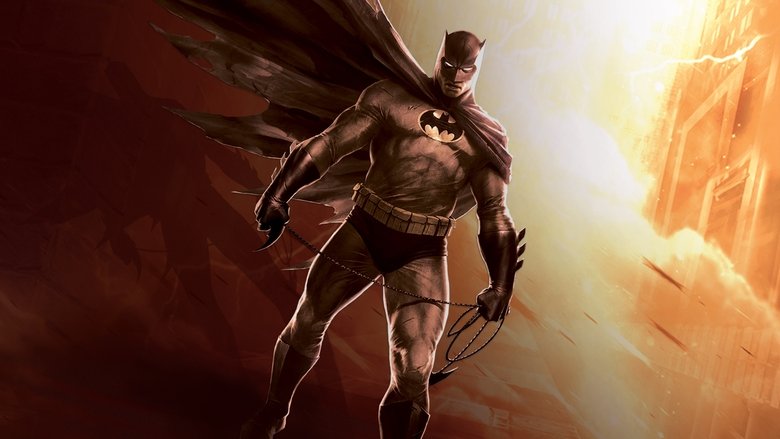
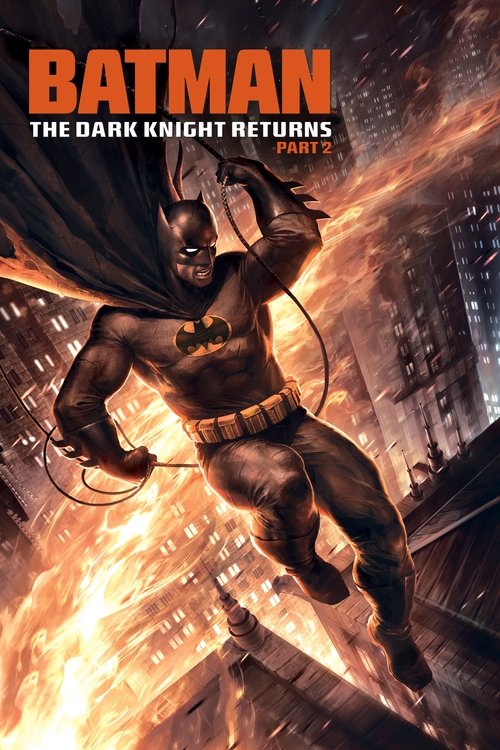
"Justice returns... vengeance returns... redemption comes to Gotham."
Batman: The Dark Knight Returns, Part 2 - Symbolism & Philosophy
Symbols & Motifs
The Bat-Symbol
It symbolizes fear, order, and ultimately, revolution. Initially, its return is a terrifying omen for criminals. As Batman restores a semblance of order to Gotham, it becomes a symbol of hope and defiance for the downtrodden. By the end, when his followers adopt it, the symbol has transformed into the mark of an underground revolutionary movement, independent of the man himself.
The symbol is seen throughout the film: on Batman's chest, projected in the sky (unofficially), and adopted by the 'Sons of Batman' gang he co-opts. Its meaning shifts from a personal brand of vigilantism to a public symbol of rebellion.
Superman as a Government Tool
Superman symbolizes compromised ideals and the co-opting of power by the state. Once a beacon of independent justice, he has become an agent of the Reagan administration, used to enforce its will globally. He represents the loss of superheroic autonomy and the moral grayness that comes with serving a political agenda, a direct foil to Batman's fierce independence.
This is shown when Reagan asks Superman to deal with the 'Batman problem' and when Superman is deployed to fight in the Corto Maltese conflict. His dialogue with Batman before their fight explicitly frames him as an enforcer for the established authority.
The Joker's Final Act
The Joker's suicide—snapping his own neck to frame Batman for his murder—symbolizes his ultimate victory in their twisted relationship. His goal was always to prove that Batman was just as chaotic as him and to push him over the edge. By forcing Batman to nearly kill him and then finishing the job himself, he ensures Batman will be hunted as a murderer, forever tainting his moral code in the eyes of the world. It's an act of pure, nihilistic love for their rivalry.
In the 'Tunnel of Love' at a county fair, after Batman paralyzes him but refuses to kill him, the Joker laughs and twists his own spine, dying with a final smile. This scene is the horrific culmination of their decades-long battle.
Philosophical Questions
Does the end justify the means?
The film relentlessly explores this question through Batman's actions. He uses brutal, often illegal, methods to bring order to Gotham. While he successfully reduces crime and makes the city safe when the rest of the country is in chaos, he does so by operating as a dictator. The film forces the audience to question whether the peace and safety he achieves are worth the moral cost of his authoritarian tactics. Is a safe city under a vigilante's iron fist preferable to a chaotic city with a broken legal system?
What is the role of a hero in a flawed society?
The core conflict between Batman and Superman presents two opposing answers. Superman believes a hero must work within the system, accepting its flaws and limitations to maintain stability and public trust. He becomes an agent of the state. Batman believes that when the system itself is corrupt and ineffective, a true hero must stand outside of it, becoming a criminal in the eyes of the law to enact true justice. The film asks whether a hero's primary duty is to the law or to justice, especially when the two are not aligned.
Can order exist without sacrificing freedom?
This question is posed by the government's ban on superheroes and Superman's role as their enforcer. The authorities decided that the unpredictable nature of independent heroes (freedom) was too great a threat to national security (order). Batman's subsequent actions in Gotham mirror this dilemma. He creates a perfectly ordered city, but does so by turning a street gang into his personal army and declaring himself 'the law.' The film suggests a perpetual tension between the desire for safety and the preservation of individual liberty.
Core Meaning
The core meaning of Batman: The Dark Knight Returns, Part 2 revolves around the clash between individualistic, uncompromising justice and state-sanctioned order. The film questions the nature of heroism in a decaying society, asking whether a hero should operate outside the law to be effective or submit to a flawed system for the sake of stability. Batman represents a rugged, almost anarchic form of justice, believing the established authority is impotent, while Superman embodies order and subservience to the government, even when its motives are questionable. Ultimately, the film suggests that true change requires rebellion against corrupt systems, with Batman's 'death' and rebirth as an underground leader symbolizing that a legend must endure beyond one man to inspire a true revolution against apathy and corruption.