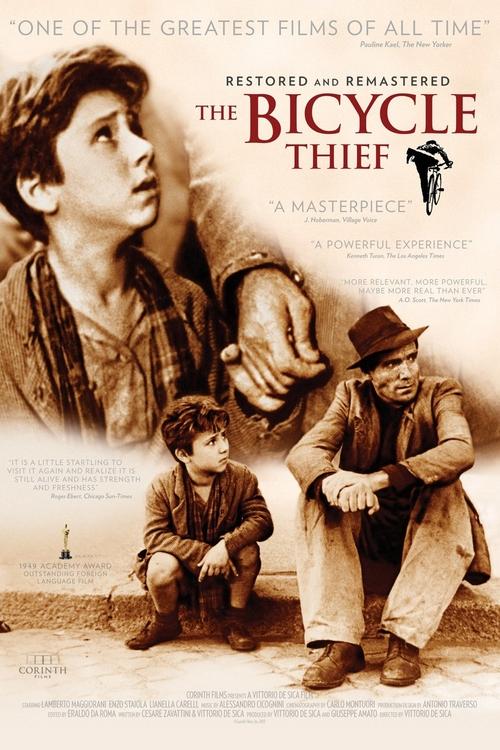
Ladri di biciclette
"The Prize Picture They Want to Censor!"
Bicycle Thieves - Symbolism & Philosophy
Symbols & Motifs
The Bicycle
The bicycle is the film's central and most powerful symbol. It represents hope, dignity, employment, and the possibility of social mobility for Antonio and his family. It is the key to his ability to work and provide, literally supporting his family. When stolen, it symbolizes the theft of his future, his dignity, and his family's survival, representing the crushing power of a society that can take everything from a man in an instant.
The film revolves entirely around the bicycle. Antonio's joy at retrieving it from the pawnshop, its theft on his first day of work, and the subsequent desperate search for it drive the entire narrative. The final scene, where Antonio attempts to steal another bicycle, brings the symbol full circle, showing how its loss has transformed him.
Crowds
Crowds appear throughout the film and represent the indifference and potential hostility of society. While composed of individuals also facing hardship, the crowds offer no solidarity to Antonio. They are either apathetic observers or an accusatory mob, as seen when they protect the actual thief and later apprehend Antonio. The crowd symbolizes the facelessness of the city, where an individual's struggle is easily lost and ignored.
The film opens with a crowd of jobless men seeking work. Crowds are present at the markets, outside the church, and most menacingly, in the thief's neighborhood where they protect him. The film ends with Antonio and Bruno disappearing back into another anonymous crowd, their individual tragedy unresolved and absorbed by the city.
The Rita Hayworth Poster
The poster of the glamorous American actress Rita Hayworth, which Antonio is pasting when his bike is stolen, symbolizes the vast gulf between the fantasy of Hollywood cinema and the grim reality of post-war Italy. It's an ironic commentary on the disconnect between mass entertainment and the real-life struggles of the people consuming it.
This symbol appears at the pivotal moment of the theft. Antonio is literally working to spread an image of unobtainable glamour and wealth at the exact moment his own fragile hope for a modest living is stolen from him.
Antonio's Hat
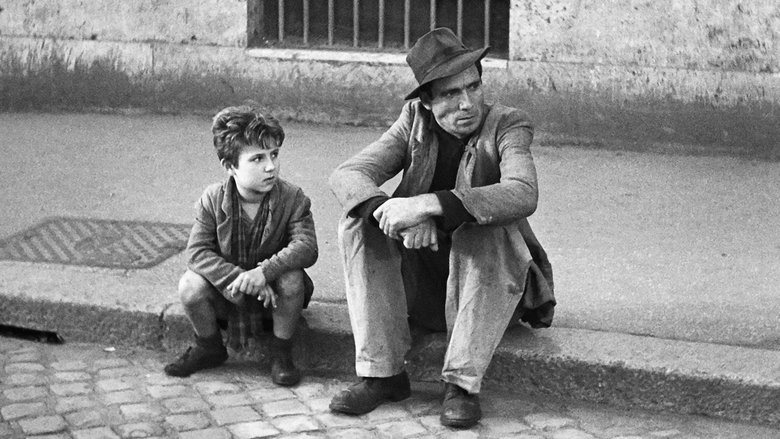
Antonio's hat represents his dignity and social standing. When he has the job, he wears his cap with pride. The act of it being knocked off his head when he is caught stealing at the end signifies his complete loss of dignity and self-respect in front of his son and the world.
He proudly wears his work hat at the start of his job. In the final scene, after he attempts to steal a bicycle, the owner confronts him and slaps the hat from his head, a moment of profound humiliation.
Philosophical Questions
Does systemic poverty inevitably lead to a loss of morality?
The film relentlessly explores this question through Antonio's tragic arc. Initially a man with a strong moral compass, his descent into desperation directly correlates with his encounters with a society that offers him no help or justice. De Sica suggests that morality might be a luxury that the desperately poor cannot afford. When institutions fail and survival is at stake, the innate drive to provide for one's family can overpower abstract ethical principles. Antonio's final, shameful act of theft is not portrayed as an evil choice, but as the heartbreaking, logical endpoint of a man stripped of all other options by an unjust system.
What is the nature of justice in an indifferent society?
"Bicycle Thieves" presents a world where official justice is unattainable for the poor. The police are powerless or apathetic, telling Antonio his problem is one among thousands. The community, rather than enforcing a collective sense of right and wrong, protects its own, even the guilty. Antonio's quest is for a personal, elemental justice—the return of what is rightfully his. The film bleakly concludes that in such a society, there is no justice to be found, only the raw consequences of power dynamics. The only "mercy" Antonio receives comes not from an institution, but from another individual who sees his shame and his son's tears.
Can dignity coexist with extreme poverty?
Antonio's entire struggle is a fight to maintain his dignity. The job, and the bicycle that enables it, is his means of achieving self-respect as a provider. Throughout the film, he is subjected to a series of humiliations: being dismissed by the police, accused by the crowd, and ultimately, being caught as a thief. The film posits that while the human spirit strives for dignity, systemic poverty is a relentless force that actively strips it away. The final scene, where Antonio weeps in shame, suggests a devastating loss of dignity, yet his son's unwavering loyalty offers a small, poignant glimmer of humanity that endures even after dignity is seemingly lost.
Core Meaning
The core message of "Bicycle Thieves" is a profound commentary on the dehumanizing effects of poverty and the indifference of society in post-war Italy. Director Vittorio De Sica intended to portray the harsh realities of working-class life, where the loss of a simple object like a bicycle can trigger a devastating crisis, stripping a man of his dignity and ability to provide for his family. The film argues that in a system where survival is a daily struggle, the line between victim and perpetrator becomes tragically blurred. It's a critique of a society that fails its most vulnerable members, leaving them isolated and forced into impossible moral compromises. The film's power lies in its assertion that individual struggles are part of a larger, systemic problem of social and economic inequality.