Bicycle Thieves
A neorealist odyssey through post-war Rome, this drama captures the crushing weight of poverty and a father's desperate hope, mirrored in the glint of bicycle spokes.
Bicycle Thieves

Bicycle Thieves

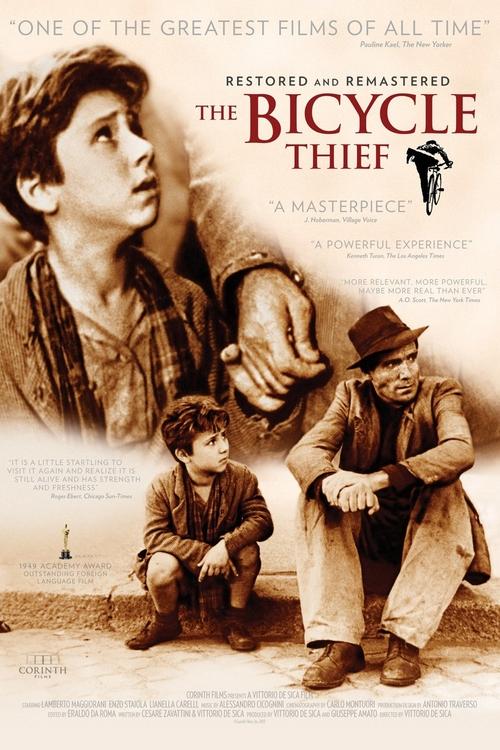
Ladri di biciclette

"The Prize Picture They Want to Censor!"

21 July 1948 Italy 89 min ⭐ 8.2 (2,535)
Director: Vittorio De Sica
Cast: Lamberto Maggiorani, Enzo Staiola, Lianella Carell, Gino Saltamerenda, Vittorio Antonucci
Drama
Poverty and Desperation Father-Son Relationship Social Injustice and Institutional Failure The Erosion of Morality
Budget: $133,000
Box Office: $450,159

Overview

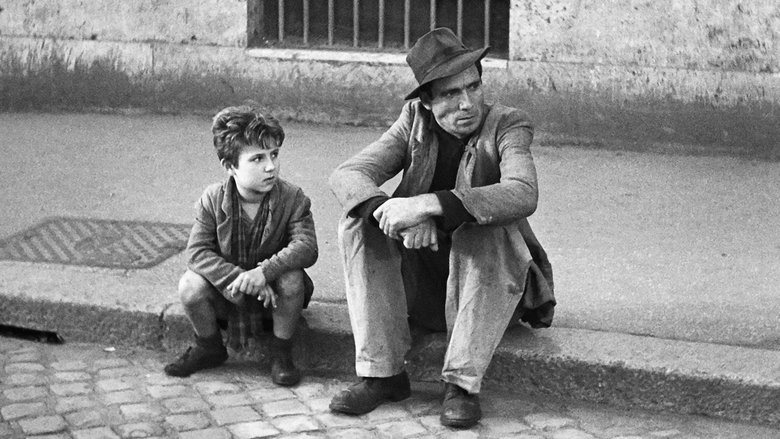
Set in the economically depressed landscape of post-World War II Rome, "Bicycle Thieves" follows the poignant story of Antonio Ricci, a man who has been unemployed for a long time. He is finally offered a job pasting advertising posters, but it requires him to have a bicycle. His wife, Maria, pawns their prized bedsheets—a significant sacrifice for a poor family—to redeem his bicycle from the pawnshop.

On his very first day of work, while Antonio is on a ladder putting up a Rita Hayworth poster, a young man steals his bicycle. Antonio's desperate chase is futile. With the police offering little help, Antonio and his young son, Bruno, embark on a frantic journey through the sprawling city of Rome to find the stolen bicycle. Their search takes them through markets, churches, and hostile neighborhoods, exposing the widespread poverty and moral ambiguity of the era. It's a simple story that masterfully explores profound themes of desperation, dignity, and the fragile bond between a father and son pushed to their limits.
Core Meaning

The core message of "Bicycle Thieves" is a profound commentary on the dehumanizing effects of poverty and the indifference of society in post-war Italy. Director Vittorio De Sica intended to portray the harsh realities of working-class life, where the loss of a simple object like a bicycle can trigger a devastating crisis, stripping a man of his dignity and ability to provide for his family. The film argues that in a system where survival is a daily struggle, the line between victim and perpetrator becomes tragically blurred. It's a critique of a society that fails its most vulnerable members, leaving them isolated and forced into impossible moral compromises. The film's power lies in its assertion that individual struggles are part of a larger, systemic problem of social and economic inequality.

Thematic DNA

Poverty and Desperation 35%
Father-Son Relationship 30%
Social Injustice and Institutional Failure 20%
The Erosion of Morality 15%

Poverty and Desperation

This is the central theme, running through nearly every scene. The film depicts the grim reality of post-war Italy, where unemployment is rampant and survival is a daily struggle. Antonio's family must sacrifice their bedsheets, a symbol of their home and comfort, just for the chance of a job. The bicycle isn't a luxury; it's the essential tool for his livelihood, and its theft plunges him and his family into absolute desperation, forcing Antonio to confront impossible moral choices.

Father-Son Relationship

The emotional core of the film is the evolving relationship between Antonio and his young son, Bruno. Bruno is not just a child but also a working contributor to the family and his father's companion in the desperate search. He witnesses his father's growing frustration, humiliation, and eventual moral collapse. The journey tests their bond, especially in the final act, where Antonio's shame in front of his son becomes the ultimate punishment. Their final, silent walk, holding hands, signifies a shared understanding and resilience in the face of devastating defeat.

Social Injustice and Institutional Failure

"Bicycle Thieves" is a sharp critique of the institutions that fail the common man. The police are bureaucratic and indifferent, unable to help with a "minor" crime that is life-altering for Antonio. The church offers no real sanctuary, and crowds often turn into hostile mobs rather than supportive communities. De Sica shows a society where individuals are isolated and cannot rely on larger forces for justice or support, reflecting a Marxist perspective that the individual is often crushed by societal structures.

The Erosion of Morality

The film explores how desperation can corrupt an honest man. Antonio starts as a proud, moral father determined to work for his family. As his search becomes more hopeless and he is met with indifference and hostility, his moral compass begins to waver. The climax, where Antonio himself attempts to become a bicycle thief, is a heartbreaking transformation, showing that poverty can force anyone into criminality. The film's plural title, "Bicycle Thieves," suggests this is a societal condition, not just the story of one man.

Character Analysis

Antonio Ricci

Lamberto Maggiorani

Archetype: The Everyman / Tragic Hero
Key Trait: Desperate

Motivation

His sole motivation is to provide for his wife and children. The bicycle is not just a possession but the means to fulfill his fundamental role as a father and breadwinner in a society with no safety net.

Character Arc

Antonio begins as a hopeful but downtrodden man, overjoyed at the prospect of a job that can support his family. The theft of his bicycle sends him on a downward spiral of desperation. His journey through Rome strips him of his optimism and faith in society. He transforms from a victim seeking justice into a perpetrator himself, attempting to steal a bicycle in a moment of utter despair, thus sacrificing his morality and dignity.

Bruno Ricci

Enzo Staiola

Archetype: The Witness / Innocent Observer
Key Trait: Loyal

Motivation

Bruno is motivated by his love and admiration for his father. He is a dedicated helper in the quest for the bicycle, understanding its critical importance to their family's survival.

Character Arc

Bruno starts as a dutiful and admiring son who works to help his family. He is a loyal companion to his father, sharing in the hopeful beginning and the grueling search. His arc is one of disillusionment. He witnesses the world's cruelty and, most tragically, his father's humiliation and moral failure. While his innocence is shattered, his final act of taking his weeping father's hand shows a newfound, mature compassion.

Maria Ricci

Lianella Carell

Archetype: The Supporter / Pragmatist
Key Trait: Resolute

Motivation

Maria is motivated by a pragmatic and fierce determination to ensure her family's survival and support her husband's chance at employment.

Character Arc

Maria's role is brief but crucial. She represents the strength and sacrifice at the heart of the family. She doesn't hesitate to pawn their dowry bedsheets, items of great personal and material value, to secure the family's future. Her character remains a steadfast, supportive presence, highlighting the stakes of Antonio's success or failure.

Symbols & Motifs

The Bicycle

Meaning:

The bicycle is the film's central and most powerful symbol. It represents hope, dignity, employment, and the possibility of social mobility for Antonio and his family. It is the key to his ability to work and provide, literally supporting his family. When stolen, it symbolizes the theft of his future, his dignity, and his family's survival, representing the crushing power of a society that can take everything from a man in an instant.

Context:

The film revolves entirely around the bicycle. Antonio's joy at retrieving it from the pawnshop, its theft on his first day of work, and the subsequent desperate search for it drive the entire narrative. The final scene, where Antonio attempts to steal another bicycle, brings the symbol full circle, showing how its loss has transformed him.

Crowds

Meaning:

Crowds appear throughout the film and represent the indifference and potential hostility of society. While composed of individuals also facing hardship, the crowds offer no solidarity to Antonio. They are either apathetic observers or an accusatory mob, as seen when they protect the actual thief and later apprehend Antonio. The crowd symbolizes the facelessness of the city, where an individual's struggle is easily lost and ignored.

Context:

The film opens with a crowd of jobless men seeking work. Crowds are present at the markets, outside the church, and most menacingly, in the thief's neighborhood where they protect him. The film ends with Antonio and Bruno disappearing back into another anonymous crowd, their individual tragedy unresolved and absorbed by the city.

The Rita Hayworth Poster

Meaning:

The poster of the glamorous American actress Rita Hayworth, which Antonio is pasting when his bike is stolen, symbolizes the vast gulf between the fantasy of Hollywood cinema and the grim reality of post-war Italy. It's an ironic commentary on the disconnect between mass entertainment and the real-life struggles of the people consuming it.

Context:

This symbol appears at the pivotal moment of the theft. Antonio is literally working to spread an image of unobtainable glamour and wealth at the exact moment his own fragile hope for a modest living is stolen from him.

Antonio's Hat

Meaning:

Antonio's hat represents his dignity and social standing. When he has the job, he wears his cap with pride. The act of it being knocked off his head when he is caught stealing at the end signifies his complete loss of dignity and self-respect in front of his son and the world.

Context:

He proudly wears his work hat at the start of his job. In the final scene, after he attempts to steal a bicycle, the owner confronts him and slaps the hat from his head, a moment of profound humiliation.

Philosophical Questions

Does systemic poverty inevitably lead to a loss of morality?

The film relentlessly explores this question through Antonio's tragic arc. Initially a man with a strong moral compass, his descent into desperation directly correlates with his encounters with a society that offers him no help or justice. De Sica suggests that morality might be a luxury that the desperately poor cannot afford. When institutions fail and survival is at stake, the innate drive to provide for one's family can overpower abstract ethical principles. Antonio's final, shameful act of theft is not portrayed as an evil choice, but as the heartbreaking, logical endpoint of a man stripped of all other options by an unjust system.

What is the nature of justice in an indifferent society?

"Bicycle Thieves" presents a world where official justice is unattainable for the poor. The police are powerless or apathetic, telling Antonio his problem is one among thousands. The community, rather than enforcing a collective sense of right and wrong, protects its own, even the guilty. Antonio's quest is for a personal, elemental justice—the return of what is rightfully his. The film bleakly concludes that in such a society, there is no justice to be found, only the raw consequences of power dynamics. The only "mercy" Antonio receives comes not from an institution, but from another individual who sees his shame and his son's tears.

Can dignity coexist with extreme poverty?

Antonio's entire struggle is a fight to maintain his dignity. The job, and the bicycle that enables it, is his means of achieving self-respect as a provider. Throughout the film, he is subjected to a series of humiliations: being dismissed by the police, accused by the crowd, and ultimately, being caught as a thief. The film posits that while the human spirit strives for dignity, systemic poverty is a relentless force that actively strips it away. The final scene, where Antonio weeps in shame, suggests a devastating loss of dignity, yet his son's unwavering loyalty offers a small, poignant glimmer of humanity that endures even after dignity is seemingly lost.

Alternative Interpretations

While the film is overwhelmingly seen as a social realist drama, it allows for several layers of interpretation. A Marxist Reading: Many critics view the film through a Marxist lens, seeing Antonio as a member of the proletariat crushed by an indifferent capitalist system. The police, the church, and even his fellow workers (in their lack of solidarity) are all parts of a societal structure that perpetuates poverty. The film illustrates how, in such a system, "the poor must steal from each other in order to survive," turning the working class against itself.

An Existential Fable: Another interpretation views the film as an existential fable about the human condition. Antonio's search is not just for a bicycle but for meaning and justice in a seemingly absurd and indifferent universe. The random cruelty of the theft and the futility of his search highlight themes of alienation and the struggle of the individual against overwhelming and chaotic forces beyond his control.

A Christian Allegory: Some analyses interpret the story as a Christian allegory. Antonio is a fallen everyman, whose initial hope gives way to a crisis of faith and a moral transgression. The restaurant scene can be seen as a form of Last Supper before his final fall from grace. The ending, where he is shown mercy by the bicycle's owner and is reunited in suffering with his son, can be seen as a moment of painful, human grace, emphasizing forgiveness and shared hardship over retribution.

Cultural Impact

"Bicycle Thieves" is considered a masterpiece of world cinema and the pinnacle of the Italian Neorealist movement. Created in the aftermath of World War II, it captured the stark social and economic realities of a vanquished Italy with unflinching honesty. Its revolutionary techniques—shooting on real locations in Rome, using non-professional actors, and focusing on the everyday struggles of ordinary people—brought a new level of realism to cinema and stood in stark contrast to the glossy studio productions of Hollywood.

The film had a profound influence on filmmakers worldwide, including Satyajit Ray, Ken Loach, and directors of the Iranian New Wave. Martin Scorsese has cited it as a major influence and an essential film. Its simple, powerful narrative has been referenced and parodied in numerous films and television shows, such as "Pee-Wee's Big Adventure" and an episode of "Master of None".

Upon its release, it was hailed by critics for its raw emotional power and social commentary, earning an honorary Oscar. For decades, it has been a fixture on "greatest films of all time" lists, celebrated for its humanism and timeless exploration of themes like poverty, desperation, and dignity. The film's enduring legacy lies in its powerful demonstration that a small, personal story can illuminate universal truths about the human condition and serve as a potent critique of societal structures.

Audience Reception

Audiences have overwhelmingly praised "Bicycle Thieves" for its profound emotional impact and raw honesty. For over 70 years, viewers have been deeply moved by the simple, universal story of a father's love and his desperate struggle. The performances of the non-professional actors, particularly Lamberto Maggiorani and Enzo Staiola, are consistently cited for their authenticity and ability to evoke powerful empathy. The film's realistic portrayal of poverty is often described as heartbreaking and unforgettable.

Criticism is sparse, but some contemporary viewers, accustomed to faster-paced narratives, might find the film's deliberate, neorealist style slow. However, most analyses recognize this pacing as essential to its power, immersing the audience in the grueling and frustrating nature of Antonio's search. There are no significant controversial moments; the film's strength lies in its straightforward, unadorned humanity. The overall verdict from audiences is that it is a timeless, must-see classic that offers a deeply moving and thought-provoking cinematic experience.

Interesting Facts

  • The film is a cornerstone of the Italian Neorealist movement, which was characterized by stories set amongst the poor and working class, filmed on location, and frequently using non-professional actors.
  • The lead actor, Lamberto Maggiorani (Antonio), was a factory worker with no acting experience. Director Vittorio De Sica cast him after seeing his face in a crowd.
  • Enzo Staiola, who played Bruno, was also a non-professional actor discovered by De Sica on the street; the director was reportedly impressed by the boy's walk.
  • Vittorio De Sica had to raise the film's budget himself from friends because no major studio would finance it.
  • A Hollywood producer reportedly offered to finance the film on the condition that Cary Grant be cast as Antonio, an offer De Sica refused in order to maintain the film's authenticity.
  • The film received an honorary Academy Award in 1950 for most outstanding foreign language film, as the competitive category did not yet exist.
  • In 1952, it was voted the greatest film of all time by Sight & Sound magazine's poll of filmmakers and critics, the first time the poll was conducted.
  • The film's original Italian title is "Ladri di biciclette," which translates to "Bicycle Thieves" (plural). The common English title "The Bicycle Thief" is a mistranslation that somewhat alters the film's meaning, as the plural form suggests a wider societal problem where anyone can be forced into theft.

⚠️ Spoiler Analysis

Click to reveal detailed analysis with spoilers

Frequently Asked Questions

Explore More About This Movie

Dive deeper into specific aspects of the movie with our detailed analysis pages

Comments (0)

Leave a comment

No comments yet. Be the first to share your thoughts!