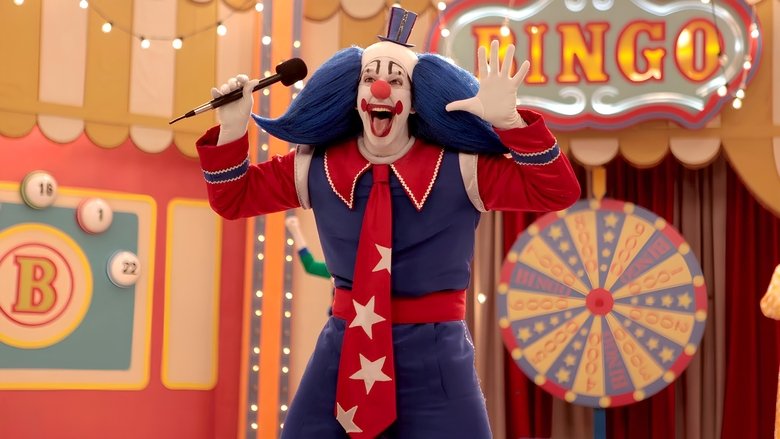

Bingo: The King of the Mornings
A vibrant, cocaine-fueled tragicomedy descending into the dizzying vertigo of anonymous fame, painted with the lurid, neon-soaked palette of 1980s Brazilian television.
Bingo: The King of the Mornings

Bingo: O Rei das Manhãs

"Clowning around can cost your soul"

24 August 2017 Brazil 113 min ⭐ 8.0 (399)
Director: Daniel Rezende
Cast: Vladimir Brichta, Leandra Leal, Tainá Müller, Ana Lúcia Torre, Augusto Madeira
Drama Comedy
The Dichotomy of Identity The Price of Fame Father-Son Relationship Art vs. Commerce

Bingo: The King of the Mornings - Ending Explained

⚠️ Spoiler Analysis

"Bingo: The King of the Mornings" follows the tragic trajectory of Augusto Mendes, who transforms from a soft-porn actor into a national icon as Bingo the clown. His irreverent, ad-libbed style makes the children's show a massive success, but his contract's anonymity clause prevents him from claiming the fame. This frustration drives him into a deep spiral of cocaine addiction and alcoholism. His relationships crumble, most significantly with his son, Gabriel, whom he repeatedly disappoints, and with the show's religious director, Lúcia, with whom he has a complex, push-pull relationship.

The film's major turning point occurs after the death of his mother, Marta, which untethers him completely, leading to his most erratic behavior. This culminates in a horrifying on-air moment where his cocaine-induced nosebleed drips from under his clown nose, a graphic symbol of his decay. He hits rock bottom when, high and disheveled, he is denied entry to his own awards ceremony because no one recognizes him as Augusto Mendes. This profound humiliation forces him to confront his lifestyle. The resolution shows Augusto finding a form of redemption after being guided by Lúcia towards her evangelical church. In the final scene, Augusto is on a new stage: preaching to a congregation while dressed as Bingo. He delivers a heartfelt performance about love and family, and for the first time, he takes off the mask and reveals his identity to the applause of a new audience, suggesting he has finally integrated his two selves and found a stage where he can be both the clown and the man.

Alternative Interpretations

While the film's ending is presented as a form of redemption, its nature is open to interpretation. One perspective is that Augusto finds true peace and purpose by combining his artistic talent with his newfound faith, finally able to perform for an audience and reveal his true self, free from the constraints of his old contract. His work in the church is seen as a genuine, positive transformation where he uses his clown persona for a higher purpose.

An alternative, more cynical interpretation suggests that Augusto has simply traded one stage for another. Is his religious conversion a true spiritual awakening, or is he an eternal performer who has merely found a new audience and a new costume? This reading views the ending not as a complete redemption but as a continuation of his fundamental need for applause and a spotlight, albeit in a different, seemingly more virtuous context. Director Daniel Rezende himself noted that he framed the story so that Augusto's redemption is found *through the stage*, which happened to be in a church, rather than a purely religious one, leaving the character's ultimate motivations ambiguous.