
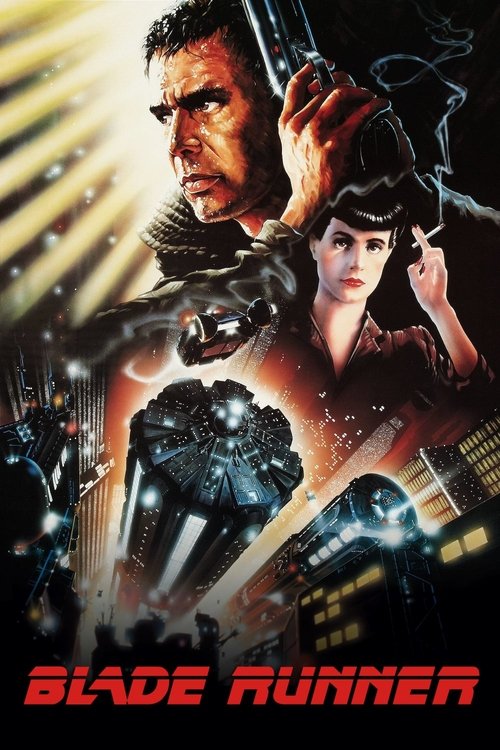
"Man has made his match... now it's his problem."
Director: Ridley Scott
Cast: Harrison Ford, Rutger Hauer, Sean Young, Edward James Olmos, M. Emmet Walsh
Blade Runner — Characters & Cast
Character Analysis
Rick Deckard
Harrison Ford
Motivation
Initially, Deckard is motivated by self-preservation, as Bryant threatens him to take the assignment. As the film progresses, his motivation shifts to a complex mix of professional duty, a growing love for Rachael, and a dawning understanding of the replicants' humanity. Ultimately, his primary motivation becomes protecting Rachael and escaping the oppressive system he once served.
Character Arc
Deckard begins as a cynical, world-weary ex-cop who is coerced back into the morally dubious job of 'retiring' replicants. Initially, he views them as mere machines or 'skinjobs'. However, his interactions with Rachael, a replicant he develops feelings for, and his final confrontation with Roy Batty, who shows him mercy, force him to rediscover his own humanity. His journey is one from a detached killer to someone who questions the nature of his work and chooses to protect a replicant, thereby finding his own capacity for empathy.
Roy Batty
Rutger Hauer
Motivation
Roy's primary motivation is survival. He seeks to defy his pre-programmed death sentence by finding his creator and demanding an extension to his life. He is also driven by a fierce loyalty to his fellow replicants, acting as their leader and protector. His actions are those of a desperate being fighting against his own planned obsolescence.
Character Arc
Roy Batty is the leader of the rogue replicants, driven by a powerful desire for 'more life' beyond his four-year lifespan. He is both brutal and poetic, a killer who is also capable of profound thought and emotion. His arc is a tragic quest for salvation that culminates in a confrontation with his creator, Tyrell, whom he murders in a fit of rage and despair. In his final moments, his character transcends villainy. He achieves a state of grace, accepting his own mortality and, in a powerful display of empathy, saving the life of his pursuer, Deckard, before delivering his iconic 'Tears in rain' monologue.
Rachael
Sean Young
Motivation
Initially, Rachael's motivation is to assert her humanity, which she does by showing Deckard her childhood photograph. After the revelation, her motivation becomes survival and the need to understand her own existence. She seeks connection and protection, finding both in her complex relationship with Deckard, which becomes her driving force.
Character Arc
Rachael is introduced as the poised assistant to Dr. Tyrell, but is soon revealed to be an experimental replicant who is unaware of her own nature. Her arc is one of devastating self-discovery and a search for identity. After learning the truth, her carefully constructed reality collapses. She transitions from a confident corporate figure to a vulnerable fugitive who must rely on Deckard. Her journey is about finding a new identity and the possibility of love and a future, however uncertain, outside the control of her creators.
J.F. Sebastian
M. Emmet Walsh
Motivation
Sebastian is motivated by a profound loneliness and a desire for companionship. He is easily manipulated by the replicants because they offer him the connection he craves. He sees them as kindred spirits due to their shared fate of a shortened life, which overrides his fear and caution.
Character Arc
J.F. Sebastian is a gifted genetic designer who works for Tyrell but lives a lonely life in the derelict Bradbury Building, surrounded by his self-made toy-like friends. He suffers from 'Methuselah Syndrome,' a genetic disorder that causes rapid aging, giving him a short lifespan similar to the replicants he helps design. This shared mortality makes him sympathetic to Roy and Pris. He is manipulated into helping Roy meet Tyrell, a decision that ultimately leads to his death. His arc is a short and tragic one, highlighting the film's themes of loneliness and the exploitation of the vulnerable.
Cast
Explore More About This Movie
Dive deeper into specific aspects of the movie with our detailed analysis pages