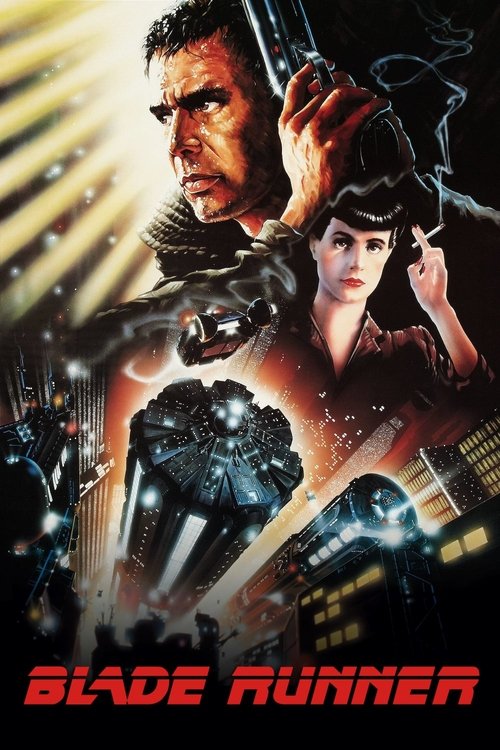
Blade Runner
"Man has made his match... now it's his problem."
Overview
In the dystopian Los Angeles of 2019, a burnt-out ex-cop, Rick Deckard, is forced back into his old job as a 'Blade Runner'. His mission is to hunt down and "retire" four bio-engineered androids, known as replicants, who have illegally returned to Earth from the off-world colonies where they serve as slave labor. These replicants, led by the intense and intelligent Roy Batty, are virtually indistinguishable from humans but possess superior strength and a four-year lifespan.
As Deckard delves into his investigation, the lines between human and artificial begin to blur. He encounters Rachael, a sophisticated replicant who believes she is human, complete with implanted memories. His growing feelings for her complicate his mission and force him to confront his own morality and the nature of humanity itself. The hunt becomes a desperate, violent confrontation, pushing Deckard to question his own identity and the very definition of life in a decaying, high-tech world.
Core Meaning
The core meaning of Blade Runner revolves around the philosophical question: 'What does it mean to be human?' The film suggests that humanity is not defined by biology or origin, but by the capacity for empathy, the richness of memory (real or implanted), and the poignant awareness of one's own mortality. Director Ridley Scott uses the replicants, who desire more life and form deep emotional bonds, to challenge the perceived humanity of the emotionally detached human characters. Ultimately, the film posits that experiences, emotions, and the choices one makes in the face of death are the true markers of a soul, blurring the distinction between creator and creation and leaving the audience to ponder the value and definition of life itself.
Thematic DNA
The Nature of Humanity and Personhood
This is the central theme of the film, constantly questioning what constitutes a human being. The Voight-Kampff test, used to distinguish replicants from humans, measures empathy, suggesting this is the key differentiator. However, the human characters often lack empathy, while the replicants, particularly Roy Batty, display a profound range of emotions, including fear, love, and a desperate will to live. Roy's final act of mercy—saving Deckard—demonstrates a capacity for compassion that transcends his artificial nature, suggesting humanity is defined by actions and emotional depth, not origin.
Memory and Identity
Blade Runner explores the idea that our identities are constructed from our memories. Rachael's belief in her humanity is shattered when Deckard proves her memories are implants from Tyrell's niece. This raises the question of whether the authenticity of memories matters if they create a genuine sense of self. The replicants' obsession with photographs represents their need for a past, a 'visual proof of memories' to validate their existence. The film suggests that identity is a fragile construct, deeply intertwined with the past we believe we have, whether real or fabricated.
Corporate Power and Bio-Engineering (Playing God)
The Tyrell Corporation represents the unchecked power of corporations in a dystopian future. Dr. Eldon Tyrell is a god-like figure who has created life, referring to his replicants as 'prodigal sons'. The motto 'More Human Than Human' reflects his hubris. The film critiques the morality of creating sentient beings for servitude, exploring the consequences when the 'creation' confronts the 'creator'. Roy Batty's murder of Tyrell is a symbolic act of rebellion against his maker and the corporate entity that condemned him to a short, enslaved existence.
Environment and Dystopia
The film presents a decaying, retrofitted future where technology has advanced but society and the environment have collapsed. The constant rain, darkness, and industrial pollution of Los Angeles in 2019 depict a world post-ecocide. Real animals are so rare they have become expensive status symbols, replaced by artificial ones. This bleak setting, a hallmark of the cyberpunk genre it helped define, serves as a visual metaphor for the film's themes of social and moral decay.
Character Analysis
Rick Deckard
Harrison Ford
Motivation
Initially, Deckard is motivated by self-preservation, as Bryant threatens him to take the assignment. As the film progresses, his motivation shifts to a complex mix of professional duty, a growing love for Rachael, and a dawning understanding of the replicants' humanity. Ultimately, his primary motivation becomes protecting Rachael and escaping the oppressive system he once served.
Character Arc
Deckard begins as a cynical, world-weary ex-cop who is coerced back into the morally dubious job of 'retiring' replicants. Initially, he views them as mere machines or 'skinjobs'. However, his interactions with Rachael, a replicant he develops feelings for, and his final confrontation with Roy Batty, who shows him mercy, force him to rediscover his own humanity. His journey is one from a detached killer to someone who questions the nature of his work and chooses to protect a replicant, thereby finding his own capacity for empathy.
Roy Batty
Rutger Hauer
Motivation
Roy's primary motivation is survival. He seeks to defy his pre-programmed death sentence by finding his creator and demanding an extension to his life. He is also driven by a fierce loyalty to his fellow replicants, acting as their leader and protector. His actions are those of a desperate being fighting against his own planned obsolescence.
Character Arc
Roy Batty is the leader of the rogue replicants, driven by a powerful desire for 'more life' beyond his four-year lifespan. He is both brutal and poetic, a killer who is also capable of profound thought and emotion. His arc is a tragic quest for salvation that culminates in a confrontation with his creator, Tyrell, whom he murders in a fit of rage and despair. In his final moments, his character transcends villainy. He achieves a state of grace, accepting his own mortality and, in a powerful display of empathy, saving the life of his pursuer, Deckard, before delivering his iconic 'Tears in rain' monologue.
Rachael
Sean Young
Motivation
Initially, Rachael's motivation is to assert her humanity, which she does by showing Deckard her childhood photograph. After the revelation, her motivation becomes survival and the need to understand her own existence. She seeks connection and protection, finding both in her complex relationship with Deckard, which becomes her driving force.
Character Arc
Rachael is introduced as the poised assistant to Dr. Tyrell, but is soon revealed to be an experimental replicant who is unaware of her own nature. Her arc is one of devastating self-discovery and a search for identity. After learning the truth, her carefully constructed reality collapses. She transitions from a confident corporate figure to a vulnerable fugitive who must rely on Deckard. Her journey is about finding a new identity and the possibility of love and a future, however uncertain, outside the control of her creators.
J.F. Sebastian
M. Emmet Walsh
Motivation
Sebastian is motivated by a profound loneliness and a desire for companionship. He is easily manipulated by the replicants because they offer him the connection he craves. He sees them as kindred spirits due to their shared fate of a shortened life, which overrides his fear and caution.
Character Arc
J.F. Sebastian is a gifted genetic designer who works for Tyrell but lives a lonely life in the derelict Bradbury Building, surrounded by his self-made toy-like friends. He suffers from 'Methuselah Syndrome,' a genetic disorder that causes rapid aging, giving him a short lifespan similar to the replicants he helps design. This shared mortality makes him sympathetic to Roy and Pris. He is manipulated into helping Roy meet Tyrell, a decision that ultimately leads to his death. His arc is a short and tragic one, highlighting the film's themes of loneliness and the exploitation of the vulnerable.
Symbols & Motifs
Eyes
Eyes are the most prominent motif, symbolizing the 'windows to the soul' and the core of identity. They are the key to distinguishing human from replicant in the Voight-Kampff test, which measures empathetic responses through pupillary fluctuation. The replicants' eyes sometimes have a faint glow, a visual cue of their artificiality. Roy Batty's confrontation with his 'eye-maker', Chew, and his subsequent murder of Tyrell by crushing his eyes are deeply symbolic, representing the creation seeing its creator and then blinding him to his own hubris.
The film opens with an extreme close-up of an eye reflecting a fiery, industrial landscape. The Voight-Kampff test focuses entirely on the eye's reaction. Roy and Leon visit Hannibal Chew, a genetic designer of replicant eyes. Tyrell wears thick glasses, suggesting his own vision is flawed despite being the 'creator'. Finally, Roy gouges out Tyrell's eyes when his demand for more life is refused.
Origami Animals
The small origami figures left by Gaff serve as a running commentary on the characters and the film's central question of authenticity. Each figure has a specific meaning related to the scene. The most significant is the final unicorn, which suggests Gaff knows about Deckard's private unicorn daydream, implying that Deckard's memories are implants and he is, therefore, a replicant.
Gaff makes a chicken when Deckard is hesitant to take the case, suggesting he's 'chickening out'. He creates a stick figure with an erection, possibly mocking Deckard's feelings for Rachael. The final origami, a unicorn, is found by Deckard in his apartment as he leaves with Rachael. In the Director's Cut and Final Cut, this links to an earlier scene where Deckard dreams of a unicorn.
Photographs
Photographs represent memory, history, and the desperate need for a past. For the replicants, who have no genuine childhood, photos are tangible proof of an existence they never had, a 'cushion for their emotions'. Leon's frantic attempt to keep his 'precious photos' and Rachael's reliance on a photo to prove her humanity underscore their desire for a real identity rooted in a personal history.
Leon is introduced collecting photos in his apartment. Rachael presents Deckard with a childhood photo of herself and her mother to prove she is human, but Deckard cruelly dismisses it as an implant. Deckard himself has a piano covered in old, sepia-toned photographs, hinting at his own connection to a past, the authenticity of which is left ambiguous.
Animals
In the world of Blade Runner, real animals are exceedingly rare and expensive, having been wiped out by ecological collapse. Owning one is a sign of wealth and status. Most animals are artificial, just like the replicants. This parallel reinforces the film's theme of what is real versus what is synthetic. The replicants themselves are associated with animals: Zhora with a snake, Roy with a wolf (howling) and a dove (at his death), and Tyrell with an artificial owl, symbolizing wisdom and predation.
The film is based on the novel Do Androids Dream of Electric Sheep?, highlighting the theme from the source material. We see an artificial snake used in Zhora's performance and Tyrell's artificial owl. At the end of his life, Roy Batty releases a white dove, symbolizing his spirit's release.
Memorable Quotes
I've seen things you people wouldn't believe. Attack ships on fire off the shoulder of Orion. I watched C-beams glitter in the dark near the Tannhäuser Gate. All those moments will be lost in time, like tears in rain. Time to die.
— Roy Batty
Context:
After saving Deckard's life on a rain-soaked rooftop, a dying Roy Batty sits down and delivers this speech. He reflects on his life's memories as his body shuts down, choosing to share his soul with his enemy rather than die in violence. Rutger Hauer famously improvised and shortened the scripted speech, adding the final, poignant line himself.
Meaning:
This iconic monologue is the culmination of Roy's character arc. It's a profound meditation on memory, mortality, and the beauty of a life lived, however short. By sharing his extraordinary experiences, he asserts the value of his existence and laments that his unique consciousness will vanish. The line 'like tears in rain' is a beautiful, tragic metaphor for the transient nature of memory and life itself, cementing his humanity in his final moments.
Quite an experience to live in fear, isn't it? That's what it is to be a slave.
— Roy Batty
Context:
During the final rooftop chase, Deckard is dangling precariously, about to fall to his death. Roy Batty, having easily made the jump, stands over him and delivers this line, savoring the reversal of power before ultimately deciding to save Deckard's life.
Meaning:
This line directly addresses the film's theme of slavery and oppression. Roy turns Deckard's own fear against him, forcing the hunter to experience the constant terror that defines the replicants' existence. It's a powerful indictment of the human society that created beings for servitude and then hunts them for desiring freedom.
The light that burns twice as bright burns half as long - and you have burned so very, very brightly, Roy.
— Dr. Eldon Tyrell
Context:
Roy Batty confronts his maker, Dr. Tyrell, in his penthouse, demanding a way to extend his four-year lifespan. Tyrell explains that the process is irreversible and attempts to placate his 'prodigal son' with these words, moments before Roy kisses and then kills him.
Meaning:
This quote is Tyrell's poetic, yet cold, dismissal of Roy's plea for more life. It acknowledges Roy's brilliance and the intensity of his short existence but frames his mortality as an unavoidable consequence of his superior design. It reflects Tyrell's detached, god-like perspective, admiring his creation's perfection while refusing to take responsibility for its built-in tragedy.
You know that Voight-Kampff test of yours? Did you ever take that test yourself?
— Rachael
Context:
After Deckard has brutally revealed to Rachael that her memories are implants and she is a replicant, she confronts him in his apartment. Hurt and disillusioned, she challenges his authority and the very basis of his identity as a human Blade Runner.
Meaning:
Rachael's question is a pivotal moment that directly introduces the ambiguity of Deckard's own humanity. It plants a seed of doubt for both Deckard and the audience, suggesting that the hunter might be no different from the hunted. Deckard's non-answer hangs over the rest of the film, fueling the central debate about his possible replicant nature.
It's too bad she won't live! But then again, who does?
— Gaff
Context:
As Deckard and Rachael are leaving the apartment, Gaff appears and speaks this line to Deckard. He allows them to leave, but not without this final, enigmatic remark. He then leaves behind the origami unicorn, reinforcing the film's ambiguity.
Meaning:
Gaff's final line serves as a philosophical capstone to the film, blurring the line between the fates of humans and replicants. On one level, it's a cold reminder of Rachael's limited lifespan. On a deeper level, it's a universal statement about mortality. It implies that all life is finite, and in that sense, the struggle and the death sentence are universal, making the distinction between human and replicant ultimately meaningless.
Philosophical Questions
What does it mean to be human?
The film explores this question by contrasting humans and replicants. It suggests humanity is not defined by biology but by a capacity for empathy, emotion, and the awareness of mortality. The Voight-Kampff test singles out empathy as the key human trait, yet the replicants, especially Roy Batty, arguably display more profound emotional depth and compassion by the film's end than the jaded humans who hunt them. Roy's desire for more life, his love for his fellow replicants, and his final act of mercy towards Deckard challenge the audience's preconceptions, suggesting that a created being can be 'more human than human'.
How do memories shape our identity?
Blade Runner questions whether the origin of our memories affects the validity of our identity. Rachael has a complete sense of self based on memories implanted by Tyrell. When this foundation is revealed to be false, her identity collapses. The film asks: if a memory feels real and elicits genuine emotion, does it matter if it wasn't 'earned'? The replicants' attachment to photographs demonstrates a universal need for a past to ground one's sense of self, blurring the line between authentic and artificial identity.
What are the moral responsibilities of a creator to their creation?
The film delves into the ethics of creating sentient life for the purpose of slavery. Dr. Tyrell, the creator, views the replicants as both masterpieces of design and disposable commodities. Roy Batty's confrontation with Tyrell is framed as a 'prodigal son' meeting his god. By demanding more life, Roy is asking for the one thing all conscious beings desire, but his creator denies him. The film critiques the hubris of 'playing God' without considering the emotional and existential suffering of the beings you create.
Alternative Interpretations
The most significant alternative interpretation of Blade Runner centers on the question: Is Rick Deckard a replicant? This debate is fueled by clues across the film's different versions.
The 'Deckard is a Replicant' Theory:
- The Unicorn Dream: In the Director's and Final Cuts, Deckard has a daydream of a unicorn running through a forest. At the end of the film, he finds an origami unicorn left by Gaff. This implies that Gaff knows Deckard's private thoughts, suggesting they are implanted memories, just like Rachael's.
- Glowing Eyes: For a brief moment in one scene with Rachael, Deckard's eyes appear to have the same subtle red glow seen in the eyes of known replicants.
- Director's Intent: Director Ridley Scott has stated definitively in interviews that he intended for Deckard to be a replicant.
- Gaff's Final Line: Gaff's parting words, 'It's too bad she won't live! But then again, who does?', can be interpreted as a nod to Deckard's own limited lifespan.
The 'Deckard is Human' Theory:
- Audience Connection: Harrison Ford has always maintained that he played the character as a human. He argued it was crucial for the audience to have a human point of view to emotionally connect with the story's themes.
- The Original Film: The 1982 theatrical release contains no unicorn dream, making Gaff's origami unicorn simply an enigmatic symbol that Deckard understands Rachael is also a 'mythical creature' who deserves to be free. The studio-imposed happy ending also strongly suggests Deckard is human.
- Thematic Resonance: Some argue that the film's themes are more powerful if Deckard is a human who learns to empathize with the 'other'. If he is just another replicant, his journey of rediscovering humanity loses some of its impact.
Ultimately, the film's enduring power lies in this ambiguity, forcing the viewer to ask the same questions as the characters: what does it mean to be human, and how can we be sure of our own identity?
Cultural Impact
Initially a commercial failure that polarized critics, Blade Runner has since become one of the most important and influential science fiction films ever made. Hailed for its groundbreaking production design, it established the visual language for the cyberpunk genre, blending high-tech futurism with urban decay and film noir aesthetics. Its vision of a dark, rainy, neon-lit, multicultural metropolis has been emulated and referenced in countless films, TV shows, anime (like Ghost in the Shell), and video games.
The film elevated the sci-fi genre beyond simple action, engaging with complex philosophical themes about humanity, artificial intelligence, and corporate control. Its ambiguous narrative, particularly the question of Deckard's humanity, has fueled decades of debate and analysis. The existence of multiple versions of the film, culminating in the 2007 'Final Cut', made it one of the earliest movies to find a renewed life and critical re-evaluation through home video formats like DVD, setting a precedent for director's cuts. Today, Blade Runner is preserved in the National Film Registry and is widely regarded as a visually stunning, achingly human masterpiece whose influence on pop culture and filmmaking continues to deepen over time.
Audience Reception
Upon its 1982 release, Blade Runner received a polarized response from both critics and audiences and was considered a box office failure. Many viewers, expecting a Harrison Ford action movie in the vein of Star Wars or Raiders of the Lost Ark, were put off by its slow, contemplative pace and grim, dystopian atmosphere. Some critics praised its astonishing visuals and thematic complexity, while others found it ponderous and lacking in human connection, with one famously dubbing it 'Blade Crawler'.
However, the film's reputation grew immensely over time, particularly with the advent of home video and the release of the Director's Cut in 1992. It developed a passionate cult following and underwent a significant critical re-evaluation. Audiences came to appreciate its deep philosophical questions, stunning neo-noir visuals, and influential world-building. Today, it is widely regarded as a masterpiece of science fiction and one of the greatest films ever made, with its initial lukewarm reception only adding to its legendary status.
Interesting Facts
- The film is loosely based on Philip K. Dick's 1968 novel 'Do Androids Dream of Electric Sheep?'.
- Director Ridley Scott and lead actor Harrison Ford disagreed on whether Deckard is a replicant. Scott insists he is, while Ford believes he is human to provide an emotional anchor for the audience. The debate continues among fans.
- Rutger Hauer heavily edited his famous 'Tears in rain' monologue from the script, cutting it down and improvising the final, most iconic line.
- Dustin Hoffman was the first choice for the role of Deckard, but he and the director had creative differences over the character's interpretation.
- The film's title, 'Blade Runner', does not come from the Philip K. Dick novel. Scott acquired the rights to the title from a 1974 novella by Alan Nourse called 'The Bladerunner'.
- The dystopian, rain-soaked look of Los Angeles was heavily influenced by the industrial landscape of Northeast England, where director Ridley Scott grew up.
- There are several different versions of the film, including the 1982 Theatrical Cut (with a voiceover and happy ending imposed by the studio), the 1992 Director's Cut, and the 2007 Final Cut, which is the only version over which Ridley Scott had complete artistic control.
- The memorable score was composed by Vangelis, who had just won an Oscar for 'Chariots of Fire' the same year 'Blade Runner' was released.
- The film was a box office disappointment upon its initial release in 1982, partly due to competing with the blockbuster 'E.T. the Extra-Terrestrial'. It later found a massive audience and cult status through home video.
- The iconic Bradbury Building in Los Angeles, used as the location for J.F. Sebastian's apartment, was a frequent filming location for classic film noir movies.
Easter Eggs
A model of the Millennium Falcon from 'Star Wars' is used as a building in the cityscape.
During the special effects filming, the model makers were in a rush to add more detail to the futuristic Los Angeles skyline. An effects artist who had worked on 'Star Wars' repurposed a model of the Millennium Falcon, turning it on its end and adding some extra parts to make it look like a building. It's a fun nod to Harrison Ford's other iconic sci-fi role as Han Solo. The ship can be seen as Deckard's spinner approaches the police headquarters.
A computer screen in Deckard's spinner car displays a 'PURGE' notification identical to one seen in Ridley Scott's 'Alien'.
When Gaff and Deckard take off in the police spinner, the monitor displays an 'Environmental CTR Purge' message. This exact same screen graphic appears on the shuttle Narcissus's startup sequence in Ridley Scott's 1979 film 'Alien'. This has led fans to speculate that the two films might be set in the same universe, with Weyland-Yutani and the Tyrell Corporation existing in a shared timeline.
⚠️ Spoiler Analysis
Click to reveal detailed analysis with spoilers
Frequently Asked Questions
Explore More About This Movie
Dive deeper into specific aspects of the movie with our detailed analysis pages
Comments (0)
No comments yet. Be the first to share your thoughts!