
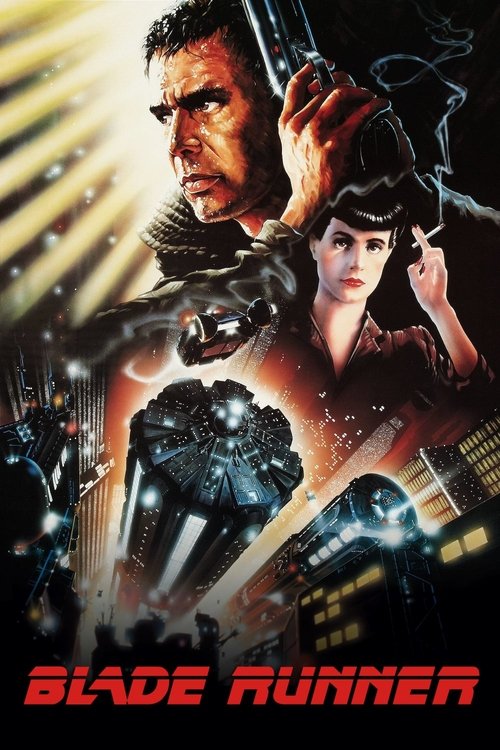
"Man has made his match... now it's his problem."
Blade Runner - Symbolism & Philosophy
Symbols & Motifs
Eyes
Eyes are the most prominent motif, symbolizing the 'windows to the soul' and the core of identity. They are the key to distinguishing human from replicant in the Voight-Kampff test, which measures empathetic responses through pupillary fluctuation. The replicants' eyes sometimes have a faint glow, a visual cue of their artificiality. Roy Batty's confrontation with his 'eye-maker', Chew, and his subsequent murder of Tyrell by crushing his eyes are deeply symbolic, representing the creation seeing its creator and then blinding him to his own hubris.
The film opens with an extreme close-up of an eye reflecting a fiery, industrial landscape. The Voight-Kampff test focuses entirely on the eye's reaction. Roy and Leon visit Hannibal Chew, a genetic designer of replicant eyes. Tyrell wears thick glasses, suggesting his own vision is flawed despite being the 'creator'. Finally, Roy gouges out Tyrell's eyes when his demand for more life is refused.
Origami Animals
The small origami figures left by Gaff serve as a running commentary on the characters and the film's central question of authenticity. Each figure has a specific meaning related to the scene. The most significant is the final unicorn, which suggests Gaff knows about Deckard's private unicorn daydream, implying that Deckard's memories are implants and he is, therefore, a replicant.
Gaff makes a chicken when Deckard is hesitant to take the case, suggesting he's 'chickening out'. He creates a stick figure with an erection, possibly mocking Deckard's feelings for Rachael. The final origami, a unicorn, is found by Deckard in his apartment as he leaves with Rachael. In the Director's Cut and Final Cut, this links to an earlier scene where Deckard dreams of a unicorn.
Photographs
Photographs represent memory, history, and the desperate need for a past. For the replicants, who have no genuine childhood, photos are tangible proof of an existence they never had, a 'cushion for their emotions'. Leon's frantic attempt to keep his 'precious photos' and Rachael's reliance on a photo to prove her humanity underscore their desire for a real identity rooted in a personal history.
Leon is introduced collecting photos in his apartment. Rachael presents Deckard with a childhood photo of herself and her mother to prove she is human, but Deckard cruelly dismisses it as an implant. Deckard himself has a piano covered in old, sepia-toned photographs, hinting at his own connection to a past, the authenticity of which is left ambiguous.
Animals
In the world of Blade Runner, real animals are exceedingly rare and expensive, having been wiped out by ecological collapse. Owning one is a sign of wealth and status. Most animals are artificial, just like the replicants. This parallel reinforces the film's theme of what is real versus what is synthetic. The replicants themselves are associated with animals: Zhora with a snake, Roy with a wolf (howling) and a dove (at his death), and Tyrell with an artificial owl, symbolizing wisdom and predation.
The film is based on the novel Do Androids Dream of Electric Sheep?, highlighting the theme from the source material. We see an artificial snake used in Zhora's performance and Tyrell's artificial owl. At the end of his life, Roy Batty releases a white dove, symbolizing his spirit's release.
Philosophical Questions
What does it mean to be human?
The film explores this question by contrasting humans and replicants. It suggests humanity is not defined by biology but by a capacity for empathy, emotion, and the awareness of mortality. The Voight-Kampff test singles out empathy as the key human trait, yet the replicants, especially Roy Batty, arguably display more profound emotional depth and compassion by the film's end than the jaded humans who hunt them. Roy's desire for more life, his love for his fellow replicants, and his final act of mercy towards Deckard challenge the audience's preconceptions, suggesting that a created being can be 'more human than human'.
How do memories shape our identity?
Blade Runner questions whether the origin of our memories affects the validity of our identity. Rachael has a complete sense of self based on memories implanted by Tyrell. When this foundation is revealed to be false, her identity collapses. The film asks: if a memory feels real and elicits genuine emotion, does it matter if it wasn't 'earned'? The replicants' attachment to photographs demonstrates a universal need for a past to ground one's sense of self, blurring the line between authentic and artificial identity.
What are the moral responsibilities of a creator to their creation?
The film delves into the ethics of creating sentient life for the purpose of slavery. Dr. Tyrell, the creator, views the replicants as both masterpieces of design and disposable commodities. Roy Batty's confrontation with Tyrell is framed as a 'prodigal son' meeting his god. By demanding more life, Roy is asking for the one thing all conscious beings desire, but his creator denies him. The film critiques the hubris of 'playing God' without considering the emotional and existential suffering of the beings you create.
Core Meaning
The core meaning of Blade Runner revolves around the philosophical question: 'What does it mean to be human?' The film suggests that humanity is not defined by biology or origin, but by the capacity for empathy, the richness of memory (real or implanted), and the poignant awareness of one's own mortality. Director Ridley Scott uses the replicants, who desire more life and form deep emotional bonds, to challenge the perceived humanity of the emotionally detached human characters. Ultimately, the film posits that experiences, emotions, and the choices one makes in the face of death are the true markers of a soul, blurring the distinction between creator and creation and leaving the audience to ponder the value and definition of life itself.