Skip to content
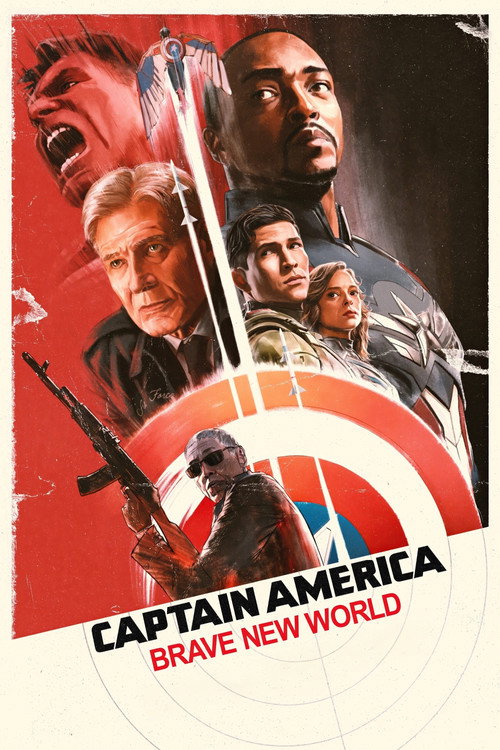
Captain America: Brave New World
A tense political thriller draped in shadows of paranoia, this film captures the raw vulnerability of human conviction clashing against overwhelming authority—a soaring falcon diving through a storm of red-hot systemic rage.
Captain America: Brave New World

Captain America: Brave New World

"The future favors the brave."

12 February 2025 United States of America 119 min 6.0 (3,238)

Director: Julius Onah

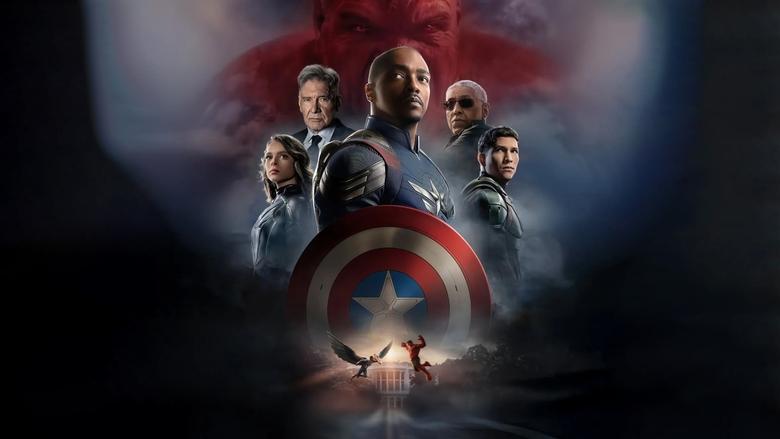
Cast: Anthony Mackie, Harrison Ford, Danny Ramirez, Shira Haas, Tim Blake Nelson

Action Thriller Science Fiction Legacy and Earned Worthiness Geopolitical Resource Exploitation & Corruption Institutional Betrayal and Historic Injustice Manipulation vs. Personal Agency Human Empathy vs. Monstrous Force
Budget: $180,000,000
Box Office: $415,101,577

Overview

Captain America: Brave New World (2025) marks the big-screen debut of Sam Wilson taking up the mantle of Captain America. Directed by Julius Onah, the story picks up following the events of The Falcon and the Winter Soldier, placing Sam at the center of an escalating international crisis. Fresh off his election as President of the United States, Thaddeus "Thunderbolt" Ross seeks to make Captain America an official military asset. However, an assassination attempt during a White House summit unravels a web of geopolitical paranoia and global conspiracy.

As Sam investigates the origins of the attack alongside his new partner, Joaquin Torres (the new Falcon), he discovers that powerful shadow forces are pulling the strings of global governments. The geopolitical stakes peak around Celestial Island—the calcified remains of the Celestial Tiamut—where global superpowers maneuver to seize control of a newly discovered, ultra-durable metal: Adamantium.

Without the Super Soldier Serum in his veins, Sam must rely on his tactical intellect, moral authority, and advanced Vibranium wings to stop a mastermind orchestrating global warfare, while navigating his own doubts about living in the shadow of Steve Rogers.
Core Meaning

The central thesis of Captain America: Brave New World is that true heroism is defined not by biological superiority or state-sanctioned power, but by unwavering moral integrity, empathy, and accountability. Director Julius Onah frames the mantle of Captain America as a moral symbol rather than a military tool. The film explores the friction between individual ideals and corrupted state institutions, emphasizing that patriotism requires holding power accountable rather than blindly serving it.

Thematic DNA

Legacy and Earned Worthiness 30%
Geopolitical Resource Exploitation & Corruption 25%
Institutional Betrayal and Historic Injustice 20%
Manipulation vs. Personal Agency 15%
Human Empathy vs. Monstrous Force 10%

Legacy and Earned Worthiness

The film explores Sam Wilson’s internal struggle with imposter syndrome as he steps into a role historically held by Steve Rogers. Unlike Rogers, Sam lacks super-soldier enhancement, making his mantle a test of human resilience and moral conviction rather than brute force.

Geopolitical Resource Exploitation & Corruption

Centered around the race for Adamantium from Celestial Island, the narrative mirrors real-world imperial conflicts over rare earth minerals and military supremacy.

Institutional Betrayal and Historic Injustice

Exposed through the character of Isaiah Bradley, the plot highlights how institutions exploit and discard individuals—particularly marginalized soldiers—for national interests.

Manipulation vs. Personal Agency

Brainwashing motifs and puppetmaster dynamics (orchestrated by Samuel Sterns) demonstrate how systemic anger and psychological conditioning can be weaponized to manipulate world leaders and public opinion.

Human Empathy vs. Monstrous Force

The contrast between Sam’s human approach (de-escalation, dialogue) and Ross’s monstrous physical transformation (Red Hulk) emphasizes that violence alone cannot solve systemic crises.

Character Analysis

Sam Wilson / Captain America

Anthony Mackie

Archetype: Hero / Idealist Key Trait: Unwavering moral integrity and diplomatic empathy

Motivation

Protecting global stability while staying true to his moral compass.

Character Arc

Overcomes imposter syndrome and systemic pushback to establish his unique identity as a non-serum Captain America who relies on empathy and strategy.

Thaddeus "Thunderbolt" Ross / Red Hulk

Harrison Ford

Archetype: Antihero / Fallen Leader Key Trait: Suppressed anger and obsessive need for control

Motivation

Securing his legacy, establishing U.S. dominance over Adamantium, and proving he has changed.

Character Arc

Transitions from a rigid military president seeking legacy and control into a literal rage monster, before coming to terms with his past mistakes and stepping down.

All 5 characters and cast

Symbols & Motifs

The Vibranium Shield

Meaning:

Symbolizes the core ideals of justice, faith, and human perseverance.

Context:

Inherited by Sam, it represents a commitment to protecting people rather than serving government agendas.

Adamantium (Celestial Island)

Meaning:

Symbolizes global greed and military escalation.

Context:

The calcified corpse of Tiamut turned into a battleground reflects how humanity exploits extraordinary wonders for warfare.

The Shaved Mustache / Clean Facade

Meaning:

Symbolizes political rebranding and the cosmetic hiding of past misdeeds.

Context:

President Ross shaves his iconic mustache upon entering office.

Red vs. Blue Color Motif

Meaning:

Blue represents institutional control and order, while Red represents hidden rage, chaos, and destruction (culminating in the Red Hulk).

Context:

Used visually across character motivations, sets, and thematic arcs throughout the story.

Mind-Control Audio Triggers

Meaning:

Represents the loss of agency and the invisible ways shadow intelligence structures manipulate citizens and veterans into doing their bidding.

Context:

Used by Samuel Sterns to trigger brainwashed individuals like Isaiah Bradley into committing attacks.

Memorable Quotes

You're not Steve Rogers. / You're right. I'm not.
— Thaddeus Ross & Sam Wilson

Context

An early meeting in the Oval Office where Ross challenges Sam's standing.

Meaning

Encapsulates the central theme of identity; Sam rejects the expectation to clone Steve Rogers and claims the role on his own terms.

Look, if we can't see the good in each other, we've already lost the fight.
— Sam Wilson

Context

Sam speaking to an enraged President Ross in Red Hulk form during the climax.

Meaning

Highlights Sam’s defining philosophy—choosing empathy and faith in humanity over violence.

All 5 quotes

Philosophical Questions

Is moral authority superior to physical dominance in leadership?

The film explores this by pitting Sam Wilson—who possesses no physical enhancements—against enhanced individuals and military presidents, arguing that moral conviction is what truly defines leadership.

Can an institution ever be held accountable from within?

Through Ross's presidency and the misuse of black super soldiers, the story asks whether government agencies can self-correct without external whistleblowers and principled dissidents.

What constitutes true personal agency in a world governed by narrative manipulation?

By featuring literal mind control and geopolitical propaganda around Adamantium, the film questions how individuals maintain free will against state-manufactured narratives.

Alternative Interpretations

The Systemic Critique Reading: In this interpretation, the government structures in the film are irredeemably corrupt. The system continuously abuses figures like Isaiah Bradley and uses brainwashing triggers to turn veterans into scapegoats, showing that true heroism can never fully align with state agendas.

Full ending explanation

Cultural Impact

Captain America: Brave New World represents the first theatrical Marvel film centered on a Black Captain America. It actively engages with themes of institutional trust, historic racial mistreatment in American history (echoing the Tuskegee Syphilis Study through Isaiah Bradley's comic origins), and global resource politics.

The film experienced a sharp split between film critics (holding a 49–53% Rotten Tomatoes score) and general audiences (holding an 80% Popcornmeter score). Critics pointed out pacing issues caused by reshoots, while audiences praised Anthony Mackie's lead performance, physical action choreography, and Harrison Ford's Red Hulk.

Produced on a $180 million budget, the film grossed approximately $415 million worldwide.

Audience Reception

Praised Aspects:

  • Anthony Mackie's grounded, charismatic portrayal of Sam Wilson.
  • Highly physical, visceral fight choreography that leans into Sam's wing suit mechanics.
  • Harrison Ford's magnetic screen presence as President Ross and the visual execution of Red Hulk.

Main Criticisms:

  • Structural unevenness and noticeable pacing shifts resulting from extensive script rewrites and reshoots.
  • Underutilization of certain side characters and villains like Sidewinder and The Leader.

Controversial Elements:

  • The heavily altered comic book background of Ruth Bat-Seraph (Sabra) from an Israeli Mossad agent to a former Black Widow/U.S. official.

Interesting Facts

  • Harrison Ford took over the role of Thaddeus "Thunderbolt" Ross following the passing of William Hurt in March 2022.
  • The film was originally announced at San Diego Comic-Con 2022 under the title Captain America: New World Order, before being retitled Captain America: Brave New World in June 2023.
  • The production underwent 22 days of reshoots in mid-2024 written by Matthew Orton, which added Giancarlo Esposito as Sidewinder and streamlined the original Serpent Society storyline.
  • Director Julius Onah and DP Kramer Morgenthau studied 1970s political paranoia thrillers (like All the President's Men and The Parallax View) to craft the movie's composition and framing.
  • The movie was shot using Panavision C-series anamorphic lenses specifically tuned to replicate 500T 5219 film grain for a gritty, grounded visual texture.
  • Production designer Ramsey Avery intentionally stripped the color red from almost all sets and costumes throughout the film, reserving it strictly for Sam's costume accent and the explosive debut of Red Hulk.

Easter Eggs

Bucky Barnes Cameo

Sebastian Stan makes an uncredited cameo appearance visiting Sam at the hospital, offering him encouragement while revealing he is running for a U.S. Congressional seat.

Celestial Tiamut Body (Adamantium Origin)

The film directly follows up on 2021's Eternals, establishing that Tiamut's giant stone body in the ocean contains the MCU's first known deposit of Adamantium.

Harlem Battle Footage

Archival footage from 2008's The Incredible Hulk showing Edward Norton's Hulk fighting Abomination is shown during a White House briefing.

Betty Ross Return

Liv Tyler reprises her role as Betty Ross for the first time since 2008, appearing at the end of the film to visit her father at the Raft prison.

Meta Shaved Mustache Line

Sam's comment about Ross shaving his mustache serves as a double-joke regarding political image changes and the recasting of Harrison Ford replacing William Hurt.

Frequently Asked Questions

Explore More About This Movie

Dive deeper into specific aspects of the movie with our detailed analysis pages

Comments (0)

Leave a comment

No comments yet. Be the first to share your thoughts!

Similar Movies