
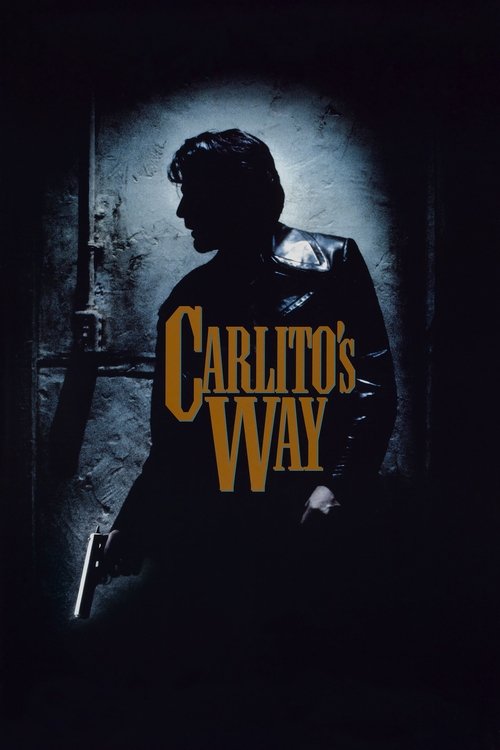
"He's got a good future if he can live past next week."
Carlito's Way - Symbolism & Philosophy
Symbols & Motifs
The 'Escape to Paradise' Poster
The poster symbolizes Carlito's dream of redemption, peace, and a new life with Gail, far away from the crime-ridden streets of New York. It represents an idealized, almost mythical, destination that is perpetually out of reach.
The poster is first seen from Carlito's point of view as he lies dying on a stretcher at the beginning of the film. In his final moments, he hallucinates the image on the billboard coming to life, with Gail dancing on the beach, signifying that while he will not make it, his dream of her and their child escaping to a better life might be realized.
Grand Central Station
Grand Central Station represents a crossroads and a point of no return. It is the gateway to Carlito's potential future and freedom, but it also becomes the arena for his final, fatal confrontation with his past. It is both a symbol of escape and an inescapable nexus of fate.
The climactic chase and shootout sequence takes place throughout the subways and culminates in Grand Central Station. Carlito must navigate this complex, public space to reach the train that will take him and Gail away forever. It is on the platform, just moments from freedom, that his past finally catches up to him in the form of Benny Blanco.
Escalators
Escalators in the film, particularly during the Grand Central chase, symbolize Carlito's struggle to ascend from his criminal past. He is physically trying to move up and away from his pursuers, which mirrors his larger metaphysical struggle to rise above his history and escape his fate.
The most iconic use of this symbol is during the climactic shootout in Grand Central. Carlito uses an escalator to gain an advantage over his Italian mob pursuers in a tense, brilliantly choreographed action sequence. This visual motif powerfully represents his uphill battle for a new life.
Philosophical Questions
Can a person truly escape their past and inherent nature?
The film relentlessly explores this question through Carlito's struggle. He has a genuine desire to change and intellectually understands what he needs to do to achieve his dream of paradise. However, every time he is tested, his old instincts and his code of honor pull him back. The film seems to argue, fatalistically, that one's identity, once forged by a life of crime and violence, becomes a permanent brand. It suggests that while the desire for redemption is a powerful human impulse, the patterns of behavior and the social webs of one's past are nearly impossible to break.
Is a personal code of honor a virtue or a fatal flaw in a corrupt world?
Carlito's unwavering loyalty to his friends, particularly Dave Kleinfeld, is presented as both a noble trait and the direct cause of his demise. He operates by a code that the world around him no longer respects. The film questions the value of such principles when they lead to ruin. Is it better to be dishonorable and survive, or to maintain one's integrity and perish? "Carlito's Way" presents this as the central tragedy of its hero: his best quality is also his most fatal flaw.
Core Meaning
At its core, "Carlito's Way" is a fatalistic tragedy about the impossibility of escaping one's past and the destructive nature of a misguided code of honor in a world devoid of it. The film posits that once a person is defined by a certain life, especially a criminal one, the path to redemption is fraught with insurmountable obstacles. Carlito's journey is a testament to the idea that external forces—old loyalties, the expectations of others, and the magnetic pull of a former life—can overpower an individual's genuine desire for change. Director Brian De Palma explores the profound and melancholic theme that striving for a dream can be a race against a bullet you can't outrun, where the very principles that define you, such as loyalty, become the instruments of your downfall. The film serves as a poignant commentary on the human condition, suggesting that destiny is often a self-fulfilling prophecy shaped by the world's perception of who you are, rather than who you aspire to be.