"Just one pillow on her bed... and just one desire in her heart."
Cat on a Hot Tin Roof - Symbolism & Philosophy
Symbols & Motifs
The Crutch
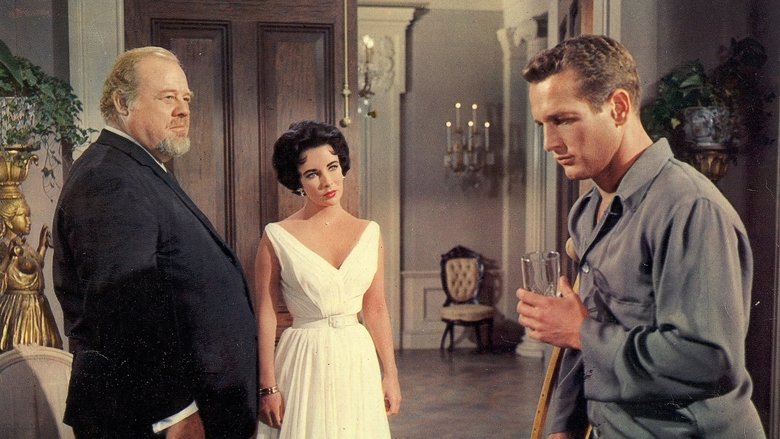
Brick's crutch represents his physical, emotional, and psychological brokenness. It is a manifestation of his dependence—on alcohol, on his past, and on his unresolved grief over his friend Skipper.
Brick relies on it throughout the film after breaking his ankle while drunkenly jumping hurdles. When Big Daddy forces a confrontation in the basement, he takes the crutch away, forcing Brick to literally and metaphorically stand on his own and face the truth.
The Bed
The large, ornate brass bed symbolizes the unconsummated state of Maggie and Brick's marriage, serving as a constant visual reminder of their alienation, lack of intimacy, and failure to produce an heir.
It dominates the center of their bedroom set. Maggie often paces around it or lounges on it in her slip, highlighting her sexual frustration and Brick's cold indifference.
The "Click"
The "click" is a psychological mechanism of avoidance. It symbolizes the numbness and artificial peace that Brick desperately seeks to shield himself from the painful reality of his guilt and his failing marriage.
Brick explicitly tells Big Daddy that he drinks until he feels a "click" in his head, which turns the "hot light off and the cool night on," bringing him momentary peace from the "mendacity" of the world.
The Empty Suitcase
The suitcase symbolizes the idea that true love and connection are far more valuable than material wealth and legacy.
In the basement, Big Daddy shows Brick the single empty suitcase his own father—a poor tramp—left him. Big Daddy realizes that despite leaving no money, his father loved him deeply, something Big Daddy struggles to replicate with his own massive fortune.
Philosophical Questions
Is it better to live a painful truth or a comforting lie?
The film aggressively scrutinizes "mendacity"—the lies people tell to survive. The family lies to Big Daddy about his impending death to keep him happy, while Brick and Maggie lie to the world about their perfect marriage. The film suggests that while lies offer temporary comfort (the "click"), true liberation and genuine connection can only happen when one strips away the illusions and faces the terrifying, naked truth.
What constitutes a true legacy, and can love be inherited or bought?
Big Daddy possesses a 28,000-acre empire, yet he is surrounded by sycophants who secretly wait for his demise. He reflects on his own father, a penniless tramp who left him nothing but an empty suitcase and genuine love. The film asks whether the pursuit of capitalist wealth inevitably corrupts familial bonds, contrasting Gooper's transactional obedience with Brick's apathetic but honest grief.
Core Meaning
The core message of the film revolves around the destructive nature of "mendacity"—the pervasive system of lies, hypocrisy, and deceit that people use to mask their pain, hide their true desires, and conform to societal expectations. Director Richard Brooks, adapting Tennessee Williams' Pulitzer Prize-winning play, explores how the characters are emotionally crippled by their inability to face the truth.
The film suggests that true salvation and genuine human connection can only be achieved by stripping away these illusions. Whether it is confronting the reality of impending death, acknowledging past failures, or fighting for love against impossible odds, the movie ultimately champions the courage to embrace a "desperate truth" over a comfortable lie.