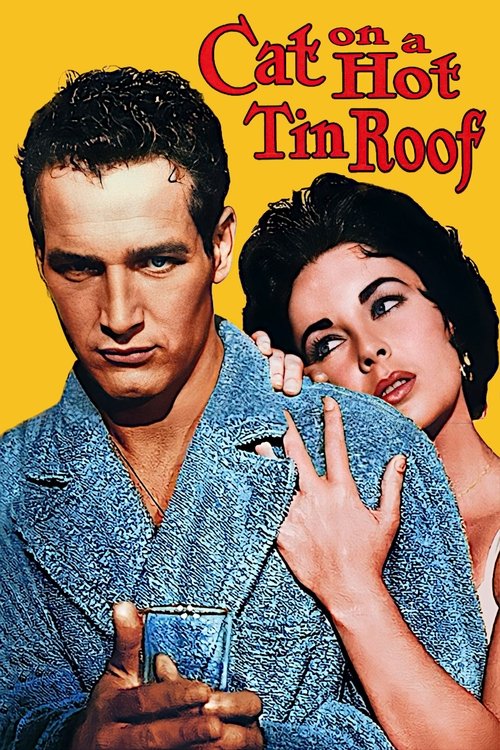
Cat on a Hot Tin Roof
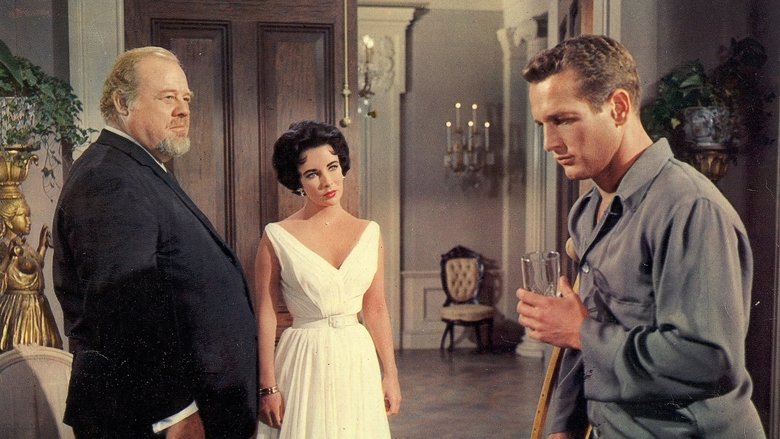
A sweltering Southern melodrama dripping with resentment, unfulfilled desires, and agonizing family secrets. Brick's broken crutch and Maggie's desperate, feline pacing perfectly encapsulate the claustrophobic agony of a loveless marriage teetering on the scorching edge of mendacity.
Cat on a Hot Tin Roof

Cat on a Hot Tin Roof

"Just one pillow on her bed... and just one desire in her heart."

29 August 1958 United States of America 108 min ⭐ 7.6 (820)
Director: Richard Brooks
Cast: Paul Newman, Elizabeth Taylor, Burl Ives, Judith Anderson, Jack Carson
Drama
Mendacity and Truth Unfulfilled Desire and Repression Family Dysfunction and Greed Atrophied Masculinity and Patriarchal Pressure
Budget: $3,000,000
Box Office: $17,570,324

Overview

Set on a sprawling, wealthy Mississippi Delta plantation, Cat on a Hot Tin Roof unfolds during the 65th birthday gathering of the domineering patriarch, Harvey "Big Daddy" Pollitt. While the family feigns joyous celebration, a dark cloud hangs over the estate: Big Daddy has been falsely told he has a minor ailment, while the rest of the family knows he is actually dying of terminal cancer. This impending death triggers a vicious battle for inheritance between his two sons.

At the center of the storm is his favored but deeply troubled younger son, Brick, an alcoholic, ex-football star hobbling on a crutch, and his beautiful, fiercely determined wife, Maggie. Maggie is frantic to secure their place in Big Daddy's will, but Brick is trapped in a spiral of grief and self-loathing following the suicide of his best friend, Skipper. He refuses to sleep with Maggie, leaving her trapped like a "cat on a hot tin roof"—desperate for his love and terrified of returning to the poverty of her youth.

As the suffocating summer evening wears on, the facade of familial harmony shatters. Gooper, Brick's sycophantic older brother, and his fiercely fertile wife, Mae, plot to take control of the estate. The rising tensions ultimately force Big Daddy and Brick into a devastating confrontation in the mansion's basement, where the family's deep-rooted "mendacity"—their culture of lies and deceit—is stripped away, forcing them to confront painful truths about love, mortality, and survival.
Core Meaning

The core message of the film revolves around the destructive nature of "mendacity"—the pervasive system of lies, hypocrisy, and deceit that people use to mask their pain, hide their true desires, and conform to societal expectations. Director Richard Brooks, adapting Tennessee Williams' Pulitzer Prize-winning play, explores how the characters are emotionally crippled by their inability to face the truth.

The film suggests that true salvation and genuine human connection can only be achieved by stripping away these illusions. Whether it is confronting the reality of impending death, acknowledging past failures, or fighting for love against impossible odds, the movie ultimately champions the courage to embrace a "desperate truth" over a comfortable lie.

Thematic DNA

Mendacity and Truth 30%
Unfulfilled Desire and Repression 25%
Family Dysfunction and Greed 25%
Atrophied Masculinity and Patriarchal Pressure 20%

Mendacity and Truth

The conflict between truth and illusion is the film's driving force. Brick constantly drinks to escape the "mendacity" of his life, while the entire family lies to Big Daddy about his terminal cancer. The climax is reached only when the characters are forced to brutally confront the truth about their motives, their grief, and their impending mortality.

Unfulfilled Desire and Repression

Maggie's intense sexual and emotional frustration drives her actions, making her the titular "cat." Brick, conversely, suffers from profound emotional repression, burying his grief over Skipper in alcohol and shutting Maggie out of his bed, creating a palpable, suffocating tension between them.

Family Dysfunction and Greed

The Pollitt family is a venomous portrait of avarice. Gooper and Mae use their children (the "no-neck monsters") and superficial obedience as weapons to secure Big Daddy's 28,000-acre estate, exposing the toxic intersection of patriarchal capitalism and familial love.

Atrophied Masculinity and Patriarchal Pressure

Brick is paralyzed by his inability to live up to his past glory as an athlete or fulfill the hyper-masculine expectations of Big Daddy. The film examines the heavy burden placed on sons to carry on a patriarch's legacy, contrasting Big Daddy's domineering wealth with Brick's shattered self-image.

Character Analysis

Margaret "Maggie" Pollitt

Elizabeth Taylor

Archetype: The Survivor
Key Trait: Fierce and sensual

Motivation

To win back her husband's love, secure their rightful place in Big Daddy's will, and ensure she never returns to the agonizing poverty of her childhood.

Character Arc

Maggie begins as a frantic, neglected wife fighting a defensive battle against her scheming in-laws while begging for her husband's affection. By the end of the film, she takes control of her destiny by boldly lying about being pregnant, turning a desperate falsehood into a catalyst that finally wins back Brick's love and respect.

Brick Pollitt

Paul Newman

Archetype: The Broken Hero
Key Trait: Apathetic and brooding

Motivation

To escape the "mendacity" (hypocrisy) of the world and numb the agonizing guilt he feels regarding the death of his best friend, Skipper.

Character Arc

Introduced as a detached, apathetic alcoholic hiding from his guilt over his friend's suicide, Brick is forced to tear down his emotional walls during a brutal confrontation with his dying father. He ultimately shatters his dependency (his crutch) and chooses to stand by Maggie, accepting her "desperate truth."

Harvey "Big Daddy" Pollitt

Burl Ives

Archetype: The Patriarch
Key Trait: Domineering and blunt

Motivation

To ensure his massive 28,000-acre empire is left in the hands of his favored son, Brick, rather than the sycophantic Gooper.

Character Arc

Big Daddy starts the evening believing he has beaten a health scare, full of vulgar vitality and plans to live luxuriously. When he discovers the truth of his terminal cancer, he undergoes a profound existential crisis, eventually finding solace in a moment of genuine, stripped-down honesty with his favored son, Brick.

Gooper Pollitt

Jack Carson

Archetype: The Schemer
Key Trait: Resentful and sycophantic

Motivation

To take legal control of the Pollitt estate and finally step out of the shadow of his favored younger brother.

Character Arc

Gooper spends the film desperately trying to prove his worth through societal milestones—becoming a lawyer, marrying, having children—only to realize that Big Daddy's love cannot be earned through obedience or contracts.

Symbols & Motifs

The Crutch

Meaning:

Brick's crutch represents his physical, emotional, and psychological brokenness. It is a manifestation of his dependence—on alcohol, on his past, and on his unresolved grief over his friend Skipper.

Context:

Brick relies on it throughout the film after breaking his ankle while drunkenly jumping hurdles. When Big Daddy forces a confrontation in the basement, he takes the crutch away, forcing Brick to literally and metaphorically stand on his own and face the truth.

The Bed

Meaning:

The large, ornate brass bed symbolizes the unconsummated state of Maggie and Brick's marriage, serving as a constant visual reminder of their alienation, lack of intimacy, and failure to produce an heir.

Context:

It dominates the center of their bedroom set. Maggie often paces around it or lounges on it in her slip, highlighting her sexual frustration and Brick's cold indifference.

The "Click"

Meaning:

The "click" is a psychological mechanism of avoidance. It symbolizes the numbness and artificial peace that Brick desperately seeks to shield himself from the painful reality of his guilt and his failing marriage.

Context:

Brick explicitly tells Big Daddy that he drinks until he feels a "click" in his head, which turns the "hot light off and the cool night on," bringing him momentary peace from the "mendacity" of the world.

The Empty Suitcase

Meaning:

The suitcase symbolizes the idea that true love and connection are far more valuable than material wealth and legacy.

Context:

In the basement, Big Daddy shows Brick the single empty suitcase his own father—a poor tramp—left him. Big Daddy realizes that despite leaving no money, his father loved him deeply, something Big Daddy struggles to replicate with his own massive fortune.

Memorable Quotes

What is the victory of a cat on a hot tin roof? I wish I knew... Just staying on it, I guess, as long as she can.

— Maggie

Context:

Maggie says this to Brick in their bedroom as she tries to explain why she refuses to leave him, despite his cold rejection and the hostility of his family.

Meaning:

This quote encapsulates Maggie's core struggle and the film's title. It represents her sheer endurance and refusal to give up on her marriage and her future, even when the situation causes her immense pain.

Mendacity is a system that we live in. Liquor is one way out an' death's the other.

— Brick

Context:

Spoken during the intense confrontation between Brick and Big Daddy in the basement, as Brick explains why he drinks.

Meaning:

Brick highlights the pervasive hypocrisy of society and his family. He presents a grim, nihilistic view of the world where people only have two avenues to escape the lies: self-medication or dying.

I've got the guts to die. What I want to know is, have you got the guts to live?

— Big Daddy

Context:

Delivered during the climax of their basement argument, after Big Daddy's cancer has been revealed.

Meaning:

Big Daddy challenges Brick's cowardly retreat into alcoholism. Having just accepted his own terminal diagnosis, Big Daddy turns the mirror on his son, daring him to face life's pain rather than hiding from it.

You can be young without money, but you can't be old without it.

— Maggie

Context:

Maggie says this while trying to convince Brick to care about Big Daddy's will and fight Gooper and Mae for the estate.

Meaning:

This exposes Maggie's deep-seated fear of poverty, stemming from her difficult childhood. It explains her relentless drive to secure Big Daddy's inheritance.

I'm not living with you! We occupy the same cage, that's all.

— Maggie

Context:

Maggie yells this at Brick when he reminds her of the conditions under which he agreed to stay married to her.

Meaning:

A sharp metaphor illustrating the claustrophobic, loveless reality of their marriage. They are trapped together by societal expectations and financial needs, but lack genuine partnership.

Philosophical Questions

Is it better to live a painful truth or a comforting lie?

The film aggressively scrutinizes "mendacity"—the lies people tell to survive. The family lies to Big Daddy about his impending death to keep him happy, while Brick and Maggie lie to the world about their perfect marriage. The film suggests that while lies offer temporary comfort (the "click"), true liberation and genuine connection can only happen when one strips away the illusions and faces the terrifying, naked truth.

What constitutes a true legacy, and can love be inherited or bought?

Big Daddy possesses a 28,000-acre empire, yet he is surrounded by sycophants who secretly wait for his demise. He reflects on his own father, a penniless tramp who left him nothing but an empty suitcase and genuine love. The film asks whether the pursuit of capitalist wealth inevitably corrupts familial bonds, contrasting Gooper's transactional obedience with Brick's apathetic but honest grief.

Alternative Interpretations

Because the Hays Code forced the filmmakers to sanitize the original play's explicit themes, Brick's motivations and the true nature of his relationship with his deceased friend Skipper are left highly ambiguous, leading to two distinct interpretations.

The Queer Subtext Interpretation: Many viewers and critics, aware of Williams' original intent, read Brick as a closeted homosexual or bisexual man. In this reading, Brick's profound grief, his disgusted rejection of Maggie, and his reliance on alcohol stem from his inability to openly mourn the man he truly loved, due to the homophobia of 1950s Southern society. Maggie's jealousy of Skipper is seen as a battle against her husband's true sexual identity.

The Crisis of Masculinity Interpretation: The narrative pushed by the film's revised screenplay suggests that Brick's issue is not repressed homosexuality, but rather an agonizing immaturity and a failure to step into adulthood. In this view, Brick is suffering from "atrophied masculinity." He clings to his past glory as a college football star and blames Maggie for Skipper's death to avoid taking responsibility for his own failure to support his friend. His arc is about finally growing up, discarding his crutch, and claiming his rightful place as the patriarch's heir.

Cultural Impact

Cat on a Hot Tin Roof was a massive commercial and critical success, becoming one of the top box-office hits of 1958 and helping to save a Hollywood studio system that was losing audiences to the rise of television. The film earned six Academy Award nominations, including Best Picture, Best Actor for Paul Newman, and Best Actress for Elizabeth Taylor. It cemented both Newman and Taylor as quintessential Hollywood icons, celebrated for combining breathtaking physical beauty with intense, raw 'Method' acting.

Culturally, the phrase "like a cat on a hot tin roof" became permanently embedded in the global lexicon to describe someone in a state of extreme anxiety, restlessness, or precariousness. The film also stands as a fascinating historical artifact of mid-century American censorship. Due to the strict Hays Code, the film heavily diluted the explicit homosexual subtext between Brick and his deceased friend Skipper, transforming the narrative from an exploration of closeted sexuality and homophobia into a broader critique of atrophied masculinity, immaturity, and the suffocating pressures of the patriarchal nuclear family. Despite these alterations, which infuriated playwright Tennessee Williams, the film was still considered incredibly mature, sultry, and boundary-pushing for its era.

Audience Reception

Upon release, audiences and critics were mesmerized by the volcanic on-screen chemistry and dramatic heft of Paul Newman and Elizabeth Taylor. Taylor's fierce, sensual performance as Maggie and Newman's brooding intensity as Brick were universally praised, while Burl Ives's towering, larger-than-life portrayal of Big Daddy was lauded as the absolute anchor of the film. The movie was a massive hit, drawing crowds eager for the sultry, emotional fireworks associated with Tennessee Williams' adaptations.

However, among modern critics, theater scholars, and purists of Williams' work, the 1958 film is often viewed with a degree of frustration. The primary point of criticism is the "bowdlerization" of the script. By erasing the clear homosexual motivations behind Brick's despair to appease the Hays Code, and by tacking on an artificially optimistic Hollywood ending where Brick suddenly reconciles with his father and takes his wife to bed, critics argue the film betrays the tragic, unresolved core of the original play. Nevertheless, as a standalone piece of cinematic melodrama, it remains highly revered as a masterclass in mid-century acting.

Interesting Facts

  • Tragically, just a couple of weeks into production, Elizabeth Taylor's husband, producer Mike Todd, was killed in a plane crash. A grieving Taylor returned to the set remarkably soon and delivered one of the most powerful performances of her career.
  • Playwright Tennessee Williams famously despised the film adaptation because the restrictive Hollywood Hays Code forced the removal of the play's overt homosexual themes. He reportedly told people waiting in line to see the movie, 'This movie will set the industry back 50 years. Go home!'
  • The film was originally slated to be shot in black-and-white, which was standard for 'artistic' adaptations of plays at the time. Director Richard Brooks insisted on shooting in color specifically to showcase Paul Newman's striking blue eyes and Elizabeth Taylor's famous violet eyes.
  • Burl Ives and Madeleine Sherwood (who played Mae) reprised the roles they originated on Broadway in the 1955 stage production directed by Elia Kazan.
  • Due to a musicians' union strike during post-production, the movie lacks a traditional, original musical score. The filmmakers had to use pre-recorded, 'canned' pieces from the MGM music library, primarily composed by André Previn.
  • Marilyn Monroe, Lana Turner, and Grace Kelly were all considered for the role of Maggie before it went to Elizabeth Taylor.

Easter Eggs

Maggie's heart-shaped diamond pendant necklace.

The stunning diamond solitaire pendant Elizabeth Taylor wears in the film was not a mere costume piece; it was a deeply personal gift from her recently deceased husband, Mike Todd. She wore it throughout the production as a sentimental tribute to him following his fatal plane crash.

The massive, sprawling console in the bedroom.

The enormous combination TV, radio, and liquor cabinet in Brick and Maggie's room is a direct nod to Tennessee Williams' original stage directions. Williams described it as a 'monumental monstrosity' and a 'shrine to virtually all the comforts and illusions behind which we hide,' perfectly matching the film's theme of mendacity.

⚠️ Spoiler Analysis

Click to reveal detailed analysis with spoilers

Frequently Asked Questions

Explore More About This Movie

Dive deeper into specific aspects of the movie with our detailed analysis pages

Comments (0)

Leave a comment

No comments yet. Be the first to share your thoughts!