Les Enfants du Paradis
"AT LAST! The Celebrated French Film."
Children of Paradise - Symbolism & Philosophy
Symbols & Motifs
The Theater Curtain
Symbolizes the boundary between art and life, illusion and reality. Its rising and falling frame the narrative, suggesting that the entire story is a grand performance.
The film famously opens with a theater curtain rising on the bustling Boulevard du Crime and ends with it falling, reinforcing the central metaphor that "all the world's a stage."
The Moon
Represents Baptiste's idealized, romantic, and often unattainable vision of love. It is associated with dreams and the poetic world of his pantomimes, contrasting with the harsh reality of daylight. Garance mentions she prefers the moonlight, suggesting an affinity for this dream world.
Baptiste's pantomimes are often set in moonlit landscapes, and his most profound moments of connection and despair with Garance are often discussed in terms of dreams and the ethereal quality of moonlight.
The Carnival Crowd
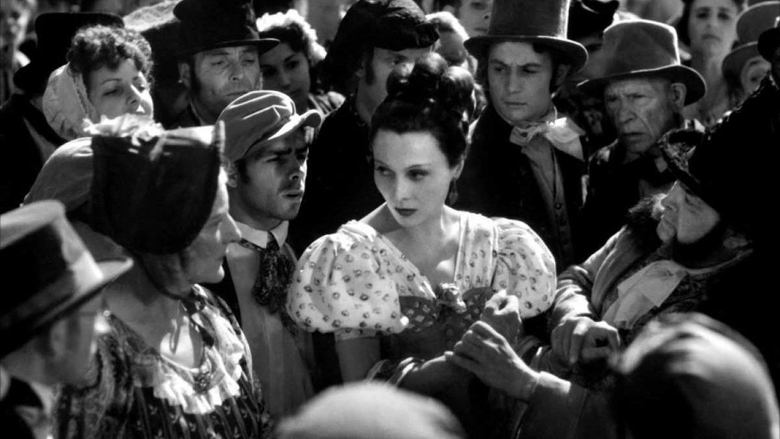
Represents the chaotic, indifferent, and overwhelming force of life and fate. The anonymous, masked figures swallow individuals, symbolizing how personal desires can be lost in the larger tide of society.
In the devastating final scene, Baptiste tries to chase after Garance's carriage but is swept away by a massive carnival crowd. Despite his desperate cries, he is lost in the sea of unheeding revelers, physically separated from his love by the unstoppable force of the world moving on.
Garance's Flower
A token of gratitude and the seed of Baptiste's undying love. It represents the simple, pure beginning of his idealized passion for her, a memory he clings to throughout the film.
After Baptiste saves her from a false accusation by performing a pantomime, Garance thanks him by tossing him a single flower. He catches it and treasures it, marking the moment he falls hopelessly in love with her.
Philosophical Questions
What is the relationship between art and reality?
The film constantly questions whether art is an escape from reality, a reflection of it, or a means to transcend it. The characters' lives bleed into their stage performances and vice versa. Baptiste can only truly express his pure love through the silent, idealized world of pantomime. Frédérick becomes a better actor only after experiencing real jealousy. The film suggests that life provides the raw material for art, but art offers a purity and clarity that life itself can never provide, creating a beautiful but painful paradox for the artist.
Can idealized love survive in the real world?
"Children of Paradise" poses this question through the central relationship of Baptiste and Garance. Baptiste's love is a perfect, dream-like ideal. Garance, however, is a product of the real world, forced to make compromises to survive. The film tragically concludes that such pure, uncompromising love cannot withstand the pressures of society, circumstance, and human fallibility. Baptiste's inability to seize the moment when Garance is available and his ultimate loss of her to the indifferent crowd suggests that idealized love belongs to the stage and the moonlight, not to the harsh light of day.
What constitutes true freedom?
Garance's character is a continuous exploration of this question. Is freedom the absence of constraints, the ability to love whom one chooses, or the refusal to be possessed? She gains financial security with the Count but loses her autonomy. She finds true love with Baptiste but is constrained by his marriage and the complications of his life. Her final departure can be interpreted as the ultimate choice for a solitary, but untethered, freedom, suggesting that for some, true freedom is incompatible with even the most profound love.
Core Meaning
"Children of Paradise" is a profound meditation on the nature of love, art, and fate. Director Marcel Carné and writer Jacques Prévert explore the idea that life itself is a form of theater, where individuals play roles dictated by society and their own passions. The central message is that true, idealized love—the kind Baptiste dreams of—is often unattainable in the real world, which is messy and complex. The film suggests a tragic dichotomy between the purity of art (Baptiste's pantomime) and the compromises of life.
The title itself refers to the common folk in the cheapest theater seats, "the gods," who watch the drama unfold, mirroring the audience of the film. Ultimately, the film conveys a sense of fatalism, a key element of the Poetic Realism movement, where characters are swept away by forces beyond their control. Baptiste's final, desperate attempt to reach Garance through an indifferent carnival crowd symbolizes the struggle of the individual artist against the overwhelming, chaotic force of life itself.