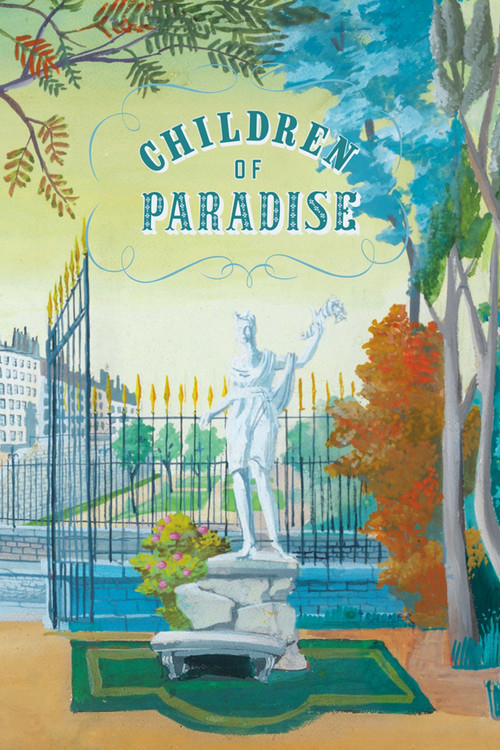
Children of Paradise
Les Enfants du Paradis
"AT LAST! The Celebrated French Film."
Overview
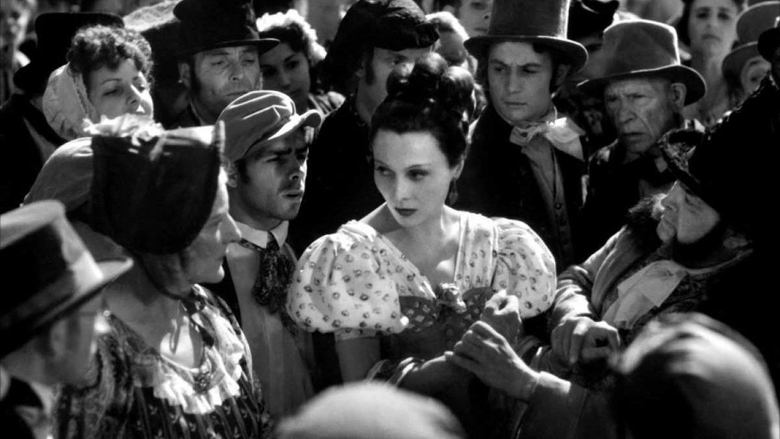
Set in the theatrical world of 1830s Paris, "Children of Paradise" tells the sprawling story of the beautiful and free-spirited courtesan, Garance (Arletty), and the four men who fall in love with her. The film is divided into two parts, "The Boulevard of Crime" and "The Man in White." The story unfolds on the bustling Boulevard du Temple, a place teeming with theaters, criminals, and street performers.
Garance's admirers come from all walks of life: the sensitive and soulful mime, Baptiste Deburau (Jean-Louis Barrault); the flamboyant and ambitious actor, Frédérick Lemaître (Pierre Brasseur); the cynical and dangerous criminal, Pierre-François Lacenaire (Marcel Herrand); and the wealthy, possessive aristocrat, the Count Édouard de Montray (Louis Salou). Each man desires Garance in his own way, but it is her profound connection with Baptiste that forms the tragic heart of the narrative.
Through a series of chance encounters, theatrical performances, and fateful decisions, their lives become inextricably intertwined. Their passions, jealousies, and unfulfilled desires play out both on the stage and in the streets, blurring the line between performance and reality. Garance, seeking freedom above all, finds herself repeatedly constrained by the love and possessiveness of the men who adore her, leading to years of separation and a heartbreaking conclusion.
Core Meaning
"Children of Paradise" is a profound meditation on the nature of love, art, and fate. Director Marcel Carné and writer Jacques Prévert explore the idea that life itself is a form of theater, where individuals play roles dictated by society and their own passions. The central message is that true, idealized love—the kind Baptiste dreams of—is often unattainable in the real world, which is messy and complex. The film suggests a tragic dichotomy between the purity of art (Baptiste's pantomime) and the compromises of life.
The title itself refers to the common folk in the cheapest theater seats, "the gods," who watch the drama unfold, mirroring the audience of the film. Ultimately, the film conveys a sense of fatalism, a key element of the Poetic Realism movement, where characters are swept away by forces beyond their control. Baptiste's final, desperate attempt to reach Garance through an indifferent carnival crowd symbolizes the struggle of the individual artist against the overwhelming, chaotic force of life itself.
Thematic DNA
The Dichotomy of Art and Life
The film constantly blurs the lines between performance on stage and the drama of the characters' real lives. The passions and tragedies they experience are mirrored, and sometimes rehearsed, in their theatrical roles. For example, Frédérick's jealousy of Baptiste and Garance fuels his ability to finally play Othello authentically. Baptiste, a master of silent expression on stage, struggles to articulate his love in real life. The theater becomes a space where hidden truths are revealed, but it also highlights the painful gap between the ideal world of art and the messy compromises of reality.
Unattainable Love and Desire
The central narrative is driven by the impossible love between Baptiste and Garance. Each of the four suitors desires Garance, but none can truly possess her. She represents an ideal of freedom and truth that eludes them all. Baptiste's love is pure but passive; Frédérick's is passionate but fleeting; Lacenaire's is possessive and intellectual; and the Count's is based on wealth and control. Garance herself is trapped by their desires, forced to make choices that compromise her freedom, ultimately leading to the tragic conclusion that their love is destined to remain unfulfilled.
Freedom vs. Possession
Garance is a symbol of freedom. Her mantra is to please those she likes, but she refuses to be owned. Her tragedy is that the men who love her constantly try to possess her, leading her to flee. Baptiste idealizes her, the Count buys her protection, Lacenaire sees her as an accomplice, and Frédérick treats her as a conquest. Her ultimate departure in a carriage, leaving Baptiste lost in the crowd, is her final act of reclaiming her independence, even at the cost of happiness.
Class and Society
The film provides a rich, panoramic view of 1830s Parisian society, from the street performers and working-class audience of the "paradise" to the wealthy aristocrats. The characters' fates are deeply intertwined with their social standing. Garance moves between these different worlds, beloved by all but belonging to none. The rigid social structures of the time create insurmountable barriers to love and happiness, particularly for Baptiste, a man of the people, and Garance, a woman with a complicated past.
Character Analysis
Garance (Claire Reine)
Arletty
Motivation
Her primary motivation is to live freely and authentically. As she tells Baptiste, she is "simple" and wants to "please those I like." She is not driven by wealth or status, but by a desire to avoid being possessed or defined by others. This core motivation forces her to leave the men who try to cage her, even the one she truly loves.
Character Arc
Garance begins as a free-spirited woman of the people, navigating the world with a mix of charm and world-weariness. She seeks freedom and simple pleasures but becomes an object of intense desire for four men. Her arc is not one of transformation but of reaction; she is constantly forced to make choices that compromise her freedom to escape the possessiveness of others. She becomes the mistress of a count to avoid prison, but eventually returns to Paris, drawn by her love for Baptiste. Ultimately, she chooses her freedom over a complicated life with him, remaining an enigmatic and unattainable figure.
Baptiste Deburau
Jean-Louis Barrault
Motivation
Baptiste is motivated by an all-consuming, idealized love for Garance. She is his muse and the source of his art. He believes dreams and life are the same, and his entire existence becomes a performance of his unrequited passion. His art is the only realm where he can fully express the love he cannot seem to grasp in reality.
Character Arc
Baptiste starts as a gifted but unrecognized street mime. His love for Garance awakens his artistic genius, transforming him into the star of the Funambules theatre. However, his idealism and inability to act decisively in his personal life lead to his tragedy. He idealizes Garance to such an extent that he hesitates when she offers herself to him. Years later, though married to Nathalie and a father, he remains consumed by his love for Garance. His arc is one of artistic triumph and personal failure, culminating in his desperate, futile pursuit of Garance through the carnival crowd.
Frédérick Lemaître
Pierre Brasseur
Motivation
Frédérick is driven by ambition and a thirst for life's experiences, both on and off the stage. He wants to conquer the theater world and every beautiful woman he meets. He sees life as a grand performance and himself as the leading man. As he exclaims, "Tonight you drank with Julius Caesar... It's my turn now. Let me have my chance."
Character Arc
Frédérick begins as a charming, arrogant, and womanizing actor, hungry for fame. He successfully seduces Garance but is incapable of the deep, devoted love Baptiste feels. Over the years, he achieves his dream of becoming a celebrated stage actor. His experience with Garance, particularly the jealousy he feels for the first time, deepens him as an artist, allowing him to finally understand and master the role of Othello. He evolves from a superficial philanderer into a more self-aware, albeit still flamboyant, artist who recognizes the nobility in Baptiste's love.
Pierre-François Lacenaire
Marcel Herrand
Motivation
Lacenaire is motivated by a contempt for societal norms and a desire to exert his will upon the world through crime and manipulation. He is an intellectual anarchist who takes pride in his evil. His interest in Garance stems from a mix of desire and the pleasure he takes in meddling in others' fates, stating that the thought of men killing each other over a woman because of him "comforts" him.
Character Arc
Lacenaire is a proud, articulate, and dangerous criminal who views the world with cynical detachment. He is involved with Garance early on and remains a menacing presence throughout the film. His character does not have a significant arc; he remains consistently amoral and contemptuous of society. He acts as a dark catalyst in the plot, his crimes forcing Garance to seek the Count's protection. His story ends as it was destined to, with him committing a final, defiant act of murder before being arrested.
Symbols & Motifs
The Theater Curtain
Symbolizes the boundary between art and life, illusion and reality. Its rising and falling frame the narrative, suggesting that the entire story is a grand performance.
The film famously opens with a theater curtain rising on the bustling Boulevard du Crime and ends with it falling, reinforcing the central metaphor that "all the world's a stage."
The Moon
Represents Baptiste's idealized, romantic, and often unattainable vision of love. It is associated with dreams and the poetic world of his pantomimes, contrasting with the harsh reality of daylight. Garance mentions she prefers the moonlight, suggesting an affinity for this dream world.
Baptiste's pantomimes are often set in moonlit landscapes, and his most profound moments of connection and despair with Garance are often discussed in terms of dreams and the ethereal quality of moonlight.
The Carnival Crowd
Represents the chaotic, indifferent, and overwhelming force of life and fate. The anonymous, masked figures swallow individuals, symbolizing how personal desires can be lost in the larger tide of society.
In the devastating final scene, Baptiste tries to chase after Garance's carriage but is swept away by a massive carnival crowd. Despite his desperate cries, he is lost in the sea of unheeding revelers, physically separated from his love by the unstoppable force of the world moving on.
Garance's Flower
A token of gratitude and the seed of Baptiste's undying love. It represents the simple, pure beginning of his idealized passion for her, a memory he clings to throughout the film.
After Baptiste saves her from a false accusation by performing a pantomime, Garance thanks him by tossing him a single flower. He catches it and treasures it, marking the moment he falls hopelessly in love with her.
Memorable Quotes
Paris est tout petit pour ceux qui s'aiment comme nous, d'un aussi grand amour.
— Garance
Context:
Garance says this to Frédérick Lemaître as they begin their affair. Frédérick worries that in a city as large as Paris, they might lose each other, but Garance reassures him with this poetic and confident declaration of their connection.
Meaning:
"Paris is small for those who share so great a passion as ours." This quote encapsulates the romantic idealism at the heart of the film, suggesting that a powerful love can make the vast, impersonal world feel intimate. It's a hopeful statement that is ultimately tested by the film's tragic events.
Les rêves, la vie, c'est la même chose. Sinon, à quoi bon vivre?
— Baptiste
Context:
Baptiste says this to Garance in her room when he confesses his love for her. She tells him that people only love in his idealistic way in dreams and books, not in real life, prompting his heartfelt response.
Meaning:
"Dreams, life; they're the same. Else life's not worth living." This is Baptiste's core philosophy. It reveals his inability to separate his idealized, artistic vision of love from the complexities of reality, which is both the source of his genius and the cause of his downfall.
Vous voulez être aimé comme un pauvre, et vous êtes riche.
— Garance
Context:
Garance delivers this line to the Count Édouard de Montray after he has become her protector. He is frustrated by her emotional distance, and she calmly explains the fundamental contradiction in his expectations of her.
Meaning:
"Not only are you rich, but you want to be loved as if you are poor." This incisive remark to the Count de Montray highlights the impossibility of his desire. Garance points out that he cannot use his wealth and power to secure her and then expect to receive a love that is pure and freely given, untainted by his status.
La jalousie appartient à tout le monde si une femme n'appartient à personne.
— Frédérick Lemaître
Context:
Frédérick makes this philosophical remark, reflecting on the complicated romantic entanglements surrounding Garance. It speaks to the central theme of freedom versus possession in the film.
Meaning:
"Jealousy belongs to all if a woman belongs to no one." This quote reflects the male characters' collective possessiveness towards Garance. Because she refuses to be owned by any single man, all of them feel a sense of jealous entitlement to her affections.
Philosophical Questions
What is the relationship between art and reality?
The film constantly questions whether art is an escape from reality, a reflection of it, or a means to transcend it. The characters' lives bleed into their stage performances and vice versa. Baptiste can only truly express his pure love through the silent, idealized world of pantomime. Frédérick becomes a better actor only after experiencing real jealousy. The film suggests that life provides the raw material for art, but art offers a purity and clarity that life itself can never provide, creating a beautiful but painful paradox for the artist.
Can idealized love survive in the real world?
"Children of Paradise" poses this question through the central relationship of Baptiste and Garance. Baptiste's love is a perfect, dream-like ideal. Garance, however, is a product of the real world, forced to make compromises to survive. The film tragically concludes that such pure, uncompromising love cannot withstand the pressures of society, circumstance, and human fallibility. Baptiste's inability to seize the moment when Garance is available and his ultimate loss of her to the indifferent crowd suggests that idealized love belongs to the stage and the moonlight, not to the harsh light of day.
What constitutes true freedom?
Garance's character is a continuous exploration of this question. Is freedom the absence of constraints, the ability to love whom one chooses, or the refusal to be possessed? She gains financial security with the Count but loses her autonomy. She finds true love with Baptiste but is constrained by his marriage and the complications of his life. Her final departure can be interpreted as the ultimate choice for a solitary, but untethered, freedom, suggesting that for some, true freedom is incompatible with even the most profound love.
Alternative Interpretations
While the film is primarily seen as a romantic tragedy, it is also frequently interpreted as a political allegory for the German occupation of France. In this reading, the beautiful and elusive Garance represents France itself, desired and threatened by various forces. The men who love her can be seen as different facets of French society: Baptiste as the pure, suffering artist (the soul of France); Frédérick as the pragmatic and pleasure-seeking collaborator; Lacenaire as the cynical nihilist; and the Count as the powerful, oppressive occupier. Garance's inability to be possessed symbolizes France's enduring, free spirit that cannot be conquered.
Another interpretation focuses on gender roles. While Garance is the object of the male gaze, she can also be viewed as a proto-feminist figure. She consistently rejects societal expectations and strives for personal autonomy. Her final act of leaving is not just tragic but can be seen as a defiant choice for freedom over being defined by a man, even one she loves. The film, in this light, critiques the possessiveness inherent in traditional romantic love.
Cultural Impact
"Children of Paradise" was released in March 1945, just after the liberation of Paris, and was immediately hailed as a masterpiece and a symbol of French cultural resilience. Filmed under the immense difficulties of the Nazi occupation, its very existence is considered a triumph of art over adversity. It became a cornerstone of the Poetic Realism movement, representing the style's grand, fatalistic, and romantic culmination.
Critically, the film has received near-universal acclaim for decades, often cited as the greatest French film of all time. Directors like François Truffaut and Marlon Brando lauded it, with Truffaut famously saying he would give up all his own films to have directed it. Its epic scale led to it being marketed as the French "Gone with the Wind," a comparison that highlights its status as a defining national epic.
Its influence can be seen in later films that celebrate theatricality and romanticism. The film's aesthetic, which blends gritty reality with lyrical beauty, influenced generations of filmmakers. The characters, many based on real 19th-century figures like the mime Jean-Gaspard Deburau and the criminal Lacenaire, have become iconic archetypes in French culture. The movie's enduring legacy lies in its powerful story of impossible love and its miraculous creation, which serves as a testament to the enduring power of art in the darkest of times.
Audience Reception
Upon its release in 1945, "Children of Paradise" was an immediate and immense success with French audiences, who saw it as a grand celebration of their culture after years of occupation. It ran for 54 consecutive weeks in Paris. Audiences praised its epic scope, the lavish and detailed reconstruction of 19th-century Paris, the poetic dialogue by Jacques Prévert, and the unforgettable performances, especially by Arletty as Garance and Jean-Louis Barrault as Baptiste. The film's blend of melodrama, romance, tragedy, and comedy resonated deeply.
Criticism is rare, though some contemporary critics noted its cool, admirable quality, finding it a spectacle that holds the viewer at a slight emotional distance. Some have found its three-hour runtime daunting. However, the overwhelming consensus, both then and now, is one of adoration. It is consistently praised for its humanity, complexity, and visual splendor, earning its reputation as one of the most beloved films in cinema history.
Interesting Facts
- The film was shot during the Nazi occupation of France under extremely difficult conditions, with shortages of film stock, food, and electricity.
- Production took place in both Vichy France (Nice) and occupied Paris. The massive main set, a quarter-mile long recreation of the Boulevard du Temple, was built in Nice but was severely damaged by a storm and had to be rebuilt.
- To get around the Nazi-imposed 90-minute limit for films, director Marcel Carné planned it as two separate films, confident he could join them into a single three-hour epic after the war.
- The production secretly employed Jewish crew members, including composer Joseph Kosma and production designer Alexandre Trauner, who had to work from hiding.
- Many of the 1,800 extras were members of the French Resistance, using the film's production as cover.
- The actor Robert Le Vigan, who played the informer Jéricho, was a known Nazi collaborator. He fled as the Allies advanced on Paris, and his scenes had to be re-shot with actor Pierre Renoir (brother of director Jean Renoir).
- Lead actress Arletty was imprisoned for a time after the Liberation for her wartime affair with a German officer. She famously retorted, "My heart is French, but my ass is international."
- At the time, it was the most expensive film ever made in France.
- In a 1995 poll of 600 French critics and professionals, it was voted the "Best Film Ever".
⚠️ Spoiler Analysis
Click to reveal detailed analysis with spoilers
Frequently Asked Questions
Explore More About This Movie
Dive deeper into specific aspects of the movie with our detailed analysis pages
Comments (0)
No comments yet. Be the first to share your thoughts!