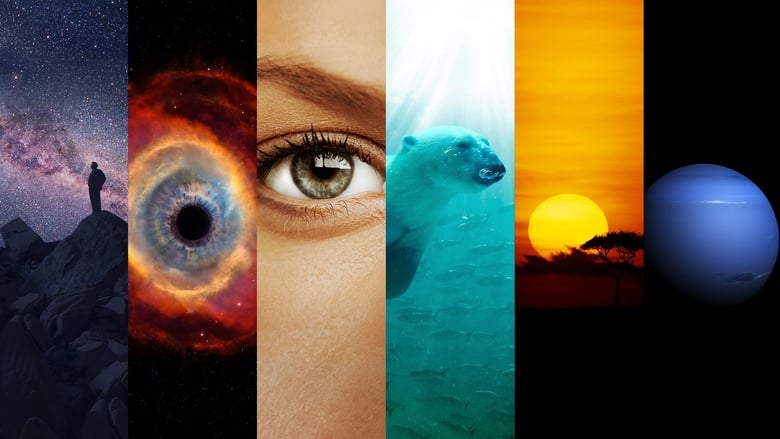
"An epic adventure in time, space and life."
Cosmos - Symbolism & Philosophy
Symbols & Motifs
Ship of the Imagination
The Ship of the Imagination symbolizes the power of human intellect and curiosity to transcend physical limitations. It is a narrative vessel that can travel anywhere in space and time, representing the boundless reach of the scientific mind. It's a vehicle powered not by fuel, but by thought and the scientific method.
Used throughout both A Spacetime Odyssey and Possible Worlds, the ship is the primary mode of transport for host Neil deGrasse Tyson. It takes viewers from the surface of a neutron star to the inside of a molecule, and from the moments after the Big Bang to the distant future, serving as a consistent visual anchor for the series' grand journey of exploration.
The Cosmic Calendar
The Cosmic Calendar is a powerful tool for cosmological perspective. It compresses the entire 13.8-billion-year history of the universe into a single Earth year. This metaphor viscerally demonstrates the immense age of the universe and the incredibly recent arrival of humanity, with all of recorded history occupying only the last few seconds of December 31st. It symbolizes our humble place in the grand sweep of cosmic time.
Introduced in the first episode of A Spacetime Odyssey and referenced again in Possible Worlds, the calendar is a recurring motif used to contextualize major events, such as the formation of the Milky Way, the birth of the Sun, the emergence of life, and the dawn of human civilization.
The Halls of Extinction
This symbolic location represents the fragility of life and the finality of extinction. It's a memorial to the countless species that have vanished from Earth due to cataclysmic events. It serves as a stark warning about the potential for self-inflicted extinction that humanity currently faces through climate change and environmental destruction.
Featured in A Spacetime Odyssey, Tyson walks through a celestial hallway lined with pillars representing Earth's five major mass extinction events. He reflects on the species lost and warns that a sixth hall is being built, this time by our own actions.
Philosophical Questions
What is our place and responsibility in the universe?
The series constantly grapples with this question. It uses scientific scale—both spatial and temporal—to induce a sense of humility, the 'cosmic perspective.' By showing that we are made of 'star stuff' and are the products of billions of years of cosmic evolution, it argues that our existence is precious and interconnected with the cosmos itself. This leads to an exploration of our responsibility: as the universe's way of knowing itself, we have an obligation to continue the search for knowledge and to protect the single oasis of life we know, Earth.
How can we distinguish truth from dogma?
Through its historical narratives, Cosmos explores the ongoing conflict between the scientific method and systems of belief that rely on authority and revelation. The stories of figures like Bruno, Galileo, and Patterson (who fought corporate interests to determine the age of the Earth) serve as parables. The series posits that the 'simple set of rules'—test ideas, question everything, follow the evidence—is the only reliable way to discern reality, and that this method is a liberating force for humanity.
What kind of future is possible for humanity?
This question is central to Cosmos: Possible Worlds. The series presents a crossroads. One path, marked by denial of science and short-sightedness, leads to environmental collapse. The other, illuminated by science and imagination, leads to a sustainable world and a future as a multi-planetary species. It explores plausible future technologies and societal shifts, framing our future not as a predetermined fate, but as a choice that depends on the wisdom we apply to our scientific knowledge.
Core Meaning
The core message of Cosmos is that the scientific method is the most powerful tool humanity has for self-discovery and understanding our true place in the universe. The series champions a worldview grounded in evidence, skepticism, and the relentless pursuit of knowledge, urging viewers to question everything and follow the evidence wherever it leads. It posits that we are not separate from the universe, but a way for the cosmos to know itself; our bodies are made of 'star stuff,' inextricably linking us to the grand cosmic drama. Ultimately, Cosmos is a call to action: to embrace our cosmic heritage, overcome our terrestrial squabbles, and use our collective intelligence to solve challenges like climate change and secure a future among the stars.