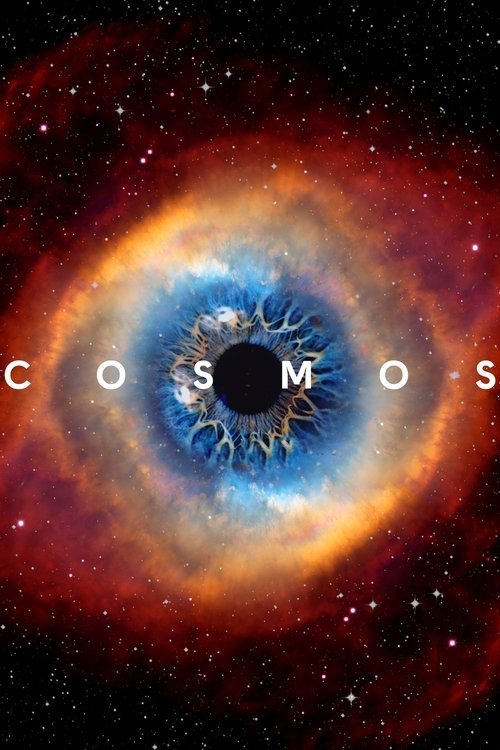
Cosmos
A documentary odyssey traveling through space and time, igniting cosmic wonder with a breathtaking visual symphony of scientific revelation.
Cosmos

Cosmos

"An epic adventure in time, space and life."

09 March 2014 — 20 April 2020 United States of America 2 season 26 episode Ended ⭐ 8.5 (1,607)
Cast: Neil deGrasse Tyson, Ann Druyan, Carl Sagan, Seth MacFarlane, Sasha Sagan
Documentary
The Pursuit of Knowledge Humanity's Place in the Cosmos Interconnectedness of Life and the Universe Hope and Responsibility for the Future

Overview

Presented by astrophysicist Neil deGrasse Tyson, Cosmos: A Spacetime Odyssey (2014) and its sequel, Cosmos: Possible Worlds (2020), serve as a profound follow-up to Carl Sagan's original 1980 series. This modern iteration continues the journey of discovery, exploring humanity's place in the universe and our quest to understand the laws of nature. Using the iconic 'Ship of the Imagination,' the series travels across billions of years and light-years, from the Big Bang to the potential futures of humanity.

The series is structured around thirteen-episode seasons, each delving into diverse scientific subjects including astrophysics, biology, history of science, and cosmology. Through stunning CGI, animated sequences, and on-location filming across the globe, Cosmos makes complex scientific concepts accessible and awe-inspiring. It profiles unsung heroes of science, illustrates key principles like evolution and relativity, and contextualizes the vastness of cosmic history with the 'Cosmic Calendar,' all while maintaining the original's spirit of skepticism, wonder, and hope for the future.

Core Meaning

The core message of Cosmos is that the scientific method is the most powerful tool humanity has for self-discovery and understanding our true place in the universe. The series champions a worldview grounded in evidence, skepticism, and the relentless pursuit of knowledge, urging viewers to question everything and follow the evidence wherever it leads. It posits that we are not separate from the universe, but a way for the cosmos to know itself; our bodies are made of 'star stuff,' inextricably linking us to the grand cosmic drama. Ultimately, Cosmos is a call to action: to embrace our cosmic heritage, overcome our terrestrial squabbles, and use our collective intelligence to solve challenges like climate change and secure a future among the stars.

Thematic DNA

The Pursuit of Knowledge 35%
Humanity's Place in the Cosmos 30%
Interconnectedness of Life and the Universe 20%
Hope and Responsibility for the Future 15%

The Pursuit of Knowledge

This is the central theme of the entire series. Each episode is a testament to the human drive to understand the universe. The show chronicles the 'heroic quest for knowledge,' highlighting historical figures like Giordano Bruno, Ibn al-Haytham, and Cecilia Payne who challenged dogma and followed evidence at great personal cost. The series frames science not as a body of facts, but as an ongoing process of discovery—a journey from ignorance to understanding, driven by curiosity and strict adherence to the scientific method.

Humanity's Place in the Cosmos

Cosmos consistently works to provide perspective on our significance. Through tools like the 'Cosmic Address' and the 'Cosmic Calendar,' it demonstrates our physical smallness and the brevity of our existence against the 13.8-billion-year history of the universe. Yet, it simultaneously celebrates our preciousness and potential. The series emphasizes that we are made of star-stuff, a direct product of cosmic evolution, and possess a consciousness capable of comprehending the universe from which we sprang—making us a vital, if tiny, part of the cosmic story.

Interconnectedness of Life and the Universe

The series beautifully illustrates the profound connections between all things. It traces the lineage of life on Earth back to its earliest microbial forms, showing that all living things share a common ancestry written in our DNA. This interconnectedness extends to the non-living, as the show explains how the elements forged in the hearts of long-dead stars form our planets, our bodies, and everything we know. It is a powerful message of unity, both terrestrial and cosmic.

Hope and Responsibility for the Future

While celebrating past discoveries, Cosmos is deeply focused on the future. A Spacetime Odyssey addresses the threat of climate change head-on in 'The World Set Free.' Possible Worlds expands on this, envisioning potential futures—some darkened by our inaction, others bright with scientific solutions and interstellar exploration. The series carries a profoundly optimistic and hopeful tone, arguing that if we embrace science and work together, we can overcome our challenges and create a better future.

Character Analysis

Neil deGrasse Tyson

Himself

Archetype: The Mentor / The Guide
Key Trait: Infectious Enthusiasm

Motivation

Tyson's motivation, both stated and demonstrated, is to ignite curiosity and share the power and wonder of the scientific perspective with the widest possible audience. He aims to bridge the gap between the scientific community and the general public, demonstrating why science is not just a subject in school but is essential to our survival, our culture, and our deepest sense of self. He seeks to empower viewers with knowledge and inspire the next generation of 'searchers.'

Character Arc

As the host, Neil deGrasse Tyson's role is not one of dramatic change, but of guiding the audience on a journey of intellectual and emotional discovery. He begins as the inheritor of Carl Sagan's legacy, standing on the same cliffs where the original series began. Throughout A Spacetime Odyssey, he is the enthusiastic and clear-eyed teacher, breaking down complex ideas. In Possible Worlds, his tone evolves slightly, becoming more urgent and hopeful as he presents visions of humanity's future, solidifying his role as a passionate advocate for a scientifically literate and aspirational society.

Symbols & Motifs

Ship of the Imagination

Meaning:

The Ship of the Imagination symbolizes the power of human intellect and curiosity to transcend physical limitations. It is a narrative vessel that can travel anywhere in space and time, representing the boundless reach of the scientific mind. It's a vehicle powered not by fuel, but by thought and the scientific method.

Context:

Used throughout both A Spacetime Odyssey and Possible Worlds, the ship is the primary mode of transport for host Neil deGrasse Tyson. It takes viewers from the surface of a neutron star to the inside of a molecule, and from the moments after the Big Bang to the distant future, serving as a consistent visual anchor for the series' grand journey of exploration.

The Cosmic Calendar

Meaning:

The Cosmic Calendar is a powerful tool for cosmological perspective. It compresses the entire 13.8-billion-year history of the universe into a single Earth year. This metaphor viscerally demonstrates the immense age of the universe and the incredibly recent arrival of humanity, with all of recorded history occupying only the last few seconds of December 31st. It symbolizes our humble place in the grand sweep of cosmic time.

Context:

Introduced in the first episode of A Spacetime Odyssey and referenced again in Possible Worlds, the calendar is a recurring motif used to contextualize major events, such as the formation of the Milky Way, the birth of the Sun, the emergence of life, and the dawn of human civilization.

The Halls of Extinction

Meaning:

This symbolic location represents the fragility of life and the finality of extinction. It's a memorial to the countless species that have vanished from Earth due to cataclysmic events. It serves as a stark warning about the potential for self-inflicted extinction that humanity currently faces through climate change and environmental destruction.

Context:

Featured in A Spacetime Odyssey, Tyson walks through a celestial hallway lined with pillars representing Earth's five major mass extinction events. He reflects on the species lost and warns that a sixth hall is being built, this time by our own actions.

Memorable Quotes

The cosmos is also within us. We're made of star stuff. We are a way for the cosmos to know itself.

— Neil deGrasse Tyson

Context:

This line is stated in Season 1, Episode 2, "Some of the Things That Molecules Do," during a discussion of the elements essential for life and how they were forged in the hearts of stars.

Meaning:

This quote, echoing a famous sentiment from Carl Sagan, encapsulates one of the series' core messages: the profound, literal connection between human beings and the universe. It reframes our existence not as small and insignificant, but as a vital and precious manifestation of the universe's own evolution toward self-awareness.

This adventure is made possible by generations of searchers strictly adherent to a simple set of rules. Test ideas by experiments and observations. Build on those ideas that pass the test. Reject the ones that fail. Follow the evidence wherever it leads, and question everything.

— Neil deGrasse Tyson

Context:

This is part of the opening narration in the first episode of A Spacetime Odyssey, "Standing Up in the Milky Way," setting the philosophical tone for the entire series.

Meaning:

This quote is the series' mission statement for the scientific method. It defines science not as a collection of unchanging facts, but as a disciplined process of inquiry that is self-correcting and evidence-based. It is the foundation upon which all the knowledge presented in the show is built.

Science works on the frontier between knowledge and ignorance. We're not afraid to admit what we don't know. There's no shame in that. The only shame is to pretend that we have all the answers.

— Neil deGrasse Tyson

Context:

Delivered in Season 1, Episode 2, "Some of the Things That Molecules Do," while discussing the mystery of abiogenesis—how life first arose on Earth.

Meaning:

This statement champions scientific humility and intellectual honesty. It directly contrasts the scientific process with dogma, emphasizing that admitting ignorance is not a weakness but a prerequisite for discovery. It highlights the comfort science has with uncertainty and the ongoing nature of the quest for knowledge.

Episode Highlights

Standing Up in the Milky Way

S1E1

This premiere episode sets the stage for the entire series. It introduces Neil deGrasse Tyson as the new host, the sleekly redesigned Ship of the Imagination, and core concepts like the 'Cosmic Address' and the 'Cosmic Calendar.' It also features a powerful animated segment on the Renaissance philosopher Giordano Bruno, whose story is used to champion free thought against dogma.

Significance:

It masterfully establishes the show's tone, visual style, and core themes, paying homage to Carl Sagan's original while carving its own identity. It successfully re-introduces Cosmos to a new generation, defining its mission to explore our place in space and time.

Hiding in the Light

S1E5

This episode is a celebration of light itself. It explores how we discovered the nature of light, from the early experiments of Ibn al-Haytham, who established the scientific method, to Newton's work with prisms and William Herschel's discovery of infrared radiation. It reveals how analyzing the light from distant stars allows us to understand their composition, age, and motion.

Significance:

It brilliantly demonstrates how a single scientific topic—light—can unlock vast amounts of information about the universe. The focus on Ibn al-Haytham also serves the series' goal of highlighting lesser-known but crucial figures in the history of science from various cultures.

Sisters of the Sun

S1E8

This episode focuses on the lives and deaths of stars. It also tells the inspiring story of the 'Harvard Computers,' a group of women, including Annie Jump Cannon and Cecilia Payne, who made foundational discoveries about the classification and composition of stars despite facing immense gender bias in the early 20th century.

Significance:

The episode is a powerful blend of astrophysics and social history. By telling the story of Cecilia Payne, it not only explains key stellar science but also delivers a compelling narrative about perseverance and the struggle for recognition in science, highlighting the contributions of women who were long overlooked.

The World Set Free

S1E12

The series directly confronts the issue of climate change. Tyson explains the greenhouse effect, the science behind global warming, and the potential catastrophic consequences of inaction. The episode contrasts the dangerous climate of Venus with Earth's delicate balance and highlights the promise of sustainable energy sources.

Significance:

This was one of the series' most discussed and politically relevant episodes. It fulfilled the tradition of the original Cosmos, where Sagan addressed the threat of nuclear war, by using its platform to issue a clear, science-based warning about the most pressing existential threat of our time.

The Man of a Trillion Worlds

S2E6

This episode of Possible Worlds is a heartfelt tribute to the visionary who started it all: Carl Sagan. It chronicles his early life, his formative relationships with mentors Gerard Kuiper and Harold Urey, and his groundbreaking work in planetary science that paved the way for missions like Voyager.

Significance:

It connects the new series directly to its roots, honoring Sagan not just as a science communicator but as a brilliant and influential scientist. The episode serves as a powerful origin story for the entire Cosmos project and its enduring philosophy.

Philosophical Questions

What is our place and responsibility in the universe?

The series constantly grapples with this question. It uses scientific scale—both spatial and temporal—to induce a sense of humility, the 'cosmic perspective.' By showing that we are made of 'star stuff' and are the products of billions of years of cosmic evolution, it argues that our existence is precious and interconnected with the cosmos itself. This leads to an exploration of our responsibility: as the universe's way of knowing itself, we have an obligation to continue the search for knowledge and to protect the single oasis of life we know, Earth.

How can we distinguish truth from dogma?

Through its historical narratives, Cosmos explores the ongoing conflict between the scientific method and systems of belief that rely on authority and revelation. The stories of figures like Bruno, Galileo, and Patterson (who fought corporate interests to determine the age of the Earth) serve as parables. The series posits that the 'simple set of rules'—test ideas, question everything, follow the evidence—is the only reliable way to discern reality, and that this method is a liberating force for humanity.

What kind of future is possible for humanity?

This question is central to Cosmos: Possible Worlds. The series presents a crossroads. One path, marked by denial of science and short-sightedness, leads to environmental collapse. The other, illuminated by science and imagination, leads to a sustainable world and a future as a multi-planetary species. It explores plausible future technologies and societal shifts, framing our future not as a predetermined fate, but as a choice that depends on the wisdom we apply to our scientific knowledge.

Alternative Interpretations

While overwhelmingly praised, the series has faced some critical interpretations. Some historians of science have argued that the show's narrative approach, particularly its use of animated historical vignettes, sometimes simplifies complex historical events. The portrayal of Giordano Bruno in the first episode, for instance, was critiqued by some as framing him as a martyr for science, when his persecution was rooted in more complex theological heresies, not just his cosmological ideas.

Additionally, some critics viewed the series' tone as overly reverential or even 'spiritual,' suggesting its cathedral-like Ship of the Imagination and soaring rhetoric positioned science as a new form of religion. Others felt that in its effort to reach a broad audience, it occasionally oversimplified the science, especially when compared to more in-depth documentaries. These interpretations, however, are in the minority and often acknowledge the series' primary goal as inspiration and outreach rather than purely academic instruction.

Cultural Impact

Cosmos: A Spacetime Odyssey was a landmark event for science communication in the 21st century. Premiering in 2014 on a major broadcast network, it brought rigorous, beautifully produced science content to a primetime audience of a scale not seen since the original series in 1980. It sparked a renewed public conversation about science, from evolution to climate change, and was widely praised by critics and educators for making complex topics accessible and inspiring. The series won numerous awards, including a Peabody Award and several Creative Arts Emmys, for its educational content and stunning visual presentation.

Its influence extended beyond television, driving interest in science education and popular science books, and solidifying Neil deGrasse Tyson's status as one of the world's most recognizable science communicators. The show's unapologetic stance on contentious issues like climate change and evolution, while praised by the scientific community, also drew criticism from creationist and climate-skeptic groups, highlighting the cultural divides the series sought to bridge with evidence and reason. The follow-up, Possible Worlds, continued this legacy, with an even greater emphasis on the future and humanity's choices. The rebooted Cosmos stands as a powerful testament to the enduring public appetite for knowledge and a potent antidote to scientific illiteracy in the modern media landscape.

Audience Reception

Cosmos: A Spacetime Odyssey was met with widespread acclaim from audiences. It holds high ratings on platforms like IMDb and Rotten Tomatoes, where viewers frequently praise its stunning visuals, accessible explanations of complex science, and Neil deGrasse Tyson's charismatic and inspiring presentation. Many viewers saw it as a worthy successor to Carl Sagan's original, successfully capturing its sense of wonder for a new generation. The animated segments telling stories from the history of science were also a frequently lauded element.

Criticism from audiences was sparse but generally centered on a few points. Some fans of the original series felt that the 2014 version, being on a commercial network, had a faster pace and less of the meditative, poetic quality of Sagan's delivery. A segment of viewers also took issue with the show's direct confrontation of topics like evolution and climate change, perceiving it as a political stance. Cosmos: Possible Worlds was also well-received, though it reached a smaller audience than the 2014 series. Overall, the audience verdict was overwhelmingly positive, with the series being celebrated as intelligent, beautiful, and important television.

Interesting Facts

  • The series was executive produced by Seth MacFarlane, creator of 'Family Guy'. MacFarlane was a fan of the original series and used his influence and financial backing to help get the new series made and aired on a major network like Fox, ensuring a massive audience.
  • Ann Druyan, who co-wrote the original series and was married to Carl Sagan, was the lead writer, director, and executive producer for both 'A Spacetime Odyssey' and 'Possible Worlds', ensuring a direct continuation of the original's vision and spirit.
  • The premiere of 'A Spacetime Odyssey' in 2014 was a massive global television event, simulcast across ten U.S. networks owned by Fox, including the main broadcast channel, FX, and National Geographic.
  • The score for the series was composed by Alan Silvestri, famous for his work on films like 'Back to the Future', 'Forrest Gump', and 'The Avengers'.
  • Neil deGrasse Tyson was inspired to pursue a career in astrophysics after meeting Carl Sagan as a high school student. Sagan invited the teenage Tyson to spend a day with him at Cornell University.
  • The shooting locations for the series were extensive, with crews filming in over 30 locations worldwide, including Iceland (to represent the early Earth), Europe, and North America, to capture the global nature of the scientific endeavor.

Easter Eggs

In the first episode of 'A Spacetime Odyssey,' when Neil deGrasse Tyson opens Carl Sagan's 1979 appointment book, one of the visible entries is a meeting with 'A. Druyan,' referring to Ann Druyan.

This is a subtle and personal nod to the deep connection between the show's creators. Ann Druyan and Carl Sagan fell in love while working on the Voyager Golden Record and were married until his death. Her stewardship of the new series is a continuation of their shared life's work.

A drawing of the 'Pioneer Plaque,' co-designed by Carl Sagan and Frank Drake, is briefly visible on a blackboard.

This references Sagan's pioneering work in the Search for Extraterrestrial Intelligence (SETI). The plaque was an attempt to communicate information about humanity and our location to any extraterrestrial life that might intercept the Pioneer 10 and 11 spacecraft.

⚠️ Spoiler Analysis

Click to reveal detailed analysis with spoilers

Frequently Asked Questions

Explore More About This Movie

Dive deeper into specific aspects of the movie with our detailed analysis pages

Comments (0)

Leave a comment

No comments yet. Be the first to share your thoughts!