カウボーイビバップ 天国の扉
"They're here to save the planet. But not for free."
Cowboy Bebop: The Movie - Symbolism & Philosophy
Symbols & Motifs
Golden Butterflies
They symbolize the nanomachines' effect on the brain, but philosophically represent the human soul and the boundary between the waking world and the dream world. They are the visual manifestation of Vincent's dissociation.
Seen surrounding victims of the virus and constantly hallucinated by Vincent. They fill the screen during the final confrontation as the nanomachines are neutralized.
The Tower (Eiffel Replica)
Represents the bridge between heaven and earth. It is a liminal space where the final judgment occurs, elevating the conflict above the mundane world of the city below.
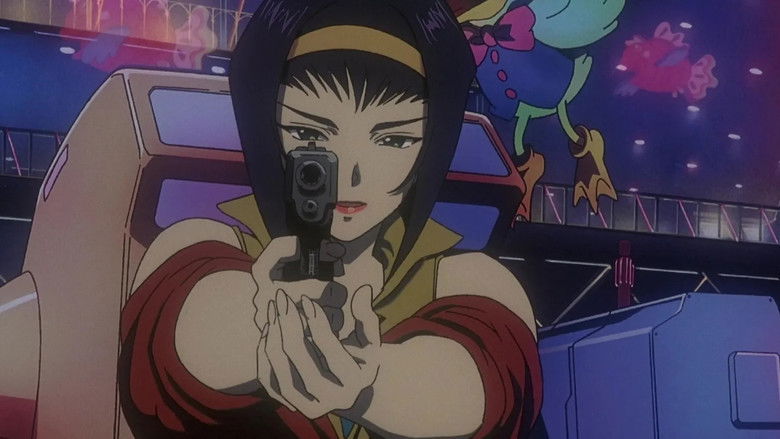
The setting for the final duel between Spike and Vincent, taking place on Halloween, a holiday traditionally associated with the thinning veil between the living and the dead.
The Jack-o'-lanterns
Symbolizes the masking of identity and the collective madness of the crowd. It reinforces the theme of a "carnival of souls" where death walks unnoticed among the living.
Used throughout the Halloween parade scenes, contrasting the festive atmosphere with the impending doom of the terrorist attack.
Philosophical Questions
Is there a distinction between the waking world and the dream world?
The film uses the Butterfly Dream paradox to suggest that reality is subjective. If one's sensory input (like Vincent's hallucinations) is altered, 'reality' changes. The film asks if living in a painful reality is better than a peaceful eternal dream.
Can we exist without our memories?
Vincent argues that without memory, there is no self, and thus he is already dead. The film explores the idea that our identity is constructed from our past connections to others, and without them, we are merely ghosts.
Core Meaning
At its heart, the film explores the nature of reality versus dreams and the prison of the past. Director Shinichirō Watanabe uses the antagonist, Vincent, as a dark reflection of Spike—both are men "killed" in their pasts who now wander through life like ghosts. The film asks whether we live in the waking world or a dream, suggesting that without connection or memory, reality loses its substance. Ultimately, it is a meditation on finding peace in a transient existence.