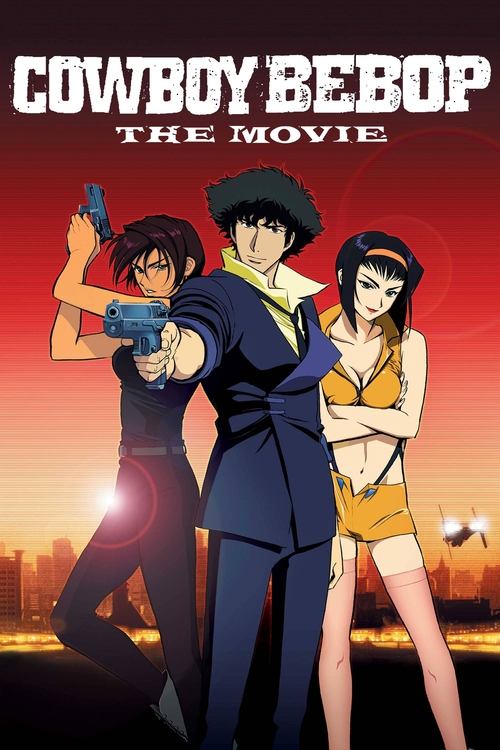
Cowboy Bebop: The Movie
カウボーイビバップ 天国の扉
"They're here to save the planet. But not for free."
Overview
Set between episodes 22 and 23 of the original series, the film follows the crew of the spaceship Bebop as they hunt for a mysterious terrorist named Vincent Volaju. After a tanker truck explosion releases a deadly pathogen in Alba City on Mars, the government issues a record-breaking bounty of 300 million woolongs. Spike Spiegel, Jet Black, Faye Valentine, and Ed (with Ein) split up to track down the perpetrator, uncovering a conspiracy involving biological experiments and a pharmaceutical corporation.
As Spike closes in on Vincent, he discovers a man haunted by his past as a test subject in the Titan War. Vincent plans to release nanomachines that mimic glowing butterflies, trapping the world in a "dream" of death to escape his own purgatory. The investigation leads Spike to Elektra Ovirowa, a security agent with a secret connection to Vincent. The climax unfolds atop a replica of the Eiffel Tower on Halloween, where Spike and Vincent engage in a brutal hand-to-hand duel amidst a rain of vaccine and golden butterflies.
Core Meaning
At its heart, the film explores the nature of reality versus dreams and the prison of the past. Director Shinichirō Watanabe uses the antagonist, Vincent, as a dark reflection of Spike—both are men "killed" in their pasts who now wander through life like ghosts. The film asks whether we live in the waking world or a dream, suggesting that without connection or memory, reality loses its substance. Ultimately, it is a meditation on finding peace in a transient existence.
Thematic DNA
Dreams vs. Reality
The central motif, inspired by Zhuangzi's Butterfly Dream. Vincent cannot distinguish his reality from a dream, seeing golden butterflies that represent the blurring of these states. Spike, too, claims to be "living in a bad dream," creating a philosophical parallel between the hero and villain.
The Ghost of the Past
Both Spike and Vincent are defined by trauma they cannot escape. While Spike runs from his past with the Syndicate, Vincent seeks to destroy the world to erase his. The film suggests that one must confront their history to find release, even if it leads to death.
Solitude and Connection
The film highlights the crushing loneliness of its characters. Vincent died "alone" in his mind, while Spike pushes others away. The resolution hinges on the realization of love (Vincent remembering Elektra), positing that connection is the only anchor in a drifting reality.
Character Analysis
Vincent Volaju
Daran Norris (English) / Tsutomu Isobe (Japanese)
Motivation
To escape the "dream" he is trapped in and find the door to the real world, believing that death is the only exit.
Character Arc
A former soldier experimented on during the Titan War, rendered amnesiac and insane. He seeks to open the "door to heaven" by killing everyone. In his final moments, he regains his memory of loving Elektra, finding the peace he sought not in death, but in remembered connection.
Spike Spiegel
Steve Blum (English) / Kōichi Yamadera (Japanese)
Motivation
To confront his own existential reflection and test his reality against Vincent's.
Character Arc
Spike starts as a bounty hunter seeking a payout but becomes personally invested in stopping Vincent as he recognizes their shared existential detachment. He fights not just to save the city, but to prove to himself that he is still alive.
Elektra Ovirowa
Jennifer Hale (English) / Ai Kobayashi (Japanese)
Motivation
To stop Vincent and free him from his suffering.
Character Arc
A corporate soldier hunting Vincent, initially appearing cold and duty-bound. It is revealed she was Vincent's lover and unknowingly carries the cure to his virus. She ultimately delivers the killing shot, an act of mercy and love.
Symbols & Motifs
Golden Butterflies
They symbolize the nanomachines' effect on the brain, but philosophically represent the human soul and the boundary between the waking world and the dream world. They are the visual manifestation of Vincent's dissociation.
Seen surrounding victims of the virus and constantly hallucinated by Vincent. They fill the screen during the final confrontation as the nanomachines are neutralized.
The Tower (Eiffel Replica)
Represents the bridge between heaven and earth. It is a liminal space where the final judgment occurs, elevating the conflict above the mundane world of the city below.
The setting for the final duel between Spike and Vincent, taking place on Halloween, a holiday traditionally associated with the thinning veil between the living and the dead.
The Jack-o'-lanterns
Symbolizes the masking of identity and the collective madness of the crowd. It reinforces the theme of a "carnival of souls" where death walks unnoticed among the living.
Used throughout the Halloween parade scenes, contrasting the festive atmosphere with the impending doom of the terrorist attack.
Memorable Quotes
I'm just watching a bad dream I never wake up from.
— Spike Spiegel
Context:
Spoken to Elektra when she asks who he is and why he fights.
Meaning:
Encapsulates Spike's entire worldview: his life ended years ago, and his current existence feels like a purgatorial illusion. It connects him directly to Vincent's philosophy.
I have no fear of death. It just means dreaming in silence. A dream that lasts for eternity.
— Vincent Volaju
Context:
During his first confrontation with Spike on the monorail.
Meaning:
Reveals Vincent's nihilism and his view of death not as an end, but as a peaceful release from the chaotic "noise" of his life.
And you will shed tears of scarlet.
— Mysterious Voice (Rasheed)
Context:
Spoken by the Moroccan shaman/merchant to Spike early in the film.
Meaning:
A prophecy warning Spike of the danger he faces, hinting at the bloody and emotional toll of the final battle.
Philosophical Questions
Is there a distinction between the waking world and the dream world?
The film uses the Butterfly Dream paradox to suggest that reality is subjective. If one's sensory input (like Vincent's hallucinations) is altered, 'reality' changes. The film asks if living in a painful reality is better than a peaceful eternal dream.
Can we exist without our memories?
Vincent argues that without memory, there is no self, and thus he is already dead. The film explores the idea that our identity is constructed from our past connections to others, and without them, we are merely ghosts.
Alternative Interpretations
The Dream Theory: Some fans interpret the entire movie as a dream Spike has while sleeping on the couch (where he starts and ends the film). This supports the film's heavy use of dream imagery but is generally debated against the official timeline.
Vincent as Spike's Future: Another reading views Vincent not just as a mirror, but as a warning of what Spike could become—a man so consumed by the loss of his past love that he destroys everything around him. Spike's victory is a rejection of this nihilistic path, even if he cannot fully escape his own fate.
Cultural Impact
Cowboy Bebop: The Movie is widely regarded as one of the greatest anime films of all time, serving as a perfect entry point to the franchise while deepening its lore. Stylistically, it set a high bar for animation quality, blending CGI with hand-drawn art in a way that remains visually impressive decades later. Critically, it was praised for its mature storytelling, complex villain, and Yoko Kanno's eclectic soundtrack, though some critics felt the runtime was too long for a plot that felt like an extended episode. Culturally, it solidified the series' status in the West, helping to usher in the 'golden age' of anime on Adult Swim in the early 2000s.
Audience Reception
Audience reception has been overwhelmingly positive, with the film holding high ratings on platforms like IMDb and Rotten Tomatoes. Praised aspects include the fluid animation, particularly the fight choreography, the atmospheric jazz/funk soundtrack, and the character depth of Vincent. Criticism is often minor, focusing on the pacing in the second act and the lack of screen time for characters like Ed and Faye compared to Spike. Overall, it is seen as a masterpiece that perfectly captures the cool, melancholic vibe of the series.
Interesting Facts
- The film's plot involves a bioterrorist attack on a skyscraper, which eerily paralleled the 9/11 attacks that occurred shortly after its Japanese release. This led to delays and limited screenings in the US.
- The character of Vincent Volaju was modeled after the actor Vincent Gallo.
- Director Shinichirō Watanabe intentionally included long, silent scenes of the city to create a 'live-action' atmosphere, inspired by films like Dirty Harry.
- The opening credits sequence features the song 'Ask DNA' and is a stylistic homage to 1960s spy thrillers.
- The fight scenes were choreographed with high fidelity to Jeet Kune Do, Bruce Lee's martial art style, which Spike practices.
- The subtitle 'Knockin' on Heaven's Door' is a direct reference to the Bob Dylan song, fitting the film's themes of death and purgatory.
- Hiroomi Murata, a minor character who dies early, was named after a real production staff member.
Easter Eggs
PlayStation 1 in the Shaman's Hut
In the clutter of Rasheed's shop, a PS1 console can be seen, a nod to the era of the film's production and the Cowboy Bebop game.
"Sany" Electronics
Throughout the film, billboards and devices feature the brand "Sany," a playful spoof of the real-world electronics giant Sony, the film's distributor.
Antonio, Carlos, and Jobim
The three recurring old men from the TV series make a cameo appearance, continuing their running gag of showing up everywhere the crew goes.
Drive-in Movie Western
During a scene at a drive-in theater, a classic Western plays on the screen, acknowledging the show's genre-blending roots as a "Space Western."
⚠️ Spoiler Analysis
Click to reveal detailed analysis with spoilers
Frequently Asked Questions
Explore More About This Movie
Dive deeper into specific aspects of the movie with our detailed analysis pages
Comments (0)
No comments yet. Be the first to share your thoughts!