
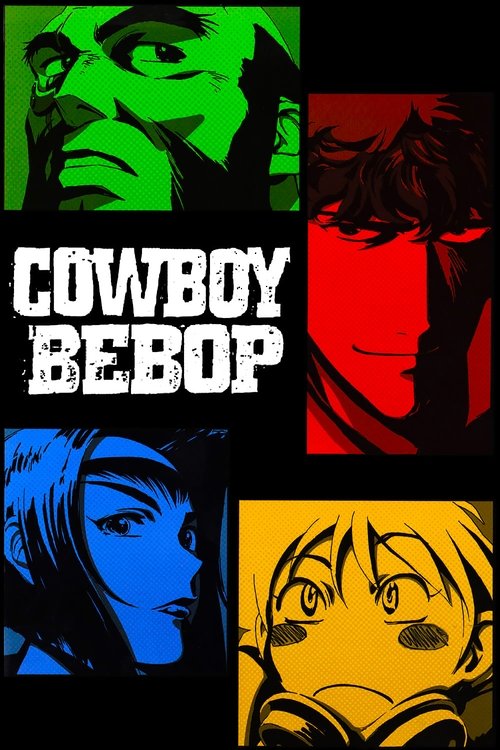
カウボーイビバップ
"See you space cowboy..."
Cowboy Bebop - Symbolism & Philosophy
Symbols & Motifs
Spike's Artificial Eye
It symbolizes Spike's fractured perception of reality and his connection to the past. He states that with one eye he sees the present, and with the other, he sees the past. This represents his inability to fully move on from his life in the Syndicate and his relationship with Julia. It suggests he is perpetually living in a dream-like state, never fully present.
Mentioned explicitly by Spike in the final episode, "The Real Folk Blues, Part 2," before he leaves to confront Vicious. During his final battle, his natural eye is blinded by blood, forcing him to rely on the artificial eye—the eye of his past—to finish his fight, symbolizing that he must fully embrace his past to meet his end.
The Spaceship Bebop
The Bebop itself symbolizes a temporary haven or purgatory for its lost souls. It is a worn, battered, and constantly in-need-of-repair vessel, mirroring the brokenness of its crew members. It's a place where they can drift and coexist, a limbo where they can postpone dealing with their pasts, but not a place where they can stay forever.
The ship is the central setting for the entire series. Its cramped and communal spaces force the isolated characters to interact, fostering their makeshift family dynamic. Its constant state of disrepair reflects their perpetual financial struggles and the precariousness of their lives.
Falling Stars / Shooting Stars
Shooting stars symbolize the fleeting nature of life and destiny. An old storyteller tells Spike the story of a warrior whose star falls when he dies. Spike sees himself as a star that has already burned out, simply waiting to fall. This motif reinforces the series' fatalistic and melancholic tone.
This is most prominent in the final episode, "The Real Folk Blues, Part 2." After Spike collapses, the camera pans up to the sky, where a single star winks out, implying his death.
Cigarettes
Cigarettes are a recurring motif, symbolizing a moment of quiet contemplation, existential boredom, or a way to pass the time before the inevitable. Spike's bent cigarettes are a specific homage to the character Jigen from "Lupin III." They represent a cool, detached, and fatalistic attitude in the face of chaos.
Characters, especially Spike and Faye, are frequently shown smoking throughout the series. It's often during moments of reflection, after intense action, or when grappling with their inner turmoil. Spike's final gesture is to form a "Bang" with his fingers before collapsing, a call back to an earlier story and a final, cool acceptance of his fate.
Philosophical Questions
Can we ever truly escape our past?
The series consistently answers this with a resounding "no." Every main character is defined and driven by their past. Spike's history with the Syndicate, Jet's police career, and Faye's amnesia are not backstories but active forces in their present lives. The narrative structure, which frequently flashes back and introduces figures from their pasts, reinforces the idea that the past is an inescapable part of one's identity. The series suggests that while you cannot erase or outrun your past, you can choose how to confront it, and that confrontation, for better or worse, is what defines your existence.
What does it mean to be 'alive'?
"Cowboy Bebop" explores this question primarily through Spike. For much of the series, he is alive physically but is emotionally and spiritually dormant, describing his life as a dream he can't wake from. His final quote, "I'm going there to find out if I'm really alive," posits that being alive is not just about breathing but about feeling, purpose, and consciousness. For Spike, true life is found only in the intensity of confronting his past and facing death, suggesting that life's meaning is found in moments of profound, authentic experience rather than in prolonged, aimless existence.
Where can one find a sense of belonging?
The series examines this through the makeshift family formed on the Bebop. Four lonely, disparate individuals find a temporary home and a fragile sense of belonging with each other. However, the series treats this belonging as transient. The crew is not a permanent solution to their individual loneliness; they are fellow travelers sharing a path for a short time. This suggests that belonging is not a permanent state but a series of fleeting connections that provide temporary solace in a vast, indifferent universe.
Core Meaning
"Cowboy Bebop" is fundamentally a story about the inability to escape one's past and the burden of carrying that weight. The creators explore existentialism, loneliness, and the search for meaning in a seemingly indifferent universe through the eyes of its characters. Each member of the Bebop crew is running from something—a past trauma, a lost love, a forgotten identity—and their formation of a makeshift family is a temporary solace, not a permanent solution. The series suggests that while you can't erase the past, confronting it is the only way to find out if you are truly alive, even if that confrontation leads to a tragic end. It's a poignant reflection on how memories and past actions define the present, and the bittersweet nature of life, loss, and acceptance.