Cowboy Bebop
カウボーイビバップ
"See you space cowboy..."
Overview
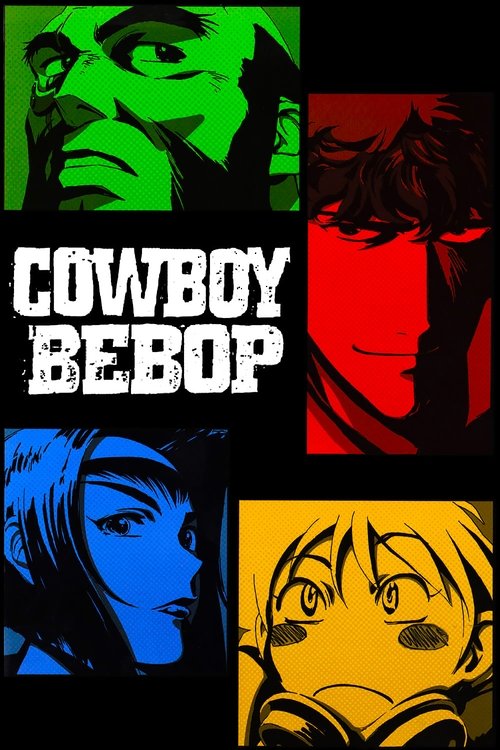
Set in the year 2071, "Cowboy Bebop" follows the lives of a ragtag crew of bounty hunters, or "cowboys," aboard their spaceship, the Bebop. Humanity has colonized several planets and moons in the solar system after Earth was left largely uninhabitable. The crew consists of Spike Spiegel, a former hitman haunted by his past; Jet Black, a pragmatic ex-cop and the ship's owner; Faye Valentine, an amnesiac con artist with a massive debt; Edward Wong Hau Pepelu Tivrusky IV (Ed), an eccentric and brilliant hacker; and Ein, a genetically engineered, highly intelligent Pembroke Welsh Corgi.
While many episodes are standalone adventures detailing their often-unsuccessful pursuit of bounties, an overarching narrative slowly unfolds, delving into the unresolved pasts of each character. The main story arc centers on Spike's deadly rivalry with Vicious, a ruthless figure from his former life in the Red Dragon Crime Syndicate, and his lingering love for a mysterious woman named Julia. The series masterfully blends genres, including space opera, western, and film noir, creating a unique and atmospheric universe that explores deep philosophical themes through the lives of its transient and troubled protagonists.
Core Meaning
"Cowboy Bebop" is fundamentally a story about the inability to escape one's past and the burden of carrying that weight. The creators explore existentialism, loneliness, and the search for meaning in a seemingly indifferent universe through the eyes of its characters. Each member of the Bebop crew is running from something—a past trauma, a lost love, a forgotten identity—and their formation of a makeshift family is a temporary solace, not a permanent solution. The series suggests that while you can't erase the past, confronting it is the only way to find out if you are truly alive, even if that confrontation leads to a tragic end. It's a poignant reflection on how memories and past actions define the present, and the bittersweet nature of life, loss, and acceptance.
Thematic DNA
The Inescapable Past
This is the central theme of the series. Every main character is haunted by their history. Spike is pursued by his violent life in the Red Dragon Syndicate and his relationship with Vicious and Julia. Jet cannot forget his past as a police officer and the betrayal that cost him his arm. Faye is tormented by her amnesia and the crippling debt she awoke to after decades in cryogenic sleep, desperately searching for a connection to her former self. The narrative consistently demonstrates that no matter how far they travel across the solar system, their pasts eventually catch up to them, forcing confrontations they've long avoided.
Existentialism and Loneliness
"Cowboy Bebop" is steeped in existential ennui. The characters often question their purpose and grapple with a profound sense of loneliness, even when surrounded by their crewmates. They are drifters in the vast emptiness of space, moving from one bounty to the next without a grand purpose. Faye's quote, "Instead of feeling alone in a group, it's better to be alone in your solitude," encapsulates this theme perfectly. The series explores the idea that life may lack inherent meaning, and individuals must create their own, often finding it in fleeting moments of connection or in the finality of confronting their fate.
The Makeshift Family
Despite their individualistic and often cynical natures, the crew of the Bebop forms a dysfunctional but genuine found family. They bicker, compete, and often keep secrets from one another, yet they also share meals, protect each other, and provide a sense of belonging that none of them had before. This family is fragile and temporary, as shown by Ed's departure and Spike's final decision to leave, highlighting the transient nature of their relationships. Faye's tearful plea for Spike to stay shows how much she has come to rely on this found family, even if she can't admit it.
Memory and Identity
The series constantly explores how memory, or the lack thereof, shapes identity. Spike sees his past in one eye and the present in the other, feeling trapped between two realities. Faye's entire arc is a quest to recover her lost memories to understand who she is, only to find that the home she remembered is gone. This theme questions whether we are defined more by our past selves or the person we have become in the present, suggesting a complex interplay between the two.
Character Analysis
Spike Spiegel
Koichi Yamadera
Motivation
Initially, Spike's motivation seems to be mere survival and finding the next meal. However, his true, underlying motivation is his unresolved connection to Julia and Vicious. He is described as being in a "near-constant lethargy" because he lost the woman he loved. His actions are ultimately driven by a need for closure and to settle the score with Vicious, a desire that fully crystallizes after Julia is killed.
Character Arc
Spike begins the series as a detached, lethargic bounty hunter who seems to be simply drifting through life. His laid-back demeanor hides a deep melancholy and a violent past as a member of the Red Dragon Crime Syndicate. As the series progresses, encounters with figures from his past force him to confront the life he left behind. His arc is not one of change, but of acceptance. He never truly escapes his past; instead, he ultimately chooses to face it head-on, leading to his final, fatal confrontation with Vicious. He goes from running from his past to consciously choosing to find out if he is "truly alive" by facing it directly.
Jet Black
Unsho Ishizuka
Motivation
Jet's motivation is to live a life of integrity on his own terms, away from the corruption he experienced as an ISSP officer. He values loyalty and responsibility, often acting as the crew's moral compass. He is driven by a need for a peaceful, orderly existence, which is constantly disrupted by the chaos his partners bring. He is also motivated by a paternal instinct to care for the crew of the Bebop.
Character Arc
Jet is the anchor of the Bebop crew, a former cop who clings to a sense of order and morality in a chaotic universe. His arc involves coming to terms with his cynical view of the world, born from a betrayal in his past that cost him his arm and his faith in the justice system. He acts as a father figure to the rest of the crew, providing stability and wisdom. Over the series, he learns to let go of some of his rigidity and accept his new life and makeshift family, though he never fully sheds his world-weary persona. His journey is one of finding a new purpose after his old life was taken from him.
Faye Valentine
Megumi Hayashibara
Motivation
Faye's primary motivation throughout the series is to uncover her past and find out who she really is. This search for identity drives her actions, often leading her into dangerous situations. She is also driven by a more basic need for survival and to pay off her overwhelming debt, which fuels her gambling habits and opportunistic nature.
Character Arc
Faye is introduced as a cynical, selfish, and untrustworthy con artist. Her tough exterior is a defense mechanism born from waking up from cryogenic sleep with amnesia and a massive debt. Her arc is a journey of self-discovery and learning to trust others. Initially, she repeatedly leaves the Bebop, but always returns, implicitly acknowledging it as the only home she has. After recovering her memories and realizing her old life is gone forever, she fully embraces the Bebop crew as her found family, showing profound emotional growth when she tearfully begs Spike not to leave for his final battle.
Edward Wong Hau Pepelu Tivrusky IV
Aoi Tada
Motivation
Ed is motivated by curiosity, fun, and a desire for adventure. She doesn't seem to care about money or material possessions. Her actions are whimsical and often unpredictable. She joins the Bebop crew on a whim and leaves just as spontaneously when she decides to reconnect with her father, demonstrating her free-spirited nature.
Character Arc
Ed is an eccentric genius hacker who lives in her own world. She serves as the show's primary source of comic relief and represents a childlike innocence and freedom that contrasts with the world-weariness of the other characters. Her arc is less about internal change and more about experiencing a sense of belonging for the first time with the Bebop crew. She eventually leaves the crew with Ein to find her eccentric father, choosing her original family over her found one. Her departure marks the beginning of the end for the Bebop crew's time together and signifies a shift to the series' darker, concluding tone.
Symbols & Motifs
Spike's Artificial Eye
It symbolizes Spike's fractured perception of reality and his connection to the past. He states that with one eye he sees the present, and with the other, he sees the past. This represents his inability to fully move on from his life in the Syndicate and his relationship with Julia. It suggests he is perpetually living in a dream-like state, never fully present.
Mentioned explicitly by Spike in the final episode, "The Real Folk Blues, Part 2," before he leaves to confront Vicious. During his final battle, his natural eye is blinded by blood, forcing him to rely on the artificial eye—the eye of his past—to finish his fight, symbolizing that he must fully embrace his past to meet his end.
The Spaceship Bebop
The Bebop itself symbolizes a temporary haven or purgatory for its lost souls. It is a worn, battered, and constantly in-need-of-repair vessel, mirroring the brokenness of its crew members. It's a place where they can drift and coexist, a limbo where they can postpone dealing with their pasts, but not a place where they can stay forever.
The ship is the central setting for the entire series. Its cramped and communal spaces force the isolated characters to interact, fostering their makeshift family dynamic. Its constant state of disrepair reflects their perpetual financial struggles and the precariousness of their lives.
Falling Stars / Shooting Stars
Shooting stars symbolize the fleeting nature of life and destiny. An old storyteller tells Spike the story of a warrior whose star falls when he dies. Spike sees himself as a star that has already burned out, simply waiting to fall. This motif reinforces the series' fatalistic and melancholic tone.
This is most prominent in the final episode, "The Real Folk Blues, Part 2." After Spike collapses, the camera pans up to the sky, where a single star winks out, implying his death.
Cigarettes
Cigarettes are a recurring motif, symbolizing a moment of quiet contemplation, existential boredom, or a way to pass the time before the inevitable. Spike's bent cigarettes are a specific homage to the character Jigen from "Lupin III." They represent a cool, detached, and fatalistic attitude in the face of chaos.
Characters, especially Spike and Faye, are frequently shown smoking throughout the series. It's often during moments of reflection, after intense action, or when grappling with their inner turmoil. Spike's final gesture is to form a "Bang" with his fingers before collapsing, a call back to an earlier story and a final, cool acceptance of his fate.
Memorable Quotes
I'm not going there to die. I'm going there to find out if I'm really alive.
— Spike Spiegel
Context:
Spoken to Faye in Episode 26, "The Real Folk Blues, Part 2," as he prepares to leave the Bebop for his final assault on the Red Dragon Syndicate headquarters.
Meaning:
This quote encapsulates Spike's entire philosophy and the core meaning of the series. He realizes that avoiding his past has left him in a state of living death or a dream. Only by confronting his nemesis, Vicious, and the life he left behind can he truly feel alive and confirm his own existence, even if it means dying in the process.
Whatever happens, happens.
— Spike Spiegel
Context:
This phrase is repeated by Spike several times throughout the series, often before heading into a dangerous situation. It's a core part of his character identity.
Meaning:
This is Spike's personal mantra, reflecting his fatalistic, Zen-like acceptance of the flow of life and death. It shows his cool, detached approach to the immense dangers he faces, suggesting he has already come to terms with his own mortality. It embodies the show's blend of noir fatalism and Eastern philosophy.
Everything has a beginning and an end. Life is just a cycle of starts and stops. It is a series of stories.
— Jet Black
Context:
Spoken during a moment of reflection, this line captures Jet's role as the wise, contemplative member of the crew, often grounding the more impulsive members with his hard-earned wisdom.
Meaning:
Jet's quote reflects his mature, philosophical perspective on life's hardships. It speaks to the cyclical nature of existence and the transient relationships that define our lives. It suggests an acceptance of loss and change as fundamental parts of the human experience, a central theme of the show.
You're gonna carry that weight.
— Ending Card
Context:
These words appear on screen as the final shot of the series in Episode 26, "The Real Folk Blues, Part 2," after Spike collapses and a star winks out in the sky.
Meaning:
This final message of the series has multiple interpretations. It can refer to the emotional burdens the surviving characters (and the audience) must carry after Spike's death. It also alludes to the central theme of the inescapable past. The line is a direct reference to The Beatles' song "Carry That Weight," connecting the show's themes of responsibility and the past to a wider cultural context.
Episode Highlights
Asteroid Blues
The first episode masterfully sets the tone for the entire series, blending stylish action, a melancholic atmosphere, and a touch of tragedy. It introduces Spike and Jet and the world of bounty hunting through their pursuit of a drug dealer. The episode's bittersweet ending establishes that the life of a cowboy is not glamorous and that happy endings are rare.
"Asteroid Blues" serves as a perfect microcosm of the show as a whole. It establishes the unique genre blend, the jazzy aesthetic, and the underlying themes of desperation and loss that will permeate the following 25 episodes. The tragic fate of the episode's bounty foreshadows Spike's own inability to escape his past.
Ballad of Fallen Angels
This episode is the first major dive into Spike's past. It introduces his arch-nemesis, Vicious, and alludes to the mysterious Julia. The episode is famed for its highly stylized and dramatic church shootout, a visually stunning sequence set to a haunting operatic score that culminates in Spike falling from a stained-glass window.
This episode is critical as it formally introduces the central conflict of the series: Spike versus Vicious and the Red Dragon Syndicate. It establishes the high stakes of Spike's past and provides the first concrete clues about the life he ran away from, setting the stage for the series' dramatic climax.
Jupiter Jazz (Parts 1 & 2)
A two-part episode that expands on the history between Spike and Vicious through the story of Gren, a war veteran with a connection to Vicious. The episode has a somber, noir feel and features some of Yoko Kanno's most memorable music. It delves deeper into the themes of betrayal and the scars of the past, both emotional and physical.
"Jupiter Jazz" is significant for developing Vicious's character beyond a simple villain and for providing more context to the Syndicate's internal politics. It acts as a major stepping stone towards the final confrontation, building the sense of impending tragedy and reinforcing Spike's fatalistic journey back to his past.
Hard Luck Woman
This episode serves as the emotional finale for both Faye and Ed. Faye finally finds a clue that leads her to the ruins of her childhood home, while Ed reconnects with her father and decides to leave the Bebop. It's a poignant episode about memory, loss, and the dissolution of the Bebop family.
"Hard Luck Woman" is the beginning of the end for the series. Ed's departure signals a major shift in the group dynamic, effectively breaking up the found family. It resolves the primary character arcs for Faye and Ed, clearing the stage for the final, Spike-centric two-part finale. The sense of loss in this episode is palpable and sets a somber tone for what is to come.
The Real Folk Blues (Parts 1 & 2)
The two-part series finale brings Spike's story to its explosive and tragic conclusion. After Julia is killed by Syndicate assassins, a resolute Spike decides to face Vicious once and for all. He shares quiet, final goodbyes with Jet and Faye before launching a one-man assault on the Red Dragon headquarters.
This is the culmination of the entire series. It resolves the central conflict between Spike and Vicious and provides a definitive, if ambiguous, ending to Spike's journey. The finale is one of the most iconic and debated in anime history, perfectly embodying the show's themes of confronting the past and the bittersweet nature of fate. It leaves the audience with the powerful and lasting message: "You're gonna carry that weight."
Philosophical Questions
Can we ever truly escape our past?
The series consistently answers this with a resounding "no." Every main character is defined and driven by their past. Spike's history with the Syndicate, Jet's police career, and Faye's amnesia are not backstories but active forces in their present lives. The narrative structure, which frequently flashes back and introduces figures from their pasts, reinforces the idea that the past is an inescapable part of one's identity. The series suggests that while you cannot erase or outrun your past, you can choose how to confront it, and that confrontation, for better or worse, is what defines your existence.
What does it mean to be 'alive'?
"Cowboy Bebop" explores this question primarily through Spike. For much of the series, he is alive physically but is emotionally and spiritually dormant, describing his life as a dream he can't wake from. His final quote, "I'm going there to find out if I'm really alive," posits that being alive is not just about breathing but about feeling, purpose, and consciousness. For Spike, true life is found only in the intensity of confronting his past and facing death, suggesting that life's meaning is found in moments of profound, authentic experience rather than in prolonged, aimless existence.
Where can one find a sense of belonging?
The series examines this through the makeshift family formed on the Bebop. Four lonely, disparate individuals find a temporary home and a fragile sense of belonging with each other. However, the series treats this belonging as transient. The crew is not a permanent solution to their individual loneliness; they are fellow travelers sharing a path for a short time. This suggests that belonging is not a permanent state but a series of fleeting connections that provide temporary solace in a vast, indifferent universe.
Alternative Interpretations
The most significant point of debate and alternative interpretation in "Cowboy Bebop" is the fate of Spike Spiegel in the finale. While the visual cues—the falling star, his severe wounds, and the peaceful collapse—strongly imply his death, director Shinichirō Watanabe has deliberately maintained ambiguity.
One interpretation is that Spike does indeed die, and this is the only logical conclusion to his character arc. His life has been a "dream" since he left the Syndicate, and his final confrontation is him choosing to "wake up" and face his past, with death being the inevitable price for closure. His final word, "Bang," is a final, cool acceptance of his fate.
Another popular interpretation is that Spike merely passes out from his wounds and survives. Watanabe has stated he wants viewers to decide for themselves, leaving the door open for a more hopeful reading. In this view, Spike has finally freed himself from the weight of his past by defeating Vicious. Having done so, he is now free to truly live, and his collapse is a symbolic death of his old self, allowing for a rebirth.
A more metaphorical interpretation suggests that whether he physically lives or dies is irrelevant. The important thing is that he finally confronted his past and felt truly alive in that moment. His mission was complete, and the physical outcome is secondary to this spiritual and existential resolution.
Cultural Impact
"Cowboy Bebop" is widely regarded as a masterpiece and one of the greatest anime series of all time. Upon its release in the late 1990s, it stood out for its mature storytelling, complex characters, and cinematic quality. It played a crucial role in introducing anime to a new wave of Western viewers in the early 2000s, particularly through its broadcast on Adult Swim in the United States, and is often called a "gateway series" for new anime fans. Its English dub is frequently cited as one of the best of all time, helping to legitimize dubbed anime for a Western audience.
The series' unique blend of genres—sci-fi, western, film noir, and action—coupled with its groundbreaking jazz and blues soundtrack by Yoko Kanno, has had a lasting influence on both anime and Western animation and filmmaking. Director Rian Johnson, for example, cited "Cowboy Bebop" as a visual influence on his films. The show's exploration of profound philosophical themes like existentialism, loneliness, and the weight of the past resonated deeply with audiences and critics, elevating the perception of what animation could achieve as a narrative medium. Its legacy is its timelessness; it remains a cultural touchstone that continues to be discovered and celebrated by new generations of viewers for its style, substance, and emotional depth.
Audience Reception
"Cowboy Bebop" received widespread critical acclaim upon its release and is consistently ranked among the best anime series ever made. It was a commercial success both in Japan and internationally, especially in the United States, where its broadcast on Adult Swim garnered a massive and dedicated fanbase. Audiences and critics alike praised its sophisticated storytelling, deep character development, cinematic visual style, and, most notably, its phenomenal, genre-defining soundtrack by Yoko Kanno. The English dub was particularly lauded, often considered a rare example of a dub that rivals or even enhances the original Japanese version for Western viewers.
The main points of praise focus on its emotional maturity and thematic depth, tackling subjects like existentialism and the inability to escape one's past with a nuance rarely seen in animation. The episodic format, which allowed for diverse genre explorations from horror to comedy, was also celebrated. Criticism is sparse, though some find the central plot involving Spike, Vicious, and Julia to be less compelling than the standalone character-focused episodes. The series finale is iconic but also divisive; while many praise its poetic and tragic conclusion, others found it unsatisfyingly ambiguous or bleak. Overall, audience opinion has remained overwhelmingly positive for over two decades, cementing its status as a timeless classic.
Interesting Facts
- The creator is credited as "Hajime Yatate," which is a collective pseudonym for the animation staff of Sunrise studio. The project was led by director Shinichirō Watanabe.
- The series was initially sponsored by a toy company that wanted to sell spaceship models. However, Watanabe's mature and complex vision for the show caused the sponsorship to be pulled, and the production faced significant creative struggles.
- During its original TV run in Japan, "Cowboy Bebop" was considered too violent and mature, leading to its cancellation after only 12 episodes were aired. It was later picked up by the satellite network WOWOW, which broadcast the entire 26-episode series.
- The rich and varied soundtrack, composed by Yoko Kanno, is considered one of the greatest in anime history. Kanno formed the jazz/blues band "The Seatbelts" specifically to create the music for the series.
- Spike's fighting style is Jeet Kune Do, the martial art developed by Bruce Lee, who is a major influence on the series.
- Character designer Toshihiro Kawamoto modeled the character of Ed after the show's composer, Yoko Kanno, based on her energetic and eccentric personality.
- Every episode title (or "Session") is a reference to a song title or musical genre, such as "Asteroid Blues," "Honky Tonk Women," and "Bohemian Rhapsody," reflecting the deep integration of music into the show's identity.
- Spike's character design and persona were heavily influenced by the Japanese actor Yusaku Matsuda, particularly from his role in the 1979 detective drama "Tantei Monogatari."
Easter Eggs
The three recurring old men who appear throughout the series are named Antonio, Carlos, and Jobim.
This is a tribute to the legendary Brazilian bossa nova musician Antônio Carlos Jobim, whose music was a significant influence on the series' soundtrack.
In "Session #15: My Funny Valentine," the cryogenic chamber Faye escapes from has the serial number NCC-1701-B.
This is a direct reference to the registry number of the U.S.S. Enterprise from the "Star Trek" franchise, one of the many nods to classic science fiction in the series.
Spike's signature bent cigarettes are an homage.
This is a visual nod to the character Daisuke Jigen from the classic anime "Lupin III," a major inspiration for Shinichirō Watanabe. It is also a reference to jazz musician Dizzy Gillespie's bent trumpet.
The episode "Toys in the Attic" is filled with visual and thematic references.
The episode is a direct homage to the 1979 sci-fi horror film "Alien." The motion tracker Spike uses and the tense, suspenseful hunt for a mysterious creature on the ship are clear references to the movie.
In "Session #2: Stray Dog Strut," Spike's fight with Abdul Hakim on a bridge is a reference to a classic martial arts film.
The fight choreography is a tribute to the battle between Bruce Lee and Kareem Abdul-Jabbar in the movie "Game of Death."
⚠️ Spoiler Analysis
Click to reveal detailed analysis with spoilers
Frequently Asked Questions
Explore More About This Movie
Dive deeper into specific aspects of the movie with our detailed analysis pages
Comments (0)
No comments yet. Be the first to share your thoughts!