Skip to content
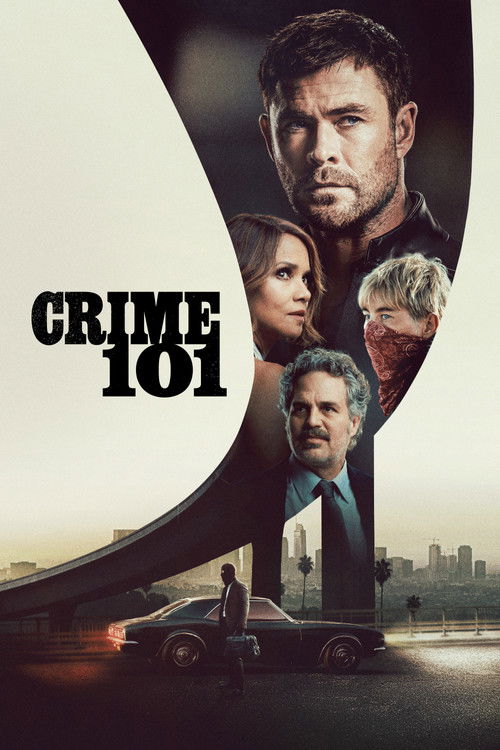
Crime 101
A sun-bleached Los Angeles noir drenched in existential loneliness, where high-speed asphalt arteries bleed into glittering criminal echo chambers as desperate, bound souls trade their ghosts for a clean exit.
Crime 101

Crime 101

"Always have an exit."

11 February 2026 United Kingdom 141 min 7.0 (1,231)

Director: Bart Layton

Cast: Chris Hemsworth, Mark Ruffalo, Halle Berry, Barry Keoghan, Monica Barbaro

Crime Thriller The Illusion of Moral Codes and Perfectionism Systemic Alienation and Modern Capitalism Obsession vs. Human Connection Discipline vs. Volatile Chaos Urban Isolation and Transience
Budget: $90,000,000
Box Office: $72,900,246

Overview

Directed and co-written by Bart Layton (The Imposter, American Animals), Crime 101 is an atmospheric neo-noir heist thriller adapted from Don Winslow’s 2020 novella of the same name. Set along the sun-scorched stretches and twilight neon corridors of Southern California’s U.S. Route 101, the story follows Mike Davis (Chris Hemsworth), an intensely disciplined, elusive jewel thief. Mike operates by an unyielding personal code: meticulous planning, targeting only high-value insured courier shipments, leaving no DNA or forensic trace, and strictly forbidding the use of physical violence.

Despite Mike’s flawless track record, LAPD Detective Lou Lubesnick (Mark Ruffalo)—a weary, hangdog investigator struggling with a decaying marriage and an unappreciative precinct—notices the subtle, recurring pattern connecting the seemingly disparate robberies along the 101 corridor. As Lou obsessively builds a profile of the ghost robber, Mike finds his routine disrupted after being grazed by a bullet during a close call. Seeking a path toward retirement, Mike allies with Sharon Combs (Halle Berry), a sharp, disillusioned insurance executive frustrated by corporate misogyny and ageism.

The fragile balance shatters when Mike’s veteran fence, Money (Nick Nolte), grows uneasy over Mike’s hesitations and introduces Ormon (Barry Keoghan), a chaos-drunk, violent rogue motorcycle thief. As Mike attempts to navigate a budding romance with a local woman named Maya (Monica Barbaro), the parallel paths of the principled thief, the relentless cop, the corporate insider, and the unpredictable wildcard inexorably converge toward a high-stakes final score.
Core Meaning

At its core, Bart Layton uses the classical mechanics of the Los Angeles heist thriller to probe modern systemic alienation, corporate inequality, and the psychological cost of self-imposed isolation. Rather than merely celebrating criminal efficiency, Layton examines how individuals across all strata of society—cops, criminals, and corporate executives—are constrained by unfeeling institutional structures.

Layton contrasts rigid, mechanical systems (corporate hierarchies, police bureaucracy, and strict criminal rules) with the messy reality of human empathy. The film argues that rigid codes and perfectionist routines are often defense mechanisms against vulnerability and poverty. Ultimately, Crime 101 suggests that genuine human connection, moral flexibility, and mutual understanding hold far greater value than institutional rules or material wealth.

Thematic DNA

The Illusion of Moral Codes and Perfectionism 30%
Systemic Alienation and Modern Capitalism 25%
Obsession vs. Human Connection 20%
Discipline vs. Volatile Chaos 15%
Urban Isolation and Transience 10%

The Illusion of Moral Codes and Perfectionism

Mike lives by 'Crime 101'—a strict set of rules meant to keep him safe and morally superior to brutal criminals. However, the film demonstrates that clean isolation is an illusion. When real danger threatens lives, Mike is forced to break his own non-violent rule, demonstrating that human morality cannot be fully categorized into rigid algorithms.

Systemic Alienation and Modern Capitalism

Every primary character is squeezed by late-stage capitalist systems. Sharon is passed over for partnership despite her expertise; Lou is marginalized by a metrics-obsessed police department; Mike steals specifically to build a safety net against poverty. The film highlights how concentrated wealth drives ordinary, capable individuals to push beyond legal boundaries.

Obsession vs. Human Connection

Lou’s fanatical obsession with his job destroys his home life, while Mike’s career requires complete emotional detachment. Both men are trapped in emotional isolation until they allow vulnerability to enter—Lou through acknowledging Mike’s humanity, and Mike through his relationship with Maya.

Discipline vs. Volatile Chaos

The narrative contrasts Mike’s patient, surgical professionalism with Ormon’s violent, impulsive aggression. Ormon represents the destructive threat that unchecked greed and chaos pose to structured environments.

Urban Isolation and Transience

Los Angeles is portrayed not as a sun-drenched paradise, but as a vast, fragmented expanse of highways where people drift past each other without making true contact.

Character Analysis

Mike / James Davis

Chris Hemsworth

Archetype: Gentleman Thief / Antihero Key Trait: Surgical precision and an absolute refusal to use gratuitous violence.

Motivation

Accumulating enough financial security to permanently exit the criminal underworld.

Character Arc

Begins as a guarded, hyper-disciplined lone wolf who believes rules can protect him from emotional and physical trauma. After a near-miss shot and falling for Maya, he risks his freedom and breaks his non-violent rule to save a life, ultimately stepping away from crime toward authentic living.

Detective Lou Lubesnick

Mark Ruffalo

Archetype: Obsessive Investigator / Unlikely Ally Key Trait: Unyielding intuition and deep-seated integrity.

Motivation

Solving cases through genuine detective work rather than institutional shortcuts.

Character Arc

A weary LAPD detective isolated by his superiors and facing personal burnout. His obsession with tracking the '101 Bandit' culminates not in an arrest, but in a profound recognition of Mike’s moral character, prompting him to choose personal ethics over systemic compliance.

All 5 characters and cast

Symbols & Motifs

U.S. Route 101 / Pacific Coast Highway

Meaning:

Represents transience, escape, and parallel lives moving along the same path without touching.

Context:

It serves as both a literal escape route and a metaphor for the continuous grind of modern life along Southern California highway corridors.

Vintage Racing Green Chevy Camaro vs. Battered Crown Victoria

Meaning:

Mike’s immaculate, green Chevy Camaro symbolizes personal pride, identity, and refined craftsmanship. Lou’s beat-up Ford Crown Victoria ('the shit bin') represents underappreciated public service and stagnant routine.

Context:

Used to contrast the two leads throughout the story; gifting the Camaro at the end acts as a transfer of mutual respect.

Scrubbed DNA / Forensic Rituals

Meaning:

Symbolizes Mike's obsessive need for invisibility and his fear of leaving any permanent mark on the world.

Context:

Showcased during Mike’s elaborate morning routine of scrubbing hair and removing skin cells prior to executing crimes.

Decoy Diamonds / Fake Jewels

Meaning:

Represent the artificial nature of luxury and value in high-society Los Angeles, demonstrating how wealth is manufactured by corporations and insurance institutions.

Context:

Featured during high-stakes diamond exchanges and thefts throughout the film.

Sleep Quality App & Motivational Podcasts

Meaning:

Reflects modern corporate burnout, anxiety, and the constant pressure to optimize self-worth in a hostile workplace.

Context:

Utilized by Sharon as she navigates corporate bias and workplace pressure.

Memorable Quotes

Those high value items your company insures... I occasionally make them disappear. And no one gets hurt.
— Mike Davis

Context

Said to Sharon while pitching their partnership.

Meaning

Establishes Mike's strict non-violent modus operandi and ethical framework for his criminal activity.

Now, remove every robbery where there was DNA left at the scene. I think all of these are the same guy, and he hits every time along the 101 freeway.
— Detective Lou Lubesnick

Context

Lou briefing his skeptical precinct colleagues about the pattern he uncovered.

Meaning

Demonstrates Lou's keen investigative instinct and establishes the core premise of the serial highway thefts.

All 5 quotes

Philosophical Questions

Can an illegal act be ethically justified if it strictly avoids physical harm and targets only illicit, insured wealth?

The film presents Mike’s non-violent thefts as cleaner than the predatory corporate practices of insurance firms and corrupt billionaires.

Does complete personal detachment preserve freedom, or does it strip life of meaning?

Mike’s isolation protects him from the law, but leaves him emotionally unfulfilled until he opens up to Maya.

When institutional justice fails, is individual moral subversion legitimate?

Lou’s decision to cover up Mike’s escape highlights the tension between strict legal duty and human morality.

Alternative Interpretations

Moral Integrity Over Systemic Law: This perspective views the climax as a triumph of personal ethics over flawed institutional laws. Detective Lou realizes that the criminal justice system often protects corrupt elites (such as Steven Monroe) while punishing desperate individuals. By letting Mike go and redirecting funds to Sharon, Lou executes true moral justice.

Full ending explanation

Cultural Impact

Released in February 2026, Crime 101 arrived as a throwback to character-focused, mid-budget crime thrillers popular in the 1990s. Critics widely praised the film for its sharp direction, visual style, and strong ensemble chemistry, earning an 88% approval rating on Rotten Tomatoes.

However, facing stiff box-office competition, the film grossed $72.9 million worldwide against a $90 million budget, underperforming theatrically. Despite its modest box-office returns, Crime 101 found major commercial success upon its release on Amazon Prime Video, becoming one of the platform's most-streamed thrillers of 2026.

Audience Reception

Viewers and critics applauded the magnetic dynamic between Hemsworth and Ruffalo, along with Barry Keoghan’s energetic performance, sleek atmospheric cinematography by Erik Wilson, and practical stunt choreography with tactile car chases.

Main points of criticism focused on the film's reliance on familiar heist tropes ('Heat-clone' tropes), a slightly bloated 140-minute runtime, and underused supporting characters like Nick Nolte's 'Money'. The ending generated debate between fans who enjoyed the satisfying resolution and purists who preferred a darker noir conclusion.

Interesting Facts

  • Crime 101 marks director Bart Layton’s first traditional, non-hybrid narrative feature film following his critically acclaimed docudramas The Imposter (2012) and American Animals (2018).
  • The film adapts Don Winslow’s 60-page novella Crime 101 from his 2020 short story collection Broken.
  • The core creative team actively fought to secure an exclusive, wide theatrical release via Amazon MGM Studios and Sony Pictures rather than releasing the film directly to streaming platforms.
  • Pedro Pascal was originally cast opposite Chris Hemsworth in August 2023, but stepped down due to scheduling conflicts; Mark Ruffalo subsequently took over the role of Detective Lou Lubesnick.
  • Legendary director William Friedkin invited Bart Layton to lunch after seeing American Animals, encouraging him to make a classic Los Angeles heist film.
  • Cinematographer Erik Wilson and Layton shot high-speed car and motorcycle chase sequences across real Los Angeles highways using custom rig setups to prioritize tactile, analog realism.
  • The film features a prominent reunion between Marvel Cinematic Universe leads Chris Hemsworth and Mark Ruffalo, while co-star Nick Nolte previously played David Banner in 2003’s Hulk.

Easter Eggs

Steve McQueen Homage

Two characters explicitly name-drop Steve McQueen in conversation. Mike’s racing green Chevy Camaro and precise driving techniques directly honor McQueen’s iconic green Ford Mustang GT in Bullitt (1968).

Michael Mann Cinematic Universe Nods

Mike’s sleek, sparsely furnished ocean-view apartment and strict rule against personal attachment pay homage to Neil McCauley in Heat (1995) and Frank in Thief (1981).

70s Car Chase Cinema

The high-speed nocturnal highway pursuit between Ormon’s motorcycle and Mike’s vehicle pays homage to classic car chase films like Vanishing Point (1971) and The Driver (1978).

Jennifer Jason Leigh Cameo

Acclaimed actress Jennifer Jason Leigh makes a cameo appearance as Angie Lubesnick, Lou’s estranged wife.

Frequently Asked Questions

Explore More About This Movie

Dive deeper into specific aspects of the movie with our detailed analysis pages

Comments (0)

Leave a comment

No comments yet. Be the first to share your thoughts!

Similar Movies