
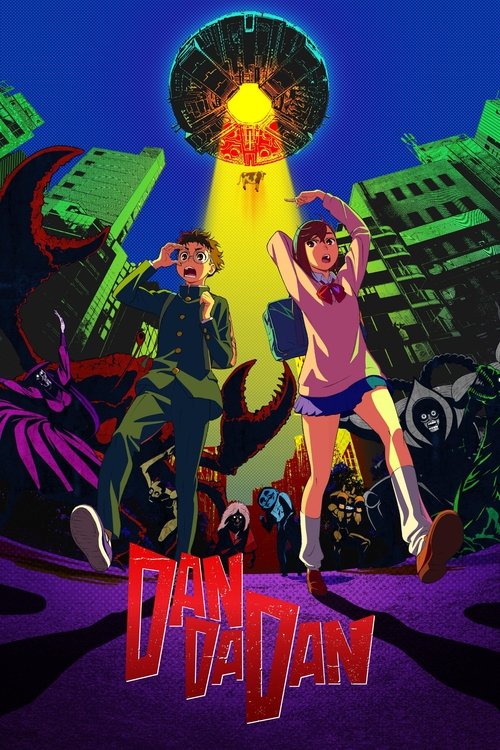
ダンダダン
Dan Da Dan - Symbolism & Philosophy
Symbols & Motifs
Aliens and Ghosts
These two entities represent the core duality of the series: the scientific versus the spiritual, the cosmic versus the earthly, and logic versus faith. They are the physical manifestations of Okarun and Momo's opposing belief systems.
From the very first episode, aliens and ghosts are established as equally real and dangerous forces. The narrative constantly forces the protagonists to confront both, demonstrating that the universe is far stranger and more complex than either of their individual worldviews allowed. Their battles with these creatures force them to synthesize their beliefs and work together, symbolizing the merging of their personalities and the growth of their relationship.
Okarun's Missing Testicles ('Golden Balls')
This is a direct and comedic symbol of Okarun's stolen masculinity, innocence, and the anxieties of puberty. Their recovery is tied to his journey of gaining confidence and becoming a hero in his own right.
After being possessed by Turbo Granny, Okarun loses his testicles, which she refers to as his 'family jewels'. The initial major quest of the series is for him and Momo to defeat Turbo Granny and retrieve them. This bizarre and crude mission serves as the catalyst for their partnership and forces Okarun to overcome his timid nature, literally fighting to reclaim a part of himself.
Turbo Granny
Turbo Granny symbolizes the predatory and chaotic nature of the supernatural world. She is a force of pure, dangerous id, but also represents a source of immense power that, once controlled, becomes a crucial asset. She embodies the series' blend of genuine horror and absurd comedy.
As the first major spiritual antagonist, Turbo Granny possesses Okarun and is obsessed with his genitals. After her defeat, her spirit is sealed within a Maneki-neko (lucky cat) doll and she becomes a begrudging, foul-mouthed ally. Her presence serves as a constant reminder of the dangerous power Okarun wields and the thin line between being a monster and controlling one.
Philosophical Questions
What is the nature of belief and evidence?
The series is founded on the clash between Momo's belief in ghosts and Okarun's belief in aliens. Both initially demand empirical proof from the other while holding their own beliefs as self-evident. The story immediately validates both perspectives, suggesting that the universe is not an either/or proposition. It explores the idea that personal experience is the most potent form of evidence and questions whether it's more absurd to believe in something without proof or to deny the existence of something just because you haven't seen it yourself.
How do we find harmony between seemingly irreconcilable forces?
"Dan Da Dan" constantly merges the supernatural (ghosts, yokai) with the extraterrestrial (aliens). This blend serves as a metaphor for the reconciliation of different belief systems and personalities. Momo and Okarun must learn to synthesize their knowledge and abilities to survive. The series explores this question on a personal level through their relationship—a popular girl and a nerdy outcast finding common ground—and on a cosmic level, suggesting that disparate, chaotic elements can form a cohesive, powerful whole.
Can absurdity and sincerity coexist?
The series masterfully juxtaposes moments of extreme, grotesque absurdity with scenes of genuine emotional sincerity. A quest to retrieve stolen testicles becomes the foundation for a touching love story. This raises the question of whether sincerity is cheapened by absurdity or if, in fact, life's most meaningful moments are often found amidst chaos and ridiculousness. The show argues that humor and heart are not opposites, but are both essential tools for coping with a terrifying and unpredictable world.
Core Meaning
At its heart, "Dan Da Dan" is a story about the exhilarating, terrifying, and absurd journey of adolescence and the forging of connections in a chaotic world. The series posits that seemingly contradictory beliefs—science fiction and the supernatural, logic and faith—can coexist and are not mutually exclusive. It explores the idea that embracing the unknown and the things we don't understand, both in the world and in each other, leads to profound personal growth. Through its relentless barrage of paranormal threats and crude humor, the show captures the awkwardness of puberty, self-discovery, and first love, suggesting that the most terrifying monsters are often easier to face than our own feelings. The central message is one of acceptance, teamwork, and finding your own truth amidst the beautiful madness of life.