Dan Da Dan
ダンダダン
Overview
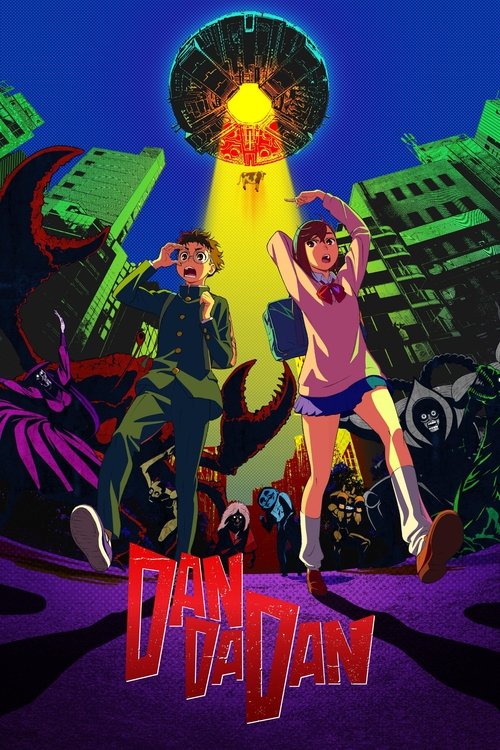
"Dan Da Dan" follows the chaotic adventures of two high school students: Momo Ayase, a spirited girl who believes in ghosts but scoffs at the idea of aliens, and Ken Takakura (whom she nicknames "Okarun"), a shy occult fanatic who is convinced aliens are real but dismisses ghosts as nonsense. To settle their debate, they make a bet, each visiting a location associated with the other's belief. Momo heads to a UFO hotspot, while Okarun ventures into a haunted tunnel.
To their mutual shock, they both encounter the genuine article. Momo is abducted by perverted aliens, which accidentally awakens her latent psychic powers, while Okarun is possessed by a powerful and malevolent spirit known as Turbo Granny, who steals a part of his body. This single, bizarre night intertwines their fates, forcing them to team up. Using Momo's newfound psychic abilities and Okarun's spirit-possessed form, they must battle an escalating series of bizarre supernatural and extraterrestrial threats, all while navigating the awkward, hilarious, and surprisingly tender moments of a budding romance.
Core Meaning
At its heart, "Dan Da Dan" is a story about the exhilarating, terrifying, and absurd journey of adolescence and the forging of connections in a chaotic world. The series posits that seemingly contradictory beliefs—science fiction and the supernatural, logic and faith—can coexist and are not mutually exclusive. It explores the idea that embracing the unknown and the things we don't understand, both in the world and in each other, leads to profound personal growth. Through its relentless barrage of paranormal threats and crude humor, the show captures the awkwardness of puberty, self-discovery, and first love, suggesting that the most terrifying monsters are often easier to face than our own feelings. The central message is one of acceptance, teamwork, and finding your own truth amidst the beautiful madness of life.
Thematic DNA
The Duality of Belief: Sci-Fi vs. Supernatural
The series is built on the foundational conflict between Momo's belief in ghosts and Okarun's belief in aliens. Initially, they set out to disprove one another, but are immediately confronted with the reality that both worlds are real and terrifyingly intertwined. This theme is explored continuously as they battle entities from both realms, often simultaneously. The show suggests that these two seemingly opposite forces are not mutually exclusive but are two sides of the same paranormal coin. Their growing acceptance of each other's beliefs mirrors their growing personal relationship, showing that understanding and harmony can be found in the union of different worldviews.
Coming-of-Age and Adolescent Absurdity
More than just a supernatural battle series, "Dan Da Dan" is a profound, if bizarre, coming-of-age story. The paranormal threats the characters face are often paralleled with the horrors of puberty and sexual awakening. Antagonists are frequently focused on the protagonists' genitalia, which, while presented with crude humor, highlights the way teenage identity is deeply connected to sexuality and the awkwardness of self-discovery. The loss of Okarun's testicles is a direct, unsubtle metaphor for anxieties about masculinity and growing up. The series uses its over-the-top, often shocking scenarios to capture the chaotic, confusing, and intensely emotional experience of being a teenager.
The Power of Unlikely Bonds
The central relationship between the fiery, popular Momo and the nerdy outcast Okarun is a classic "opposites attract" trope, amplified by paranormal chaos. Their bond is forged in shared trauma and the necessity of survival. Throughout the series, they learn to rely on each other's strengths, with Momo's courage inspiring Okarun and his steadfastness grounding her. This theme extends to the wider cast they assemble, including spirit mediums and former rivals. The series emphasizes that strength doesn't come from individual power alone, but from the trust and collaboration between people from completely different walks of life, united against a common threat.
Genre-Bending as Worldview
"Dan Da Dan" refuses to be confined to a single genre, blending action, horror, romantic comedy, and science fiction into a single, seamless narrative. This thematic choice reflects the show's core message: that life is not one simple story but a chaotic and often contradictory mix of experiences. A moment of genuine body horror can be immediately followed by slapstick comedy, and a tender romantic scene can be interrupted by a kaiju battle. This constant tonal shifting keeps the audience off-balance and reinforces the idea that horror and humor, love and fear, are not separate but are intimately connected parts of the human experience.
Character Analysis
Momo Ayase
Shion Wakayama
Motivation
Her primary motivation is to protect her friends, especially Okarun, and her grandmother. She is driven by a strong sense of justice and an instinct to stand up for those who can't defend themselves. As her feelings for Okarun develop, her desire to see him safe and help him become whole becomes a central driving force. The creator, Yukinobu Tatsu, compares her inspirational nature to that of Superman.
Character Arc
Momo begins as a confident, strong-willed high school girl who, despite her tough exterior, has a genuine belief in spirits passed down from her grandmother. Initially, she protects Okarun from bullies but is dismissive of his beliefs. After her abduction awakens her powerful psychic abilities, she is thrust into a leadership and protector role. Her arc focuses on honing her immense power, learning to trust others, and confronting her own romantic feelings for Okarun, which she initially struggles to admit. She evolves from a reactionary fighter into a proactive and clever strategist who inspires courage in those around her.
Ken Takakura ('Okarun')
Natsuki Hanae
Motivation
Initially, his motivation is simple survival and reclaiming his stolen testicles. However, it quickly evolves into a deep-seated desire to be useful to and protect Momo, who was the first person to show him kindness. He is motivated by his growing feelings for her and his newfound friendships, pushing himself past his physical and emotional limits to become someone worthy of standing by her side.
Character Arc
Okarun starts as a classic nerdy outcast, friendless and bullied for his obsession with aliens and the occult. His initial encounter with a ghost shatters his worldview and leaves him possessed and partially powerless. His journey is one of immense growth in confidence and courage. By harnessing the dangerous power of Turbo Granny, he transforms from a timid boy who needs protection into a formidable fighter capable of protecting others. His arc is about finding his inner strength, learning to believe in himself as much as he believes in aliens, and navigating his first real friendship and romance.
Seiko Ayase
Mayumi Tanaka
Motivation
Seiko's motivation is the protection of her family and the maintenance of balance between the human and spirit worlds. She is driven by a sense of duty inherited through her lineage as a spirit medium. She steps in to guide Momo and Okarun not just to defeat immediate threats, but to prepare them for the greater dangers she knows exist, ensuring her granddaughter can control her powers and survive.
Character Arc
Seiko, Momo's grandmother, is introduced as a powerful and seemingly aloof spirit medium. She initially appears to have a strained relationship with Momo but is quickly revealed to be an incredibly knowledgeable and capable ally against supernatural threats. Her arc involves moving from a background figure of authority to an active mentor, providing crucial information, training, and support to Momo and Okarun. She serves as the anchor to the world of spirits, explaining the rules and dangers they face, while also showing deep, underlying care for her granddaughter and her new friend.
Turbo Granny
Kazuya Nakai
Motivation
Initially, her motivation is purely instinctual and predatory. After being sealed, her motivation becomes self-preservation and the desire to eventually regain her freedom and power. She helps Okarun and Momo primarily because their survival is linked to her own, and she enjoys the chaos and violence of their battles. Her motivations are never heroic, providing a constant source of internal conflict and tension.
Character Arc
Turbo Granny begins as a terrifying and grotesque antagonist, a powerful yokai who possesses Okarun. Upon her defeat, her spirit is sealed and she is forced into the role of a reluctant, foul-mouthed ally. Her arc is a transformation from a pure villain to a chaotic neutral force. While she never loses her crude personality or self-interest, she becomes an essential source of power for Okarun and occasionally provides critical insight. She represents the dangerous supernatural world that the protagonists are forced to bargain with and control, rather than simply destroy.
Symbols & Motifs
Aliens and Ghosts
These two entities represent the core duality of the series: the scientific versus the spiritual, the cosmic versus the earthly, and logic versus faith. They are the physical manifestations of Okarun and Momo's opposing belief systems.
From the very first episode, aliens and ghosts are established as equally real and dangerous forces. The narrative constantly forces the protagonists to confront both, demonstrating that the universe is far stranger and more complex than either of their individual worldviews allowed. Their battles with these creatures force them to synthesize their beliefs and work together, symbolizing the merging of their personalities and the growth of their relationship.
Okarun's Missing Testicles ('Golden Balls')
This is a direct and comedic symbol of Okarun's stolen masculinity, innocence, and the anxieties of puberty. Their recovery is tied to his journey of gaining confidence and becoming a hero in his own right.
After being possessed by Turbo Granny, Okarun loses his testicles, which she refers to as his 'family jewels'. The initial major quest of the series is for him and Momo to defeat Turbo Granny and retrieve them. This bizarre and crude mission serves as the catalyst for their partnership and forces Okarun to overcome his timid nature, literally fighting to reclaim a part of himself.
Turbo Granny
Turbo Granny symbolizes the predatory and chaotic nature of the supernatural world. She is a force of pure, dangerous id, but also represents a source of immense power that, once controlled, becomes a crucial asset. She embodies the series' blend of genuine horror and absurd comedy.
As the first major spiritual antagonist, Turbo Granny possesses Okarun and is obsessed with his genitals. After her defeat, her spirit is sealed within a Maneki-neko (lucky cat) doll and she becomes a begrudging, foul-mouthed ally. Her presence serves as a constant reminder of the dangerous power Okarun wields and the thin line between being a monster and controlling one.
Philosophical Questions
What is the nature of belief and evidence?
The series is founded on the clash between Momo's belief in ghosts and Okarun's belief in aliens. Both initially demand empirical proof from the other while holding their own beliefs as self-evident. The story immediately validates both perspectives, suggesting that the universe is not an either/or proposition. It explores the idea that personal experience is the most potent form of evidence and questions whether it's more absurd to believe in something without proof or to deny the existence of something just because you haven't seen it yourself.
How do we find harmony between seemingly irreconcilable forces?
"Dan Da Dan" constantly merges the supernatural (ghosts, yokai) with the extraterrestrial (aliens). This blend serves as a metaphor for the reconciliation of different belief systems and personalities. Momo and Okarun must learn to synthesize their knowledge and abilities to survive. The series explores this question on a personal level through their relationship—a popular girl and a nerdy outcast finding common ground—and on a cosmic level, suggesting that disparate, chaotic elements can form a cohesive, powerful whole.
Can absurdity and sincerity coexist?
The series masterfully juxtaposes moments of extreme, grotesque absurdity with scenes of genuine emotional sincerity. A quest to retrieve stolen testicles becomes the foundation for a touching love story. This raises the question of whether sincerity is cheapened by absurdity or if, in fact, life's most meaningful moments are often found amidst chaos and ridiculousness. The show argues that humor and heart are not opposites, but are both essential tools for coping with a terrifying and unpredictable world.
Alternative Interpretations
The series' most debated aspect is its use of overt, often crude, sexual humor and horror, leading to different interpretations of its intent and impact. One perspective views these elements as low-effort fan service and shock value that is disappointingly leering, particularly given the high school setting. This interpretation argues that scenes of attempted sexual assault played for comedy are uncomfortable and undermine the story's otherwise strong character work and visual artistry.
Conversely, another interpretation sees the series' obsession with genitalia and sexual threats as a deliberate, if shocking, narrative tool to explore the anxieties of adolescence. From this viewpoint, the absurd and grotesque focus on "weenies" and "banana organs" is a direct metaphor for the confusing, terrifying, and all-consuming nature of puberty and sexual awakening. It's seen not as mere fan service, but as a parallel between paranormal horror and the genuine awkwardness of discovering one's identity and sexuality, making it a powerful, if unconventional, coming-of-age story.
Cultural Impact
Even before its premiere, "Dan Da Dan" generated immense cultural buzz due to the massive popularity of its source manga, which was celebrated for its unique blend of genres and high-energy artwork. The announcement that animation studio Science SARU would be adapting the series amplified this anticipation, as the studio is renowned for its fluid, expressive, and unconventional animation style seen in critically acclaimed works like 'Devilman Crybaby' and 'Keep Your Hands Off Eizouken!'. This pairing was seen by fans as a perfect match for the manga's chaotic energy.
Upon release, the series was met with widespread critical acclaim, particularly for its stunning visual presentation and faithful-yet-dynamic adaptation of the source material. Critics and audiences praised Science SARU for capturing the manga's kinetic feel, elevating it with vibrant color palettes and mind-bending animation sequences. The series quickly became a standout of the 2024 anime season, praised as a fresh and innovative take on the shonen genre. However, its use of crude, sexually charged humor also sparked debate, with some viewers finding it off-putting or juvenile, while others defended it as integral to its themes of adolescent awkwardness. Its immediate success has led to the confirmation of a second season, cementing its status as one of the most significant new anime debuts of the decade.
Audience Reception
The audience reception for "Dan Da Dan" has been largely positive and enthusiastic, driven by a strong existing fanbase from the manga. Viewers have overwhelmingly praised the anime for its stunning and energetic animation by Science SARU, considering it a perfect visual translation of the manga's chaotic style. The dynamic action sequences, vibrant color design, and expressive character animation are frequently highlighted as standout features. The chemistry between Momo and Okarun, along with the series' unique blend of horror, comedy, and romance, has also been widely acclaimed.
The primary point of criticism and division among the audience is the show's crude and sexually charged humor. While many fans of the manga accept it as part of the series' bizarre charm, some new viewers have found the jokes involving sexual assault and the focus on the characters' private parts to be uncomfortable, juvenile, or off-putting. Despite this controversy, the overall verdict from the audience is that "Dan Da Dan" is one of the most exciting and visually inventive anime of 2024, a wild ride that successfully captures the spirit of its beloved source material.
Interesting Facts
- The creator, Yukinobu Tatsu, was previously an assistant for Tatsuki Fujimoto (creator of 'Chainsaw Man') and Yuji Kaku (creator of 'Hell's Paradise').
- Yukinobu Tatsu was inspired to become a professional manga artist by his manager at a convenience store job who saw his doodles on receipts and encouraged him.
- The animation studio is Science SARU, acclaimed for its work on 'Devilman Crybaby', 'Keep Your Hands Off Eizouken!', and 'Scott Pilgrim Takes Off'.
- The anime's director is Fūga Yamashiro, who previously worked under celebrated director Masaaki Yuasa.
- The music is composed by Kensuke Ushio, known for his distinctive electronic scores for 'Devilman Crybaby' and 'Chainsaw Man'.
- Creator Yukinobu Tatsu has stated that Momo Ayase is his favorite character, and he will redraw her repeatedly until he feels he has captured her cuteness perfectly, sometimes delaying his work.
- The opening theme song is "Otonoke" by the musical duo Creepy Nuts, which has been widely praised by fans for its energetic and joyful tone.
⚠️ Spoiler Analysis
Click to reveal detailed analysis with spoilers
Frequently Asked Questions
Explore More About This Movie
Dive deeper into specific aspects of the movie with our detailed analysis pages
Comments (0)
No comments yet. Be the first to share your thoughts!