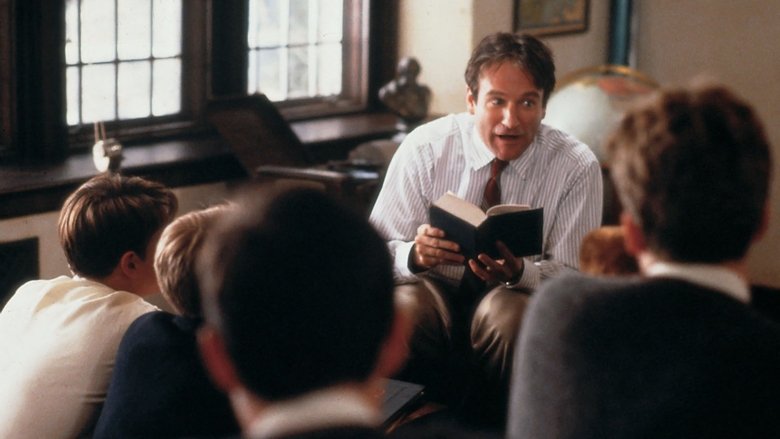
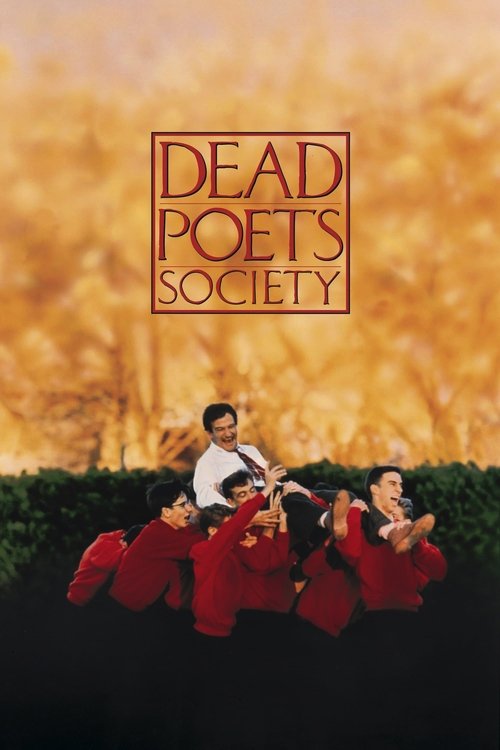
"He was their inspiration. He made their lives extraordinary."
Dead Poets Society - Symbolism & Philosophy
Symbols & Motifs
Standing on the Desk
Standing on the desk symbolizes the act of looking at the world from a different perspective, breaking free from convention, and challenging established norms. It's a physical manifestation of Keating's core lesson to think for oneself.
Keating first stands on his desk to demonstrate this principle to his students. The motif returns in the film's powerful final scene. After Keating is fired, Todd Anderson initiates a defiant tribute by standing on his own desk and proclaiming, "O Captain! My Captain!" a gesture then repeated by many of his classmates, showing that Keating's lesson in independent thought has taken root.
The Cave
The cave where the Dead Poets Society meets symbolizes a sanctuary from the oppressive, structured world of Welton Academy. It is a space of freedom, creativity, intellectual exploration, and authentic self-expression where the boys can escape conformity.
After learning about Keating's time in the club, the boys find the old Indian cave and resurrect the Dead Poets Society. It is here, by candlelight, that they share poetry, play music, and bond outside the watchful eyes of the administration. It's important to note the cave seen in the film was not a real cave but a set piece made of latex.
Puck's Crown
The crown of thorns worn by Neil as Puck in "A Midsummer Night's Dream" symbolizes both his liberation and his martyrdom. In the role, he feels truly alive and free, but the crown also foreshadows the suffering and sacrifice that will result from his defiance against his father.
Neil wears the crown during his triumphant performance in the play, the one moment where he fully embraces his passion. Later that night, after his father crushes his dreams, Neil puts the crown back on in his room before taking his own life, tragically linking his moment of greatest joy to his ultimate despair.
Ripping out the Textbook Introduction
The act of tearing out the introduction to their poetry textbook, which promotes a rigid, mathematical way of understanding poetry, is a symbolic rejection of the orthodox, uninspired, and oppressive teaching methods of Welton Academy. It represents a cleansing of the old to make way for a new, passionate engagement with art.
In one of his first classes, Mr. Keating decries J. Evans Pritchard's essay on "Understanding Poetry" as "excrement." He instructs his shocked students to rip the entire introduction out of their books, a bold and liberating act that signals the beginning of their unconventional education.
Philosophical Questions
What is the true purpose of education?
The film presents a direct conflict between two educational philosophies. Welton Academy's approach is pragmatic and traditional, aimed at preparing boys for prestigious careers by instilling discipline and conformity. Mr. Keating's philosophy, rooted in Transcendentalist ideas of nonconformity and self-reliance, argues that education's purpose is to teach students how to think for themselves and to live meaningful, passionate lives. The film forces the audience to question whether education should be a means to an end (a good job) or an end in itself (a good life).
To what extent should one 'seize the day'?
"Carpe Diem" is the film's central message, but its application is complex. Keating encourages his students to make their lives extraordinary, but also warns that "a wise man understands" there's a time for daring and a time for caution. The film explores the spectrum of this idea. Neil's passionate pursuit of acting is liberating, but his inability to confront his father has tragic consequences. Charlie's rebellious outbursts are bold but lead to punishment. The film doesn't provide a clear answer, instead posing the question of how to balance living passionately with navigating the realistic constraints and consequences of the world.
What is the relationship between the individual and society?
"Dead Poets Society" is a microcosm of the eternal struggle between individual desire and societal expectation. The students are pressured to conform to the roles laid out for them by their parents and their school. Keating encourages them to find their own voices and follow their own paths. Neil's tragedy highlights the devastating outcome when this conflict becomes irreconcilable. The film explores the courage it takes to maintain one's beliefs in the face of overwhelming pressure and asks what our responsibility is to ourselves versus our responsibility to the institutions and communities we are a part of.
Core Meaning
The core meaning of "Dead Poets Society" revolves around the profound importance of individualism and the courage to live an authentic life in the face of stifling conformity. Director Peter Weir, through Tom Schulman's Oscar-winning screenplay, posits that a true education is not merely the absorption of facts but the cultivation of independent thought and the nurturing of the human spirit. The film champions the idea of "Carpe Diem" – seizing the day – urging individuals to pursue their passions and make their lives extraordinary, rather than succumbing to societal pressures and predetermined paths.
It critiques rigid, authoritarian educational systems that prioritize discipline and tradition over creativity and personal growth. The film argues that art, particularly poetry, is not a trivial pursuit but essential to the human experience – it is what we "stay alive for." Ultimately, the message is a powerful, albeit tragic, reminder that while rebellion against conformity has consequences, the suppression of one's true self can lead to an even greater loss. The film leaves the audience to ponder the true cost of both defiance and compliance.