DEATH NOTE リライト ~幻視する神~
Death Note Relight 1: Visions of a God - Symbolism & Philosophy
Symbols & Motifs
Apples
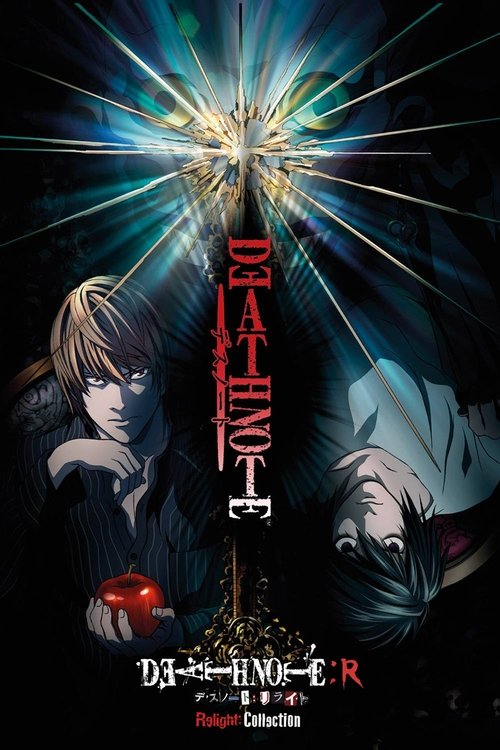
Apples are a potent symbol of temptation, knowledge, and the original sin. They directly reference the forbidden fruit from the Garden of Eden. Light's acceptance and use of the Death Note is his "first sin," similar to Adam and Eve eating the apple, leading to his fall from grace. For the Shinigami Ryuk, they are a simple pleasure that ties him to the human world, but for the story, they represent the alluring and corrupting knowledge of life and death.
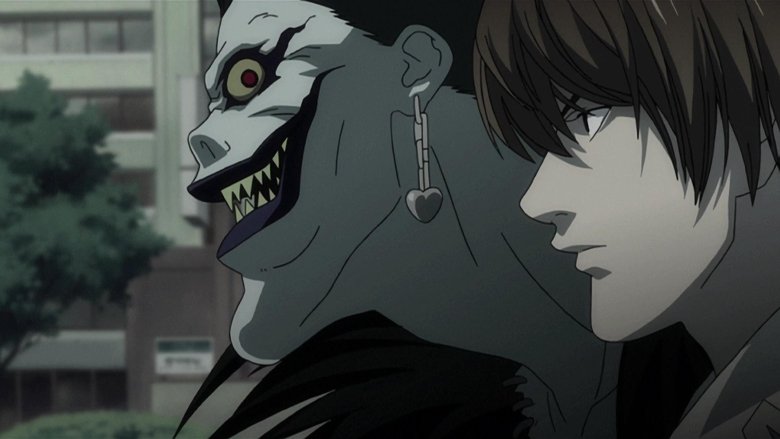
Ryuk is frequently seen eating apples, and his addiction to them is a plot point Light exploits. The visual of Ryuk, a god of death, handing Light an apple is a direct parody of Michelangelo's 'The Creation of Adam,' symbolizing a death god giving man a corrupting temptation instead of life.
Color Palette (Red vs. Blue)
The film uses color to represent the opposing forces and inner states of its protagonists. Light is consistently associated with the color red, symbolizing power, rage, danger, and evil intentions. L, his foil, is represented by blue, which signifies calmness, intelligence, and tranquility. This stark contrast visually reinforces their ideological battle.
This color symbolism is most prominent during internal monologues and confrontational scenes, where the lighting shifts to highlight the red or blue aura of the character, giving the audience a visual cue to their moral and psychological alignment.
Christian Imagery
The film is replete with Christian allegorical imagery to elevate the philosophical conflict. The most cited example is the scene where L washes Light's feet, mirroring Jesus washing the feet of his disciples, including Judas, who would betray him. This act symbolizes L's awareness of Light's betrayal and his own impending fate. Light's desire to be a "god" of the new world is a messianic complex, positioning him as a fallen angel or false prophet.
The foot-washing scene occurs just before L's death, heightening the dramatic tension and foreshadowing his demise. Light is also often depicted in high places, looking down on the city, reinforcing his god complex. The final manga cover depicts Light in a crucified pose, further cementing these messianic parallels.
Philosophical Questions
Can murder ever be justified for a perceived greater good?
The film places utilitarian ethics in direct conflict with deontological principles. Light Yagami argues from a utilitarian standpoint: killing thousands of criminals is justified if it leads to a world with millions of safe and happy people. The narrative constantly challenges this by showing how this path forces Light to kill innocents and lose his own morality, asking the viewer to decide if a peaceful world built on a mountain of corpses is truly just.
What is the nature of justice, and who has the right to administer it?
"Death Note" explores whether justice is an objective system of laws (L's view) or a subjective ideal that can be enforced by a powerful individual (Light's view). The film shows the danger of placing the power of judge, jury, and executioner into a single person's hands, as personal biases, ego, and the need to protect one's own power inevitably corrupt the original, perhaps noble, goal.
Does absolute power inevitably corrupt absolutely?
Light's transformation from a well-intentioned idealist to a paranoid, manipulative mass murderer is a textbook case study for this question. The Death Note gives him ultimate power over life and death, and the film meticulously documents how wielding this power erodes his empathy, compassion, and sanity. His journey suggests that no single human is equipped to handle such authority without being consumed by it.
Core Meaning
The core meaning of "Visions of a God" is an exploration of the corrupting nature of absolute power and the fragility of morality when confronted with temptation. The film questions the very definition of justice, asking whether a noble end can justify monstrous means. Director Tetsurō Araki aimed to focus on the compelling aspects of the original story, particularly the thoughts and actions of Light Yagami, rather than overtly moralizing. The film posits that the desire to play God, even when born from righteous intentions, inevitably leads to a loss of humanity and a descent into tyranny. It's a cautionary tale about how the path to hell can be paved with the grandest of ambitions.