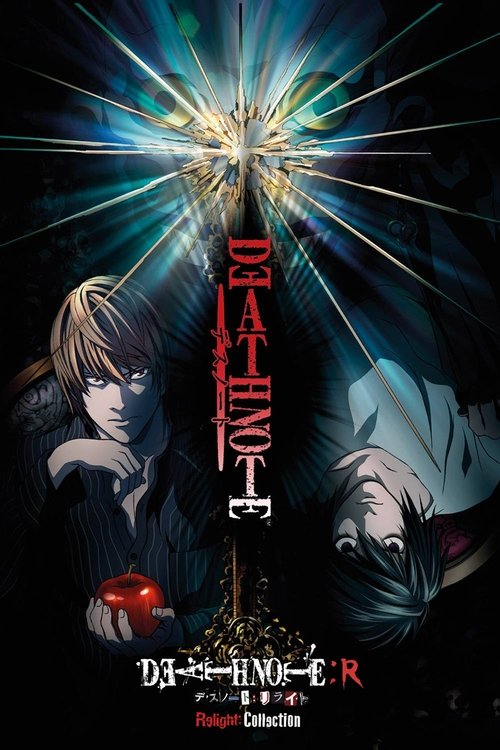
Death Note Relight 1: Visions of a God
A cerebral thriller where divine power meets human ambition, painting a shadowy portrait of justice, corruption, and the haunting symphony of a god complex.
Death Note Relight 1: Visions of a God

Death Note Relight 1: Visions of a God

DEATH NOTE リライト ~幻視する神~

23 September 2009 Japan 131 min ⭐ 7.9 (367)
Director: Tetsuro Araki
Cast: Mamoru Miyano, Shido Nakamura, Kappei Yamaguchi, Aya Hirano, Naoya Uchida
Drama Crime Animation Fantasy Thriller TV Movie
Justice and Morality The Corruption of Power Humanity, Mortality, and Divinity Deception and Duality

Overview

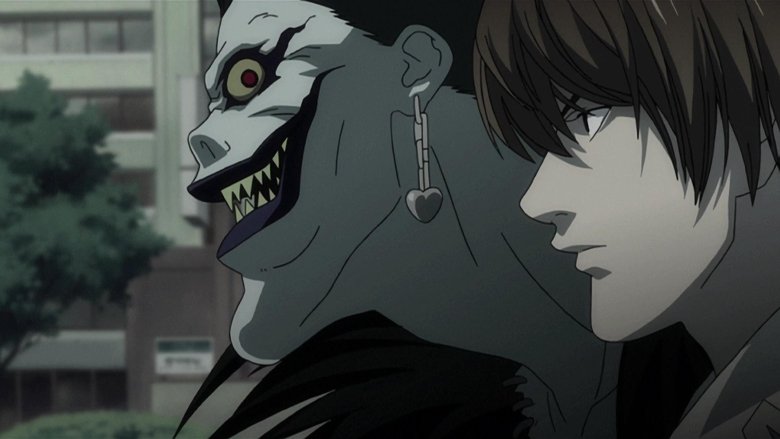
"Death Note Relight 1: Visions of a God" serves as a condensed retelling of the first major arc of the acclaimed anime series, covering episodes 1-25. The story is framed through a new narrative device: in the bleak Shinigami realm, the death god Ryuk recounts his experiences in the human world to a curious, unnamed Shinigami. This recap chronicles the intense psychological battle between two brilliant minds.

The main narrative follows Light Yagami, a prodigious but bored high school student who discovers the "Death Note," a supernatural notebook that allows him to kill anyone whose name he writes in its pages, provided he knows their face. Believing the world is rotten, Light takes on the persona of "Kira" and begins a crusade to execute criminals and create a utopian new world. His actions soon attract the attention of the world's greatest detective, the enigmatic and eccentric L. What ensues is a gripping cat-and-mouse game, a duel of wits where each tries to outmaneuver the other, blurring the lines between justice and evil.
Core Meaning

The core meaning of "Visions of a God" is an exploration of the corrupting nature of absolute power and the fragility of morality when confronted with temptation. The film questions the very definition of justice, asking whether a noble end can justify monstrous means. Director Tetsurō Araki aimed to focus on the compelling aspects of the original story, particularly the thoughts and actions of Light Yagami, rather than overtly moralizing. The film posits that the desire to play God, even when born from righteous intentions, inevitably leads to a loss of humanity and a descent into tyranny. It's a cautionary tale about how the path to hell can be paved with the grandest of ambitions.

Thematic DNA

Justice and Morality 35%
The Corruption of Power 30%
Humanity, Mortality, and Divinity 20%
Deception and Duality 15%

Justice and Morality

The central conflict is a clash of ideologies concerning justice. Light Yagami believes true justice requires sacrificing criminals for the greater good, creating a perfect world through fear. L, conversely, represents the established legal system, arguing that no individual has the right to pass judgment and execute others, branding Kira as a mass murderer. The film forces the audience to question their own moral compass, presenting Light's utilitarian perspective against L's deontological adherence to law.

The Corruption of Power

The Death Note grants Light god-like power, which initially he uses with a sense of righteous purpose. However, this power quickly corrupts him. To protect his identity as Kira, he transitions from killing only criminals to eliminating anyone who stands in his way, including innocent investigators. His descent illustrates the classic axiom that absolute power corrupts absolutely, transforming an idealist into a ruthless tyrant who sees himself as the god of his new world.

Humanity, Mortality, and Divinity

Light's ambition is to transcend his human limitations and become a god. The film explores what it means to be human, with mortality as a defining characteristic. The Shinigami, immortal gods of death, are portrayed as listless and bored, finding entertainment in human affairs. Ryuk's famous line, "The human whose name is written in this note shall die," underscores the ultimate finality that Light tries to control. The film questions whether a human can truly wield divine power without losing the very essence of their humanity.

Deception and Duality

Every main character leads a double life. Light is a model student to the public and a ruthless killer in private. L is a world-renowned detective who hides behind an alias and an unassuming appearance. This theme is woven into the narrative through constant strategic deception, lies, and psychological manipulation as Light and L attempt to unmask one another while protecting their own identities.

Character Analysis

Light Yagami (Kira)

Mamoru Miyano

Archetype: Anti-hero / Villain Protagonist
Key Trait: Megalomania

Motivation

Initially motivated by a desire to purge the world of evil and end crime, Light's core drive shifts to preserving his own power and solidifying his status as the god of a new world. His primary motivation becomes defeating L and anyone else who threatens his reign, viewing them as obstacles to his perfect society.

Character Arc

Light begins as a brilliant but cynical honors student, disgusted by the world's injustices. Upon finding the Death Note, he embarks on a seemingly noble crusade that quickly devolves into a megalomaniacal quest for power. His arc is one of tragic downfall; the tool he uses to enact his justice becomes the instrument of his own corruption, stripping him of empathy and humanity until he is willing to sacrifice anyone, including his own family, to achieve his goal of becoming a god.

L (L Lawliet)

Kappei Yamaguchi

Archetype: The Detective / The Rival
Key Trait: Eccentric Brilliance

Motivation

L is motivated by solving the ultimate puzzle and upholding the rule of law. He is not driven by emotion but by a pure, almost childlike, desire to win the intellectual game and prove his hypothesis that Light Yagami is Kira. He is fundamentally against Kira's ideology that one person can be judge, jury, and executioner.

Character Arc

L is a static character in terms of his core principles but undergoes subtle emotional development. He begins the investigation as a detached, eccentric genius driven by the intellectual challenge of the Kira case. As he engages with Light, whom he considers his first and only friend, a hint of emotional vulnerability emerges. His arc is defined by his unwavering pursuit of justice through logic and reason, culminating in a sacrifice to expose the truth.

Ryuk

Shido Nakamura

Archetype: The Trickster / Observer
Key Trait: Amoral Indifference

Motivation

Ryuk's sole motivation is to alleviate his boredom. He finds humans "interesting" and is entertained by Light's ambitious and audacious use of the Death Note. He follows Light not out of loyalty but because Light is the source of his amusement.

Character Arc

Ryuk's arc is non-existent as he is primarily a spectator. As a Shinigami, he is immortal and detached from human morality. He drops the Death Note into the human world purely out of boredom and remains a neutral observer throughout the conflict, acting only when it serves his own interests (like getting apples). His role is to introduce the supernatural element and serve as a cynical commentator on the human drama he has instigated. This film frames the entire story as his retelling.

Symbols & Motifs

Apples

Meaning:

Apples are a potent symbol of temptation, knowledge, and the original sin. They directly reference the forbidden fruit from the Garden of Eden. Light's acceptance and use of the Death Note is his "first sin," similar to Adam and Eve eating the apple, leading to his fall from grace. For the Shinigami Ryuk, they are a simple pleasure that ties him to the human world, but for the story, they represent the alluring and corrupting knowledge of life and death.

Context:

Ryuk is frequently seen eating apples, and his addiction to them is a plot point Light exploits. The visual of Ryuk, a god of death, handing Light an apple is a direct parody of Michelangelo's 'The Creation of Adam,' symbolizing a death god giving man a corrupting temptation instead of life.

Color Palette (Red vs. Blue)

Meaning:

The film uses color to represent the opposing forces and inner states of its protagonists. Light is consistently associated with the color red, symbolizing power, rage, danger, and evil intentions. L, his foil, is represented by blue, which signifies calmness, intelligence, and tranquility. This stark contrast visually reinforces their ideological battle.

Context:

This color symbolism is most prominent during internal monologues and confrontational scenes, where the lighting shifts to highlight the red or blue aura of the character, giving the audience a visual cue to their moral and psychological alignment.

Christian Imagery

Meaning:

The film is replete with Christian allegorical imagery to elevate the philosophical conflict. The most cited example is the scene where L washes Light's feet, mirroring Jesus washing the feet of his disciples, including Judas, who would betray him. This act symbolizes L's awareness of Light's betrayal and his own impending fate. Light's desire to be a "god" of the new world is a messianic complex, positioning him as a fallen angel or false prophet.

Context:

The foot-washing scene occurs just before L's death, heightening the dramatic tension and foreshadowing his demise. Light is also often depicted in high places, looking down on the city, reinforcing his god complex. The final manga cover depicts Light in a crucified pose, further cementing these messianic parallels.

Memorable Quotes

This world is rotten, and those who are making it rot deserve to die. Someone has to do it, so why not me?

— Light Yagami

Context:

Light says this early in the story, after testing the Death Note and realizing its power. It is a defining moment where he accepts his self-appointed role as the world's savior.

Meaning:

This quote encapsulates Light's initial justification for his actions as Kira. It reveals his profound cynicism, his god complex, and the rationalization he uses to embark on his crusade, setting the stage for his transformation.

I am justice!

— Light Yagami and L

Context:

This phrase is a personal declaration for both characters, often used during moments of intense confrontation or internal conviction, representing the peak of their self-assurance in their respective missions.

Meaning:

Uttered by both protagonists at different times, this quote highlights the core ideological conflict of the series. Both Light and L believe they are the true embodiment of justice, yet their methods and philosophies are diametrically opposed. It underscores the subjective and dangerous nature of the concept of justice.

The human who possesses the Death Note can neither go to heaven nor hell.

— Ryuk

Context:

Ryuk explains this rule to Light early on, framing the stakes of his journey. The concept is a recurring motif that hangs over Light's entire story, culminating in his death.

Meaning:

This rule, explained by Ryuk, establishes the ultimate consequence of using the notebook. It suggests a state of nothingness or limbo (Mu) for its users after death. This becomes a central philosophical point, implying that those who play God forfeit any chance of a traditional afterlife, adding a layer of existential dread to Light's choices.

Humans are so... interesting.

— Ryuk

Context:

Ryuk often mutters this to himself after witnessing Light's clever schemes or the dramatic turns of the investigation, reinforcing his role as an outsider entertained by the chaos he has unleashed.

Meaning:

This is Ryuk's signature phrase and summarizes his perspective as an amoral observer. He views the life-and-death struggle between Light and L with the detached amusement of a spectator watching a play, highlighting the cosmic indifference of the Shinigami to human suffering and morality.

Philosophical Questions

Can murder ever be justified for a perceived greater good?

The film places utilitarian ethics in direct conflict with deontological principles. Light Yagami argues from a utilitarian standpoint: killing thousands of criminals is justified if it leads to a world with millions of safe and happy people. The narrative constantly challenges this by showing how this path forces Light to kill innocents and lose his own morality, asking the viewer to decide if a peaceful world built on a mountain of corpses is truly just.

What is the nature of justice, and who has the right to administer it?

"Death Note" explores whether justice is an objective system of laws (L's view) or a subjective ideal that can be enforced by a powerful individual (Light's view). The film shows the danger of placing the power of judge, jury, and executioner into a single person's hands, as personal biases, ego, and the need to protect one's own power inevitably corrupt the original, perhaps noble, goal.

Does absolute power inevitably corrupt absolutely?

Light's transformation from a well-intentioned idealist to a paranoid, manipulative mass murderer is a textbook case study for this question. The Death Note gives him ultimate power over life and death, and the film meticulously documents how wielding this power erodes his empathy, compassion, and sanity. His journey suggests that no single human is equipped to handle such authority without being consumed by it.

Alternative Interpretations

The most significant alternative interpretation stemming directly from "Visions of a God" is the Light Reincarnation Theory. The introduction of the unnamed Shinigami who seeks out Ryuk's story is the basis for this popular fan theory. Proponents point to several pieces of evidence:

  • Physical Resemblance: The Shinigami wears attire reminiscent of Light's school uniform, has a similar hair style, and in some dubs, shares the same voice actor.
  • Mannerisms: His actions and the way he interacts with Ryuk are interpreted by some as being similar to Light's.
  • Cosmic Irony: This interpretation provides a poetic, ironic end for Light. Having failed to become the god of a new world, he is reborn as a lowly, bored god of death, forever trapped in the stagnant realm he despised and seeking out the very story of his own dramatic failure for entertainment.

While the rules of the Death Note state a user can go to neither Heaven nor Hell, it doesn't explicitly forbid reincarnation into another realm, leaving the theory plausible within the series' lore. However, many consider the film and its added scenes non-canon, viewing this simply as a symbolic nod rather than a literal plot point.

Cultural Impact

"Death Note Relight 1: Visions of a God" primarily served as a companion piece to the monumentally successful "Death Note" anime series. Released shortly after the series' conclusion, its main impact was to offer a condensed, feature-film-like experience for both dedicated fans and newcomers. For existing fans, it provided a chance to re-experience the intense rivalry between Light and L with some added scenes, most notably the framing device in the Shinigami realm. This new footage had a significant cultural impact within the fandom, spawning the enduring and widely debated fan theory that the unnamed Shinigami is a reincarnated Light Yagami.

For the broader culture, the "Relight" specials helped solidify "Death Note's" status as a modern anime classic, making its complex plot more accessible in a shorter format. However, critics and many viewers agree that it sacrifices crucial character development and pacing, making it an inferior experience to the full 37-episode series. Its existence demonstrates the franchise's popularity and the demand for more content, acting as a bridge between the original series and subsequent adaptations, while its non-canon additions (like Light gloating at L's grave) have become infamous points of discussion online.

Audience Reception

Audience reception for "Death Note Relight 1" is generally mixed, with a consensus that it is inferior to the original anime series. Fans praise it as a decent way to re-live the story's best moments without committing to the full 37-episode run. The inclusion of new scenes, especially the framing device in the Shinigami realm and the added confrontation between Light and L, is often cited as a key reason to watch.

However, the most common criticism is the rushed pacing. Condensing roughly 26 episodes into two hours results in the loss of significant character development and the nuanced psychological depth that made the original series so compelling. Many viewers feel that without the context of the full series, the plot can feel disjointed and the character motivations underdeveloped. New viewers are almost universally advised to watch the original series first to get the proper experience, with the "Relight" specials being considered supplementary material for established fans.

Interesting Facts

  • This TV special is a "director's cut" compilation, condensing the first 26 episodes of the anime into a two-hour movie.
  • The film adds new animated sequences, primarily the framing story of Ryuk talking to another Shinigami in their realm.
  • Despite being advertised as a retelling from Ryuk's point of view, the film doesn't offer a significantly different perspective from the original anime.
  • The unnamed Shinigami that Ryuk speaks to has led to a popular and persistent fan theory that he is the reincarnation of Light Yagami.
  • The creator of the manga, Tsugumi Ohba, claimed that Naomi Misora was killed off early in the story because she was written to be "too smart" and was solving the case much faster than intended.
  • In the original pilot manga, a "Death Eraser" existed which could revive those killed by the Death Note. This concept was abandoned for the main series.
  • The anime's production studio, Madhouse, also made an anime called "Death Parade," in which a character who strongly resembles Light Yagami makes a cameo appearance, fueling further fan theories about his afterlife.

Easter Eggs

An unnamed Shinigami appears in the framing scenes, seeking out Ryuk to hear his story.

This Shinigami's design bears a striking resemblance to Light Yagami—similar hair, a red tie-like feature, a limp, and the same voice actor in some versions. This has led to the popular fan theory that after his death, Light was reincarnated as a Shinigami, condemned to the boring realm he once sought to escape. Though not officially canon, this interpretation adds a layer of cosmic irony to Light's fate.

In Full Metal Panic! The Second Raid, Light, L, and Misa make a background cameo appearance.

In the sixth episode of the anime "Full Metal Panic! The Second Raid," characters who are clear visual doubles for Light Yagami, L, and Misa Amane can be seen in the background of a scene, a nod from one animation studio to another popular series.

⚠️ Spoiler Analysis

Click to reveal detailed analysis with spoilers

Frequently Asked Questions

Explore More About This Movie

Dive deeper into specific aspects of the movie with our detailed analysis pages

Comments (0)

Leave a comment

No comments yet. Be the first to share your thoughts!