ダンジョン飯
"Eat or be eaten."
Delicious in Dungeon - Symbolism & Philosophy
Symbols & Motifs
The Shared Meal
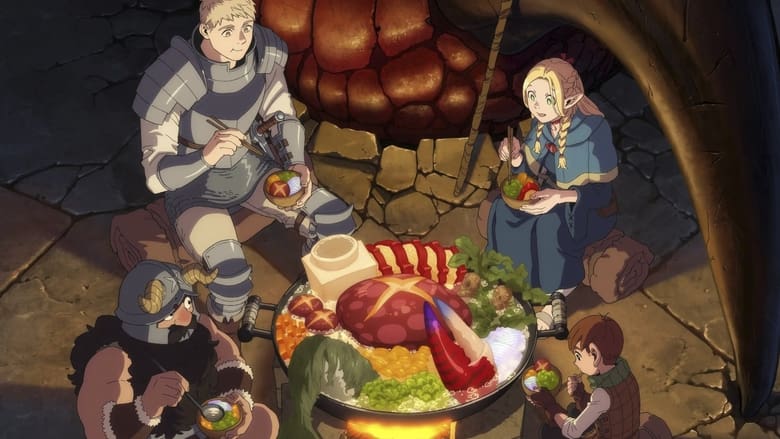
Symbolizes communion, trust, and the formation of community. Each meal the party shares strengthens their bonds, turning a simple act of survival into a ritual of friendship and mutual reliance. It is the core metaphor for the series' message about connection.
Present in every episode, from the first walking mushroom hotpot to the climactic feast on the red dragon. The triumphant musical score that plays when Senshi serves a meal reinforces its significance. The final act of the story, gathering multiple parties to eat the dragon, is the ultimate expression of this symbol.
The Dungeon
Represents a self-contained ecosystem, a cycle of life and death, and a manifestation of desire. It is not just a place of monsters and treasure but a living, breathing entity whose nature is shaped by its ruler's wishes. It acts as a crucible that strips characters down to their essential selves.
The entire series is set within the dungeon. Its rules, inhabitants, and history are slowly revealed as the party descends. The revelation that the dungeon's form is tied to the desires of its master (first the mad sorcerer, then Laios) is a pivotal plot point in the latter half of the story.
The Winged Lion
The personification of insatiable desire and temptation. As a demon, it offers to fulfill the wishes of mortals in exchange for their souls, representing the corrupting influence of unchecked ambition. Laios's ultimate victory is not just defeating it, but mastering it by consuming its essence.
Initially appearing as a benevolent guide in visions, the Winged Lion is revealed to be the main antagonist orchestrating events from the shadows. Laios's interactions with it mark the central conflict of the story's second half, culminating in him becoming the new master of the dungeon by consuming the demon.
Philosophical Questions
What is the ethical line between a 'monster' and 'food'?
The series constantly forces its characters and the audience to confront this question. Initially, the line is simple: if it's not a demi-human race, it can be food. However, this is complicated when they encounter creatures that display intelligence or humanoid features, like mandrakes or merfolk. Chilchuck objects to eating merfolk because they use tools, while Laios argues from a biological standpoint. Senshi provides a utilitarian perspective, advocating for respecting the ecosystem and using every part of a kill without waste. The show never provides a simple answer, instead using the debate to explore how different cultures and individuals construct their own moral frameworks around consumption.
Is the cycle of consumption (life eating life) inherently tragic or simply natural?
Marcille initially views eating monsters as a tragic, disgusting necessity, a fallback from 'civilized' food. In contrast, Laios and Senshi view it as a natural and fascinating part of the world. The series presents the dungeon as a complete, functioning ecosystem where consumption is not an act of malice but a fundamental process of existence. By showing the delicious, life-sustaining meals that come from seemingly horrifying creatures, the series suggests that the cycle is not something to be mourned but understood and respected. The ultimate solution to save Falin—consuming her monstrous form—frames this cycle as a necessary, even hopeful, part of rebirth and continuation.
Core Meaning
The core meaning of "Delicious in Dungeon" is an exploration of the intertwined nature of life, death, and desire, articulated through the universal act of eating. The series posits that to live is to consume, and in doing so, to participate in a complex, often brutal, but ultimately interconnected ecosystem. It strips away the pretenses of society and civilization to examine what it fundamentally means to be a living creature that must take from its environment to survive. Beyond this, the story is a profound statement on the power of community and shared experience—symbolized by the shared meal—to overcome even the most daunting adversities and existential fears. It suggests that true sustenance is found not just in food, but in the bonds forged with others.