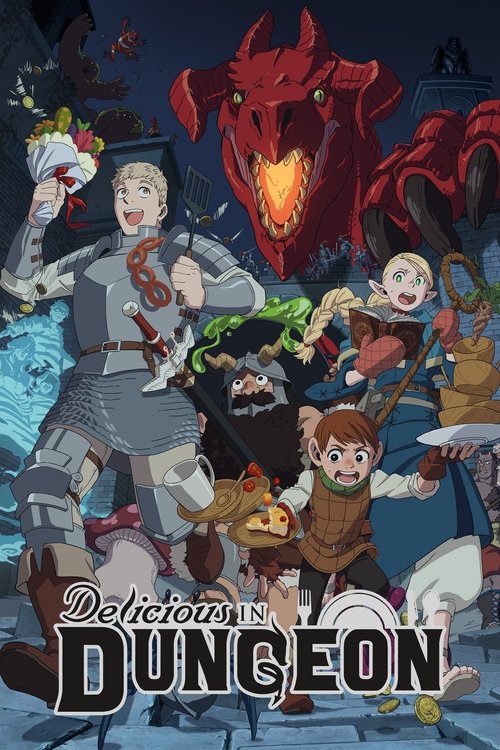
Delicious in Dungeon
ダンジョン飯
"Eat or be eaten."
Overview
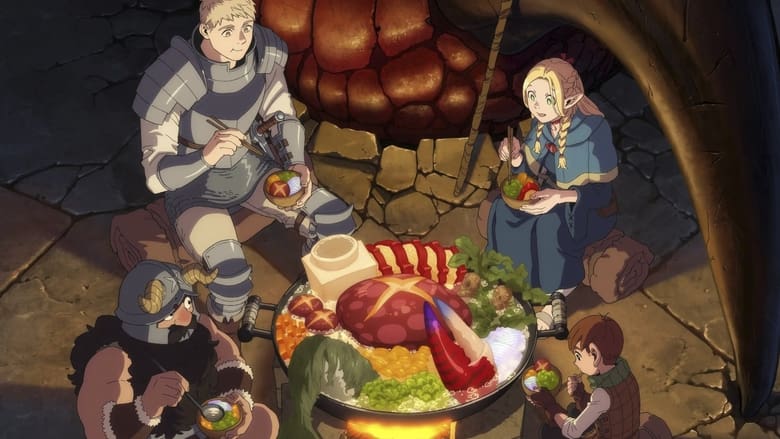
"Delicious in Dungeon" follows the adventurer Laios Touden, his companions Marcille Donato and Chilchuck Tims, after a disastrous encounter with a Red Dragon deep within a dungeon leaves Laios's sister, Falin, devoured. With no money or supplies, they resolve to save her before she is fully digested by surviving off the dungeon's ecosystem—eating the very monsters they defeat. They are soon joined by Senshi, a dwarf who has spent years perfecting the art of dungeon cuisine.
What begins as a quirky quest for sustenance evolves into a complex journey into the heart of the dungeon's mysteries. The party uncovers the history of a cursed golden kingdom, the machinations of a mad magician, and the influence of a powerful winged lion demon who feeds on desire. The series masterfully balances slice-of-life comedy and intricate world-building with moments of genuine horror and emotional depth, exploring the nature of life, death, and community through the fundamental act of eating.
Core Meaning
The core meaning of "Delicious in Dungeon" is an exploration of the intertwined nature of life, death, and desire, articulated through the universal act of eating. The series posits that to live is to consume, and in doing so, to participate in a complex, often brutal, but ultimately interconnected ecosystem. It strips away the pretenses of society and civilization to examine what it fundamentally means to be a living creature that must take from its environment to survive. Beyond this, the story is a profound statement on the power of community and shared experience—symbolized by the shared meal—to overcome even the most daunting adversities and existential fears. It suggests that true sustenance is found not just in food, but in the bonds forged with others.
Thematic DNA
Found Family and Community
The series is built upon the bonds between the core party members, who start as a fractured group and grow into a deeply loyal and co-dependent family. Their shared meals are the central ritual that solidifies their connection. This theme expands as they are forced to cooperate with rival parties and even former enemies, culminating in a massive communal feast to save Falin, illustrating that community is essential for survival and achieving the impossible.
The Cycle of Life, Death, and Consumption
Eating monsters is the central premise, forcing characters to confront the reality of the food chain. The dungeon is presented as a complete ecosystem where every creature has a role. The series explores the ethics of what is acceptable to eat, challenging both the characters' and the audience's preconceptions. This theme culminates in the ultimate taboo: the party must consume Falin's dragon form to save her soul, directly engaging with the idea that consumption and rebirth are inextricably linked.
The Nature of Desire
The dungeon's master, the Winged Lion, is a demon that manipulates and feeds on the desires of mortals. The entire plot is driven by desires: Laios's desire to save his sister (and eat monsters), Marcille's desire for safety and adherence to convention, and the mad magician's desire to control life and death. The story's climax revolves around Laios consuming the demon's power over desire itself, ultimately becoming king but being cursed to never fulfill his own deepest desire, offering a bittersweet commentary on ambition and sacrifice.
Deconstruction of Fantasy Tropes
The series takes classic Dungeons & Dragons-style fantasy and grounds it in practicality. It asks logistical questions rarely addressed in the genre: How do adventurers afford supplies? What is the biological basis for a slime? How would you actually cook a basilisk? This realistic and often comedic approach demystifies the fantasy world, making it feel tangible and lived-in, while still celebrating its sense of adventure.
Character Analysis
Laios Touden
Kentaro Kumagai
Motivation
Initially, his motivation is purely to rescue his sister, Falin. However, this is always intertwined with his deep, almost academic, fascination with monsters, particularly their flavor. This passion evolves from a quirky character trait into a profound understanding of the dungeon's ecosystem, which is key to his eventual success. His final motivation is to create a kingdom where humans and all other races can coexist peacefully.
Character Arc
Laios begins as a capable but socially awkward swordsman whose primary motivation is saving his sister, closely followed by his obsessive curiosity about eating monsters. He is often seen as strange by his peers. Throughout the journey, he is forced to become a true leader, balancing his eccentricities with the responsibility of keeping his party alive. His encyclopedic knowledge of monsters, once a mere hobby, becomes their greatest asset. He ultimately confronts the demon of desire, consumes its power, and becomes the wise, if still odd, king of the dungeon, sacrificing his own greatest desire—to see and interact with monsters—for the peace of his kingdom.
Marcille Donato
Sayaka Senbongi
Motivation
Her primary motivation is safety and a return to normalcy. She wants to rescue Falin using conventional, 'clean' methods and is deeply loyal to her friends. As the series progresses, her motivation shifts from merely escaping the dungeon to actively protecting her found family and the future of the kingdom they build, accepting the strange new world she's a part of.
Character Arc
Marcille starts as the most conventional and risk-averse member of the group, disgusted by the idea of eating monsters and terrified of breaking magical taboos. Her journey is one of shedding her rigid prejudices. Forced by circumstance, she gradually learns to appreciate the dungeon's ecosystem and the value of their unconventional methods. She confronts her deep-seated fear of death and loss, which stems from her long elven lifespan, and her relationship with the short-lived Laios and Falin. She grows from a by-the-book mage into a powerful and adaptable sorceress who uses forbidden magic to help save Falin and becomes Laios's most trusted advisor as king.
Chilchuck Tims
Asuna Tomari
Motivation
Initially, his motivation is purely professional: do the job (disarm traps, find paths) and get paid. He stays with Laios out of a sense of responsibility and the knowledge that they would die without him. Over time, this professional obligation transforms into a personal investment in the well-being of his companions, particularly Laios and Marcille.
Character Arc
Chilchuck is introduced as a pragmatic, no-nonsense halfling locksmith who treats dungeon crawling purely as a job. He maintains an emotional distance from the party, viewing them as reckless amateurs. His arc involves him slowly letting his professional guard down and admitting his genuine affection and concern for the group. We learn he has a family he's estranged from, which informs his cynical exterior. By the end, he fully embraces his role as a core member of their found family, acting as the exasperated but fiercely protective older brother figure.
Senshi
Hiroshi Naka
Motivation
His initial motivation is a ten-year-long quest to cook and eat the Red Dragon that he feels is a blight on the dungeon. He believes in a perfect nutritional balance and living in harmony with the dungeon's ecosystem. After achieving his goal, his motivation becomes supporting Laios and ensuring his new family is always well-fed and safe.
Character Arc
Senshi is introduced as a master of the dungeon, a dwarf who has dedicated his life to studying its ecosystem and perfecting monster cuisine. He appears as a simple, food-obsessed hermit, but his backstory reveals a deep trauma related to the destruction of his original dwarven mining party and his quest to defeat the Red Dragon. His arc is about reconnecting with others and finding a new purpose. He serves as the party's anchor, providing not just physical sustenance but also wisdom about living in harmony with one's environment. He fulfills his personal quest and then finds a new home and family with Laios's group.
Symbols & Motifs
The Shared Meal
Symbolizes communion, trust, and the formation of community. Each meal the party shares strengthens their bonds, turning a simple act of survival into a ritual of friendship and mutual reliance. It is the core metaphor for the series' message about connection.
Present in every episode, from the first walking mushroom hotpot to the climactic feast on the red dragon. The triumphant musical score that plays when Senshi serves a meal reinforces its significance. The final act of the story, gathering multiple parties to eat the dragon, is the ultimate expression of this symbol.
The Dungeon
Represents a self-contained ecosystem, a cycle of life and death, and a manifestation of desire. It is not just a place of monsters and treasure but a living, breathing entity whose nature is shaped by its ruler's wishes. It acts as a crucible that strips characters down to their essential selves.
The entire series is set within the dungeon. Its rules, inhabitants, and history are slowly revealed as the party descends. The revelation that the dungeon's form is tied to the desires of its master (first the mad sorcerer, then Laios) is a pivotal plot point in the latter half of the story.
The Winged Lion
The personification of insatiable desire and temptation. As a demon, it offers to fulfill the wishes of mortals in exchange for their souls, representing the corrupting influence of unchecked ambition. Laios's ultimate victory is not just defeating it, but mastering it by consuming its essence.
Initially appearing as a benevolent guide in visions, the Winged Lion is revealed to be the main antagonist orchestrating events from the shadows. Laios's interactions with it mark the central conflict of the story's second half, culminating in him becoming the new master of the dungeon by consuming the demon.
Episode Highlights
Hot Pot/Tart
This episode perfectly establishes the series' unique premise and tone. After the harrowing opening scene where Falin is eaten by a dragon, the episode quickly pivots to the comedic dilemma of surviving without supplies, introducing Senshi and the central concept of monster cuisine. The detailed, loving preparation of a giant scorpion and walking mushroom hotpot immediately sets it apart from any other fantasy series.
It lays the entire groundwork for the show's blend of high-stakes fantasy, practical survival, and loving culinary detail. It introduces the core cast (minus Falin) and their fundamental dynamics, establishing the central conflict and the quirky solution that drives the plot.
Living Armor
The party discovers that the classic RPG enemy, Living Armor, is actually comprised of symbiotic mollusks. This episode is a standout for its clever deconstruction of a fantasy trope, blending ecological principles with absurd comedy. The visual style and animation by Studio Trigger shine here, showcasing their ability to make a potentially mundane encounter dynamic and memorable.
This episode solidifies the series' commitment to its world-building, demonstrating how it will thoughtfully and logically explain the biology of its monsters. It's an early sign to the audience that the show is more than just a simple gag series; it's a meticulously crafted world.
Red Dragon I
The culmination of the first major arc: the party's confrontation with the Red Dragon that ate Falin. The episode is a masterclass in tension, combining thrilling action with the emotional weight of their quest. It features both a high-stakes battle and the beginning of the complex process of rescuing Falin from the dragon's corpse.
This is a major turning point in the plot. While they succeed in killing the dragon, Falin's subsequent resurrection by the mad sorcerer as a chimera sets up the central conflict for the rest of the story, elevating the stakes from a simple rescue mission to a complex magical crisis.
Harpy/Chimera
A shocking and pivotal episode where the party finally finds Falin, only to discover she has been resurrected by the Mad Sorcerer and twisted into a grotesque chimera under his control. The reveal is horrifying and heartbreaking, shifting the tone of the series dramatically. The chimera's design and actions are genuinely unsettling.
This episode completely redefines the main quest. The goal is no longer a simple resurrection but a desperate attempt to save Falin's soul and humanity from a powerful curse. It introduces the primary antagonist, the Mad Sorcerer Thistle, and establishes the darker, more serious stakes of the story's second half.
Dumplings II/Bacon and Eggs
The season finale sees the party regrouping after defeating the chimera-Falin. They formulate a radical plan: to separate Falin's soul from the dragon's, they must eat the remaining dragon parts of her body. The episode ends with Laios resolving to gather all the allies they've made for a massive feast, setting the stage for the next chapter.
It concludes the first season by perfectly encapsulating the show's core themes: the solution to a horrifying magical problem is found through community and the act of eating. It serves as a cliffhanger that transitions the story from a personal quest to a large-scale, collaborative effort, promising an even grander scope for the announced second season.
Philosophical Questions
What is the ethical line between a 'monster' and 'food'?
The series constantly forces its characters and the audience to confront this question. Initially, the line is simple: if it's not a demi-human race, it can be food. However, this is complicated when they encounter creatures that display intelligence or humanoid features, like mandrakes or merfolk. Chilchuck objects to eating merfolk because they use tools, while Laios argues from a biological standpoint. Senshi provides a utilitarian perspective, advocating for respecting the ecosystem and using every part of a kill without waste. The show never provides a simple answer, instead using the debate to explore how different cultures and individuals construct their own moral frameworks around consumption.
Is the cycle of consumption (life eating life) inherently tragic or simply natural?
Marcille initially views eating monsters as a tragic, disgusting necessity, a fallback from 'civilized' food. In contrast, Laios and Senshi view it as a natural and fascinating part of the world. The series presents the dungeon as a complete, functioning ecosystem where consumption is not an act of malice but a fundamental process of existence. By showing the delicious, life-sustaining meals that come from seemingly horrifying creatures, the series suggests that the cycle is not something to be mourned but understood and respected. The ultimate solution to save Falin—consuming her monstrous form—frames this cycle as a necessary, even hopeful, part of rebirth and continuation.
Alternative Interpretations
While largely seen as a heartfelt adventure comedy, "Delicious in Dungeon" can be interpreted through a darker lens. Some viewers emphasize the body horror and cosmic horror elements that become more prominent as the series progresses. The act of eating monsters, while comedic, is also inherently violent and gruesome. Falin's transformation into a chimera is a moment of pure body horror. Furthermore, the dungeon itself can be seen as a Lovecraftian entity, a place with its own alien logic that slowly chips away at the sanity and humanity of those within it. The final antagonist, a demon that feeds on desire, lends itself to a reading of the story as a cautionary tale about the all-consuming nature of ambition, with the dungeon acting as a metaphor for a descent into obsession.
Cultural Impact
"Delicious in Dungeon" has been praised for its unique and successful genre-blending, masterfully combining high fantasy, slice-of-life comedy, and cooking show elements. Its success has helped popularize the "cozy fantasy" subgenre, which focuses on lower stakes and more intimate character moments within a fantasy setting. The meticulous world-building, which treats the dungeon as a realistic ecosystem, has been lauded by fans of tabletop RPGs like Dungeons & Dragons for its clever and logical deconstruction of classic fantasy tropes.
Critically, the series has received widespread acclaim for its strong character writing, tonal balance, and Studio Trigger's faithful and expressive animation. It has resonated with audiences for its heartwarming focus on found family and its surprisingly deep exploration of philosophical themes like mortality and the ethics of consumption. The show's popularity on a global platform like Netflix has introduced a massive new audience to Ryoko Kui's completed manga, solidifying its legacy as a modern fantasy classic that is both charmingly bizarre and profoundly human.
Audience Reception
"Delicious in Dungeon" has been met with overwhelmingly positive audience reception. Fans of the original manga praised Studio Trigger's faithful adaptation, particularly its ability to capture the unique blend of comedy, adventure, and slice-of-life charm. Newcomers were drawn in by the inventive premise, endearing characters, and detailed world-building. The series is frequently lauded for its wholesome focus on friendship and found family, providing a comforting watch for many. The main points of praise are often directed at the character dynamics, the surprisingly intricate plot that unfolds from a simple premise, and the lovingly animated cooking sequences. There has been very little criticism, though some viewers were surprised by the story's shift into darker, more serious territory in its second half, a tonal shift that was ultimately well-received for adding depth and stakes to the narrative.
Interesting Facts
- The manga's creator, Ryoko Kui, was very involved in the anime's production, offering guidance and detailed notes to director Yoshihiro Miyajima to ensure the adaptation was faithful to her vision.
- This is the first time Studio Trigger, known for its original works like 'Kill la Kill' and 'Promare', has adapted a manga series for television.
- The anime's score was composed by Yasunori Mitsuda, the legendary composer behind iconic video games like 'Chrono Trigger' and 'Xenogears', which contributes to the series' classic RPG feel.
- Director Yoshihiro Miyajima was a fan of Ryoko Kui's work since 2011 and directed a commercial for the manga's eighth volume in 2019, years before being tapped to direct the full series.
- The creator Ryoko Kui is a self-proclaimed picky eater, which makes her detailed and appetizing depiction of monstrous meals all the more fascinating.
⚠️ Spoiler Analysis
Click to reveal detailed analysis with spoilers
Frequently Asked Questions
Explore More About This Movie
Dive deeper into specific aspects of the movie with our detailed analysis pages
Comments (0)
No comments yet. Be the first to share your thoughts!