
おくりびと
"The gift of last memories."
Departures - Symbolism & Philosophy
Symbols & Motifs
The Cello
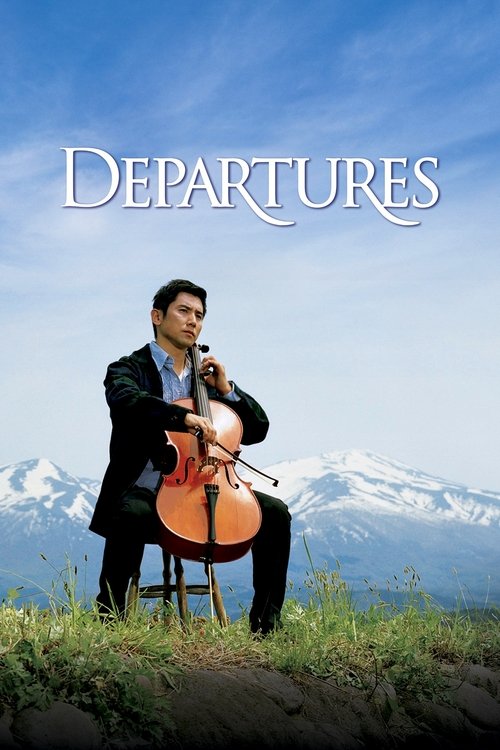
The cello symbolizes Daigo's past life, his lost dreams, and his connection to his estranged father. Initially, he sells his professional cello, signifying the end of his career ambitions. However, he later rediscovers his childhood cello, representing a return to his roots and a more authentic form of expression. Playing it becomes a way to process his emotions and connect with his memories, rather than a professional obligation.
Daigo sells his expensive orchestra cello after the group disbands. Back in his hometown, he finds the smaller cello he owned as a child. He is shown playing it on a hillside, a deeply personal and emotional act. The instrument's melancholic and beautiful sound, composed by Joe Hisaishi, becomes the emotional score of the film, linking Daigo's artistic soul to the quiet grace of his new profession.
Stone Letters (Ishibumi)
The stone letters represent unspoken communication, love, and the enduring connection between parent and child. It's a tradition Daigo's father created, where the texture of a stone conveys feelings—smooth for happiness, rough for worry. It symbolizes a form of communication that transcends words and even time, becoming the ultimate proof of his father's love and remembrance.
Daigo has kept the rough stone his father gave him before leaving, a symbol of his lingering feelings of abandonment. The film's most powerful emotional moment comes at the end, when Daigo prepares his deceased father's body and finds a small, smooth stone clutched in his hand—the stone Daigo had given him as a child. This discovery allows Daigo to finally understand his father's love and forgive him, bringing his emotional journey to a close. Daigo then gently places the stone on his wife's pregnant belly, passing the legacy of love to the next generation.
Food and Eating
Food and the act of eating serve as a powerful symbol of life in the midst of death. It is a recurring motif that grounds the characters in the physical, living world. Sasaki often tells Daigo to eat well, stating, "The living eat the dead... Unless you want to die, you eat." This philosophy highlights the natural cycle of life and death and the necessity for the living to continue living fully.
Numerous scenes feature the characters eating with gusto, from the pufferfish roe Sasaki declares a dangerous delicacy to the Christmas fried chicken shared in the office. These moments of community and simple pleasure provide a stark, life-affirming contrast to their work with the deceased. It underscores the film's message that appreciating death deepens one's appreciation for the simple, vibrant acts of being alive.
Salmon Swimming Upstream
The salmon swimming upstream to spawn and subsequently die represents the powerful, instinctual drive towards life's purpose, even when it leads directly to death. It is a visual metaphor for the natural, beautiful, and sometimes tragic cycle of life.
Daigo observes the salmon in a river, commenting on their struggle: "To swim against the tide just to die." This moment of contemplation reflects his growing philosophical understanding of his work. He is beginning to see death not as a failure, but as the purposeful conclusion to a life lived, a natural and inevitable destination.
Philosophical Questions
What is the relationship between life and death?
The film explores this question by rejecting the idea of death as the opposite of life, instead presenting it as an integral part of it. As the mentor character Sasaki states, "The living eat the dead." This cyclical view is reinforced through symbolism like the salmon swimming upstream to die and the constant, life-affirming presence of food. The film argues that by embracing the reality of death and treating it with dignity, our appreciation for the beauty and fragility of life is immensely deepened. It suggests that a full understanding of life is impossible without a respectful acknowledgment of death.
What defines a meaningful profession?
"Departures" challenges conventional notions of a 'good job'. Daigo loses a prestigious career as a cellist only to find true purpose in a profession that society scorns. The film posits that the meaning of one's work is not determined by salary or social status, but by the human connection and value it provides. Daigo's work, while dealing with the deceased, is ultimately for the living, offering them peace and closure. The film asks viewers to reconsider their own prejudices about different types of labor and to find dignity and importance in work that serves others, regardless of how it is perceived.
How do we find closure and forgive the past?
This question is explored through Daigo's relationship with his absent father. His journey is not just about finding a new career but also about healing a deep childhood wound. The film suggests that understanding and forgiveness are not always achieved through direct confrontation or conversation, but can come through empathetic acts and symbolic gestures. It is only when Daigo performs the intimate ritual of encoffining for his father that he is able to see him as a vulnerable human and finally let go of his resentment. The discovery of the 'stone letter' confirms his father's love, showing that closure can arrive unexpectedly, through a final, silent communication.
Core Meaning
The core meaning of "Departures" revolves around the idea that by confronting death, one can truly learn to live. Director Yojiro Takita suggests that modern society has sanitized and distanced itself from the natural process of dying, creating a culture of fear and prejudice against those who work with the deceased. The film's central message is a quiet protest against this discrimination, asserting that death is a normal, integral part of life, not something repulsive.
Through Daigo's journey from a disillusioned musician to a masterful 'nōkanshi' (encoffiner), the film argues for the importance of ritual and dignity in finding closure and honoring life. The meticulous, respectful encoffining ceremony becomes a powerful metaphor for finding beauty and meaning in endings. Ultimately, the film is not just about death, but about life itself: about finding a calling in an unexpected place, the healing of family bonds, and the profound realization that every life, and its conclusion, has a unique and valuable story.