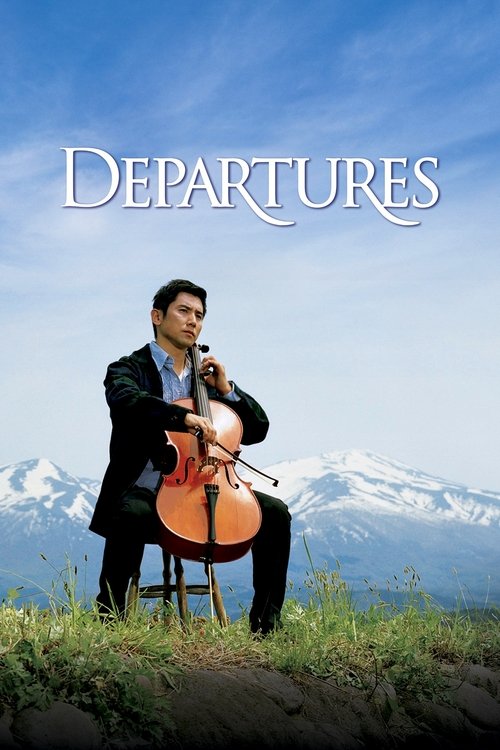
Departures
おくりびと
"The gift of last memories."
Overview
"Departures" (おくりびと) is a deeply moving 2008 Japanese drama directed by Yojiro Takita. The film follows Daigo Kobayashi, a young cellist whose orchestra in Tokyo is abruptly disbanded. Facing unemployment and debt, he and his wife, Mika, decide to move back to his childhood home in rural Yamagata Prefecture. Desperate for work, Daigo answers a cryptic newspaper ad for a job "assisting departures," assuming it to be a travel agency.
To his surprise, he discovers the job is with NK Agent, a company that performs 'nōkan' – the traditional Japanese art of encoffining, which involves ceremonially preparing the deceased for cremation in front of their loved ones. Despite his initial repulsion and the strong social stigma attached to those who handle death, the high salary tempts him to take the position under the mentorship of the quiet but dignified owner, Sasaki. Daigo hides the true nature of his work from his wife, leading to misunderstanding and conflict as he navigates a world that is at once macabre and profoundly beautiful.
As Daigo learns the precise and respectful rituals of his new trade, he begins to find an unexpected sense of purpose and fulfillment. The film gently explores his journey of personal growth, his reconciliation with his past, and his newfound understanding of life, death, and the intricate web of human connections. It is a story that confronts the taboo of death with warmth, humor, and immense humanity.

Core Meaning
The core meaning of "Departures" revolves around the idea that by confronting death, one can truly learn to live. Director Yojiro Takita suggests that modern society has sanitized and distanced itself from the natural process of dying, creating a culture of fear and prejudice against those who work with the deceased. The film's central message is a quiet protest against this discrimination, asserting that death is a normal, integral part of life, not something repulsive.
Through Daigo's journey from a disillusioned musician to a masterful 'nōkanshi' (encoffiner), the film argues for the importance of ritual and dignity in finding closure and honoring life. The meticulous, respectful encoffining ceremony becomes a powerful metaphor for finding beauty and meaning in endings. Ultimately, the film is not just about death, but about life itself: about finding a calling in an unexpected place, the healing of family bonds, and the profound realization that every life, and its conclusion, has a unique and valuable story.
Thematic DNA
The Dignity of Death and Ritual
The film's central theme is the exploration of death as a dignified and integral part of life, rather than a taboo subject. This is primarily shown through the meticulous and graceful ceremony of encoffining ('nōkan'). Sasaki, Daigo's mentor, teaches him that their job requires "calmness, precision and affection." Each ceremony is depicted not as a morbid task but as a beautiful, respectful performance that provides comfort and closure to the grieving family, allowing them to see their loved one looking peaceful and beautiful one last time. The film contrasts the societal prejudice against this work with the profound gratitude of the families Daigo serves, highlighting the immense value of these rituals in the grieving process.
Personal Transformation and Finding a Calling
Daigo's journey is a classic tale of transformation. He starts as a man who has lost his dream and purpose, adrift after his orchestra is disbanded. His accidental entry into the world of encoffining forces him to confront his own prejudices and fears. Through his work, he sheds his initial shame and develops a deep sense of pride and fulfillment. The film posits that a true calling is not always found in glamorous pursuits but can be discovered in unexpected, even socially ostracized, professions. Daigo's artistic sensibility as a cellist translates into the grace and empathy he brings to his new craft, suggesting that our inherent skills can find new forms of expression.
Family, Reconciliation, and Forgiveness
The theme of family is woven throughout the narrative. Daigo's primary internal conflict is his deep-seated resentment towards the father who abandoned him as a child. This unresolved pain is a constant undercurrent to his life. His work with the deceased, witnessing the complex emotions of grieving families, gives him a new perspective on familial bonds. The climax of his emotional arc is performing the encoffining ceremony for his own father, a moment that allows him to finally understand and forgive him, completing his journey of personal healing. Furthermore, his relationship with his wife Mika, which is strained by the secrecy and nature of his job, is eventually healed through her understanding and acceptance, reinforced by the promise of their own growing family.
Societal Prejudice and Acceptance
"Departures" directly confronts the strong social taboos in Japan surrounding death and those who work in professions related to it. These individuals are often seen as 'unclean' due to cultural and religious beliefs about the 'kegare' (defilement) of death. Daigo faces this prejudice from his wife, his childhood friend, and the wider community. The film critiques this social ostracism by beautifully illustrating the honor and necessity of Daigo's work. The journey towards acceptance, both Daigo's self-acceptance and his eventual acceptance by others, is a key narrative driver, culminating when his wife and friend witness the ceremony and finally understand its profound dignity.
Character Analysis
Daigo Kobayashi
Masahiro Motoki
Motivation
Initially, Daigo's motivation is purely financial; he is desperate for a job with a high salary after his orchestra is disbanded. This practical need forces him into a profession he would never have chosen. However, his motivation evolves as he witnesses the profound impact of his work. He becomes driven by a desire to provide dignity to the deceased and comfort to the living, finding an artistic and spiritual fulfillment that his music career no longer offered.
Character Arc
Daigo begins the film as a man defined by a failed dream, feeling lost and inadequate. His journey is one of profound self-discovery. Initially repulsed and ashamed by his job as an encoffiner, he gradually finds an unexpected calling. Through the tutelage of his mentor and his experiences with grieving families, he moves from shame to pride, finding a deep sense of purpose and humanity in his work. His arc culminates in confronting his deepest wound—the abandonment by his father. By performing the final rites for him, Daigo transitions from a resentful son to an empathetic, forgiving man, ready to become a father himself.
Ikuei Sasaki
Tsutomu Yamazaki
Motivation
Sasaki is motivated by a profound respect for life's final ritual. Having encoffined his own wife, he deeply understands the importance of a beautiful and dignified farewell. He runs his business not just as a job, but as a solemn duty. He is also motivated to pass on his knowledge and finds a worthy successor in Daigo, whom he guides with a firm but gentle hand, acting as the father figure Daigo never had.
Character Arc
Sasaki is a largely static character who has already found his peace and purpose, allowing him to serve as the stable anchor for Daigo's development. He is presented as a master of his craft, treating his work with solemn dignity and quiet wisdom. His own backstory is revealed subtly; he began this work after his wife died, and his dedication is rooted in that personal experience. His arc is not one of change, but of imparting his philosophy to a new generation, ensuring the traditions and, more importantly, the respect for life and death, are passed on.
Mika Kobayashi
Ryoko Hirosue
Motivation
Mika's initial motivation is her love for Daigo and her desire for a normal, respectable life together. Her rejection of his job stems from a deeply ingrained social taboo and concern for their reputation. Ultimately, her core motivation is their relationship and burgeoning family. She returns to Daigo because she loves him and is pregnant, forcing a resolution. Her final motivation becomes supporting her husband in the calling he has found, once she understands its true worth.
Character Arc
Mika begins as a cheerful, supportive wife who follows Daigo's lead. Her arc is one of evolving understanding and acceptance. When she discovers the true nature of Daigo's job, her reaction is shaped by societal prejudice; she is horrified and ashamed, eventually leaving him. Her turning point comes when she witnesses Daigo perform the encoffining ceremony for the local bathhouse owner, a woman they both knew. Seeing the beauty, grace, and importance of his work firsthand, her disgust transforms into admiration and love. Her pregnancy acts as a catalyst, pushing the conflict to a crisis but ultimately cementing their reconciliation and future.
Symbols & Motifs
The Cello
The cello symbolizes Daigo's past life, his lost dreams, and his connection to his estranged father. Initially, he sells his professional cello, signifying the end of his career ambitions. However, he later rediscovers his childhood cello, representing a return to his roots and a more authentic form of expression. Playing it becomes a way to process his emotions and connect with his memories, rather than a professional obligation.
Daigo sells his expensive orchestra cello after the group disbands. Back in his hometown, he finds the smaller cello he owned as a child. He is shown playing it on a hillside, a deeply personal and emotional act. The instrument's melancholic and beautiful sound, composed by Joe Hisaishi, becomes the emotional score of the film, linking Daigo's artistic soul to the quiet grace of his new profession.
Stone Letters (Ishibumi)
The stone letters represent unspoken communication, love, and the enduring connection between parent and child. It's a tradition Daigo's father created, where the texture of a stone conveys feelings—smooth for happiness, rough for worry. It symbolizes a form of communication that transcends words and even time, becoming the ultimate proof of his father's love and remembrance.
Daigo has kept the rough stone his father gave him before leaving, a symbol of his lingering feelings of abandonment. The film's most powerful emotional moment comes at the end, when Daigo prepares his deceased father's body and finds a small, smooth stone clutched in his hand—the stone Daigo had given him as a child. This discovery allows Daigo to finally understand his father's love and forgive him, bringing his emotional journey to a close. Daigo then gently places the stone on his wife's pregnant belly, passing the legacy of love to the next generation.
Food and Eating
Food and the act of eating serve as a powerful symbol of life in the midst of death. It is a recurring motif that grounds the characters in the physical, living world. Sasaki often tells Daigo to eat well, stating, "The living eat the dead... Unless you want to die, you eat." This philosophy highlights the natural cycle of life and death and the necessity for the living to continue living fully.
Numerous scenes feature the characters eating with gusto, from the pufferfish roe Sasaki declares a dangerous delicacy to the Christmas fried chicken shared in the office. These moments of community and simple pleasure provide a stark, life-affirming contrast to their work with the deceased. It underscores the film's message that appreciating death deepens one's appreciation for the simple, vibrant acts of being alive.
Salmon Swimming Upstream
The salmon swimming upstream to spawn and subsequently die represents the powerful, instinctual drive towards life's purpose, even when it leads directly to death. It is a visual metaphor for the natural, beautiful, and sometimes tragic cycle of life.
Daigo observes the salmon in a river, commenting on their struggle: "To swim against the tide just to die." This moment of contemplation reflects his growing philosophical understanding of his work. He is beginning to see death not as a failure, but as the purposeful conclusion to a life lived, a natural and inevitable destination.
Memorable Quotes
死んだ人のこと、きれいにして、旅立ちのお手伝いをする。厳かで、静かで、でも、何より、優しい。
— Daigo Kobayashi (Narration)
Context:
This is part of Daigo's internal monologue after watching Sasaki perform one of the first encoffining ceremonies. He is mesmerized by the grace and dignity of the ritual, which is in stark contrast to his own fear and the societal perception of the job. It is a pivotal moment in his journey toward accepting his new calling.
Meaning:
English Translation: "To prepare the deceased and help them on their journey. It was calm, and precise, and more than anything, it was filled with affection." This quote encapsulates Daigo's epiphany about his profession. It marks the shift in his perception from seeing the job as grotesque to understanding it as a profound act of love and care.
困るんだよ、死んだって。生きてるもんが死んだもん喰ってんだ。うまいんだよ、これが。
— Ikuei Sasaki
Context:
Sasaki says this to Daigo in his office greenhouse while they are about to eat fugu shirako (pufferfish roe), a delicacy that is itself potentially deadly. The moment is both humorous and profound, serving as a lesson for Daigo to embrace life fully and without fear, even as he works so closely with death.
Meaning:
English Translation: "It's a corpse. The living eat the dead... Unless you want to die, you eat. And it's good." This quote bluntly states the film's philosophy on the cycle of life and death. Sasaki uses the act of eating to ground Daigo in the reality that life sustains itself through death, stripping away the sentimentality to reveal a fundamental, natural truth.
昔、文字が発明される前、自分の気持ちにあった石を選んで、贈る相手に渡したんだって。その石の触り心地や重さで、気持ちを伝えたんだ。
— Daigo Kobayashi
Context:
Daigo explains this to his wife Mika as he gives her a small stone, trying to reconnect with her after their relationship has been strained by his job. He is recalling the tradition his father taught him, a pivotal moment that foreshadows the emotional climax of the film where a stone letter becomes the key to forgiving his father.
Meaning:
English Translation: "Long ago, before writing, you'd send someone a stone that suited how you were feeling. From its weight and touch, they'd know how you felt." This explains the concept of the 'stone letters,' a central symbol in the film. It speaks to a form of pure, elemental communication that transcends words, representing the deep, often unspoken, bonds of family.
Philosophical Questions
What is the relationship between life and death?
The film explores this question by rejecting the idea of death as the opposite of life, instead presenting it as an integral part of it. As the mentor character Sasaki states, "The living eat the dead." This cyclical view is reinforced through symbolism like the salmon swimming upstream to die and the constant, life-affirming presence of food. The film argues that by embracing the reality of death and treating it with dignity, our appreciation for the beauty and fragility of life is immensely deepened. It suggests that a full understanding of life is impossible without a respectful acknowledgment of death.
What defines a meaningful profession?
"Departures" challenges conventional notions of a 'good job'. Daigo loses a prestigious career as a cellist only to find true purpose in a profession that society scorns. The film posits that the meaning of one's work is not determined by salary or social status, but by the human connection and value it provides. Daigo's work, while dealing with the deceased, is ultimately for the living, offering them peace and closure. The film asks viewers to reconsider their own prejudices about different types of labor and to find dignity and importance in work that serves others, regardless of how it is perceived.
How do we find closure and forgive the past?
This question is explored through Daigo's relationship with his absent father. His journey is not just about finding a new career but also about healing a deep childhood wound. The film suggests that understanding and forgiveness are not always achieved through direct confrontation or conversation, but can come through empathetic acts and symbolic gestures. It is only when Daigo performs the intimate ritual of encoffining for his father that he is able to see him as a vulnerable human and finally let go of his resentment. The discovery of the 'stone letter' confirms his father's love, showing that closure can arrive unexpectedly, through a final, silent communication.
Alternative Interpretations
While "Departures" is largely seen as a straightforward and heartfelt narrative, some alternative readings exist. One interpretation focuses less on death and more on the film as a critique of modern Japanese society's emphasis on status and conformity. Daigo's initial career as a cellist is respectable but leaves him unfulfilled and in debt. His move to a 'disreputable' but essential job can be seen as a rejection of superficial societal values in favor of a more authentic and meaningful existence. In this view, the film champions the idea that true fulfillment lies outside the narrow confines of conventional success.
Another interpretation views the film through a more spiritual or religious lens, specifically Buddhist and Shinto traditions that are subtly woven into the narrative. The title itself, 'Okuribito' (one who sends off), frames Daigo as a spiritual guide, akin to a gatekeeper between the world of the living and the next. The encoffining ceremony, with its ritual cleansing, can be seen as a purification rite that prepares the soul for its journey. The film's ending, where Daigo reconciles with his father and anticipates the birth of his child, can be interpreted as an affirmation of the cycle of reincarnation and the continuation of life's journey through generations.
Cultural Impact
"Departures" had a profound cultural impact both within Japan and internationally. In Japan, the film directly challenged long-held societal taboos about death and the people who work as morticians. Traditionally, these professions have been associated with 'kegare' (defilement) and are subjects of prejudice, forcing those in the trade to the margins of society. By portraying the 'nōkanshi' with such dignity, grace, and humanity, the film opened a national conversation, fostering a new appreciation for the ritual and the professionals who perform it. It was a critical and commercial success, becoming the highest-grossing domestic film of 2008 in Japan and winning Picture of the Year at the Japanese Academy Awards.
Internationally, the film's 2009 Academy Award win for Best Foreign Language Film brought it global attention. For many Western audiences, it was an introduction to the intricate and beautiful Japanese rituals surrounding death. Critics and viewers alike were moved by its universal themes of finding one's purpose, family reconciliation, and the beauty of life in the face of mortality. The film transcended its specific cultural context to tell a story about human connection that resonated worldwide, demonstrating that a film deeply rooted in specific Japanese traditions could have powerful, cross-cultural appeal. Its success helped to reinvigorate interest in Japanese cinema on the world stage.
Audience Reception
Audience reception for "Departures" has been overwhelmingly positive worldwide. Viewers frequently praise the film for its profound emotional depth, its ability to handle a morbid subject with grace, humor, and warmth, and its life-affirming message. Many audiences connect deeply with Daigo's journey of self-discovery and his ultimate reconciliation with his father, often citing the final scene as incredibly moving and tear-jerking. The beautiful cinematography and the poignant musical score by Joe Hisaishi are also consistently highlighted as major strengths that enhance the film's emotional impact.
The main points of praise revolve around the film's unique and respectful portrayal of the encoffining ritual, which many viewers find fascinating and beautiful. However, a point of minor criticism from some viewers and critics is that the film can occasionally lean towards being overly sentimental or emotionally manipulative, particularly with its use of music and montage sequences. Despite this, the overall verdict from audiences is that "Departures" is a masterful, touching, and unforgettable film that offers a unique and valuable perspective on life, death, and human dignity.
Interesting Facts
- The idea for the film came to lead actor Masahiro Motoki after he traveled to India and witnessed a funeral ceremony on the Ganges River, which prompted him to read books on the subject of death, leading him to Shinmon Aoki's memoir, "Coffinman".
- Masahiro Motoki spent time studying the art of encoffining from a real-life mortician. He meticulously learned the delicate and precise hand movements required for the ceremony.
- The film's international success, particularly its surprise win for Best Foreign Language Film at the 81st Academy Awards, was a major event. It was the first Japanese film to win in this category.
- Despite its eventual success, distributors in Japan were initially reluctant to release the film due to the strong cultural taboos surrounding the subject of death and the mortician profession.
- The beautiful and emotive musical score was composed by the legendary Joe Hisaishi, who is famous for his collaborations with Studio Ghibli and director Hayao Miyazaki.
- The director, Yojiro Takita, was previously known for his work in the 'pinku eiga' (softcore erotic) genre, making his transition to this deeply sensitive and poignant drama a remarkable shift in his career.
- Following the film's release and success, there was reportedly an increased interest in the profession of 'nōkanshi' in Japan, shedding light on a little-known and often stigmatized career.
⚠️ Spoiler Analysis
Click to reveal detailed analysis with spoilers
Frequently Asked Questions
Explore More About This Movie
Dive deeper into specific aspects of the movie with our detailed analysis pages
Comments (0)
No comments yet. Be the first to share your thoughts!