Divorzio all'italiana
"He ordered marriage on the rocks with a twist... Italian Style!"
Divorce Italian Style - Symbolism & Philosophy
Symbols & Motifs
Ferdinando's Daydreams
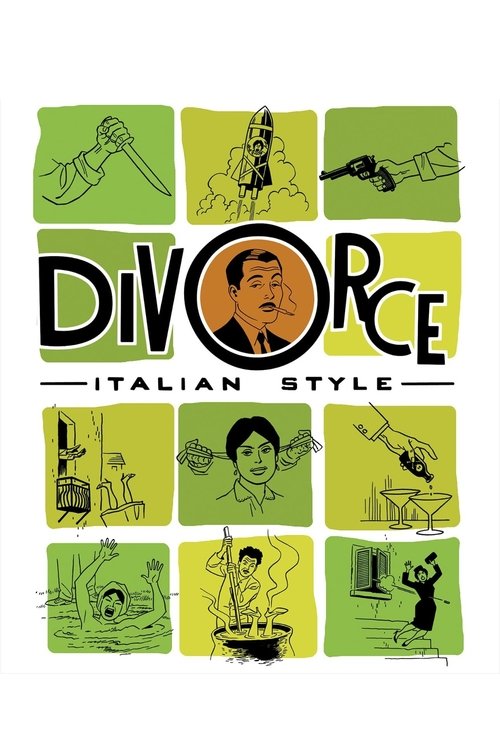
Ferdinando's elaborate and often violent fantasies of killing his wife symbolize his deep-seated frustration and the psychological pressure of his entrapped situation. They represent his only outlet for escape in a society that offers no legal or socially acceptable alternatives. The humorous and over-the-top nature of these daydreams serves to both lighten the dark subject matter and underscore the absurdity of his predicament.
These fantasies are interspersed throughout the first part of the film. We see Ferdinando imagining his wife, Rosalia, being launched into space in a rocket, drowned in quicksand, and boiled in a cauldron. These visually creative sequences provide a stark contrast to the mundane and oppressive reality of his life in Agramonte.
The Decaying Cefalù Palace
The crumbling and once-grand Cefalù family palace symbolizes the decay of the old aristocracy and the traditional values they represent. It mirrors Ferdinando's own impoverished state and his feeling of being trapped by his lineage and circumstances. The dilapidated state of the palace reflects the moral and social decay of the world the characters inhabit.
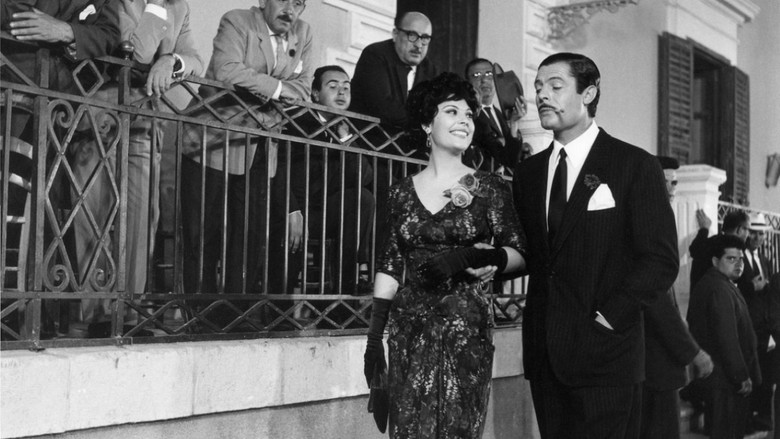
The film is largely set within the walls of this decaying palace, where Ferdinando lives with his wife, parents, and other relatives. The physical confinement of the setting reinforces the sense of emotional and social entrapment experienced by the protagonist.
The Film 'La Dolce Vita'
The screening of Federico Fellini's "La Dolce Vita" in the town's cinema symbolizes the clash between modern, liberal ideas and the traditional, conservative values of Sicilian society. It also serves as a meta-reference, as Marcello Mastroianni, who plays Ferdinando, was the star of "La Dolce Vita." This creates a layer of irony, as the townspeople flock to see a film condemned by the church, showcasing their underlying hypocrisy.
There is a scene where the entire town, full of moralistic fervor, turns out to watch "La Dolce Vita," which had been deemed scandalous. Ferdinando uses the town's preoccupation with the film as an opportunity to further his own illicit plans, highlighting how public moralizing can mask private indiscretions.
Philosophical Questions
Can laws and societal norms truly suppress fundamental human desires, or do they merely force them into more destructive and hypocritical channels?
The film explores this question through its central premise. The absolute prohibition of divorce in 1960s Italy does not eliminate Ferdinando's desire to leave his wife; instead, it channels his frustration into a grotesque and murderous scheme. Pietro Germi suggests that when society provides no legitimate outlet for common human experiences like falling out of love, it forces individuals to become monstrous in their pursuit of freedom. Ferdinando's journey from a daydreaming, unhappy husband to a cold, calculating murderer illustrates how repressive social structures can corrupt morality and make the unthinkable seem logical.
What is the nature of 'honor,' and how is it constructed and weaponized by society?
"Divorce Italian Style" viciously satirizes the concept of honor as a social construct, particularly in a patriarchal context. The film demonstrates that honor is not an intrinsic moral quality but a matter of public reputation, dictated by the community. Ferdinando's plan relies entirely on manipulating this social code; he must create the public appearance of a dishonored husband to justify his crime. The law's leniency towards "crimes of honor" reveals a system where a man's reputation is valued more highly than a woman's life, exposing honor as a tool to enforce male dominance and control female sexuality.
Is true freedom attainable, or are we always moving from one form of entrapment to another?
This question is poignantly raised by the film's ironic ending. Ferdinando goes to extreme, immoral lengths to achieve what he believes is the ultimate freedom: marriage to his beloved Angela. He endures prison and social scrutiny, all for this idealized future. However, the final shot, revealing Angela's flirtation with the boatman, suggests that his newfound happiness is an illusion. He has not found freedom but has simply entered a new cycle of potential jealousy and marital strife. The film seems to argue that the idealized freedom we chase is often a fantasy, and that human relationships are inherently complex and fraught with the potential for entrapment, regardless of external circumstances.
Core Meaning
The core meaning of "Divorce Italian Style" is a biting satire of the legal and social hypocrisy of 1960s Italy, particularly concerning marriage, divorce, and the concept of honor. Director Pietro Germi uses the darkly comedic premise of a man plotting to murder his wife as a more socially acceptable alternative to divorce to expose the absurdity of a society bound by archaic laws and rigid Catholic doctrine. The film critiques a patriarchal system where a man's honor is deemed more valuable than a woman's life, and where violence can be legally mitigated if framed as a "crime of passion." By making the protagonist's morally reprehensible plan seem like a logical, albeit extreme, solution to his marital woes, Germi highlights the profound flaws in the legal and religious institutions that governed Italian life, effectively forcing individuals into desperate and grotesque actions to achieve personal freedom. The film is a powerful commentary on how repressive societal norms can distort human desire and morality.